


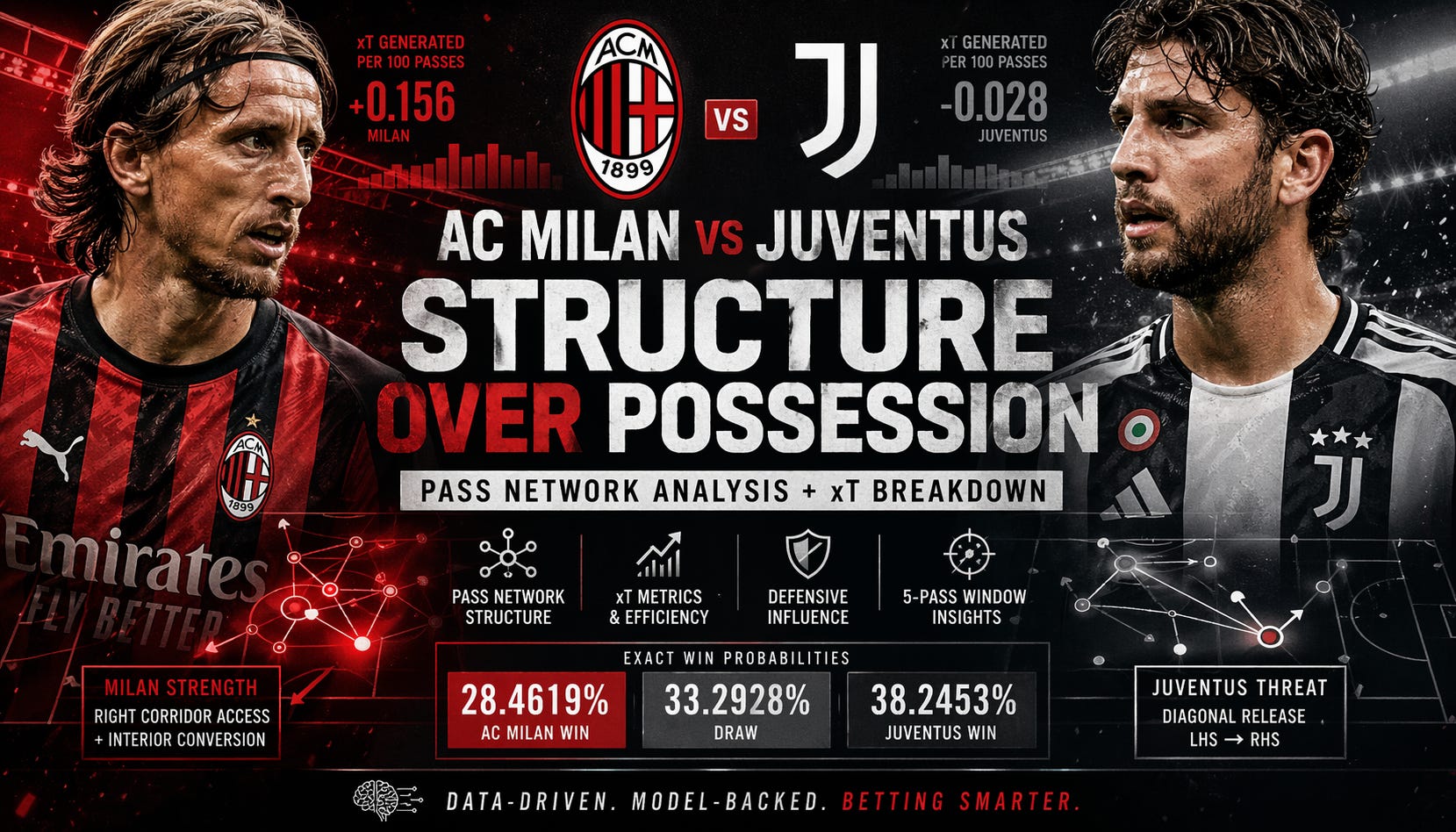
This analysis is entirely based on pass network structure and Expected Threat (xT) data, removing subjective bias and focusing purely on how each team generates, preserves, and loses value on the pitch.
This Sunday, AC Milan and Juventus meet in a decisive match, with both teams aiming to lock in their Champions League qualification and eliminate any potential downside risk.
If you want to go beyond surface-level analysis and access exact probabilities, fair odds, and Monte Carlo simulations for this match, you can find them here:
👉 https://app.footballhacking.com/
For this specific matchup, the model outputs are:
AC Milan win: 28.46%
Draw: 33.29%
Juventus win: 38.24%

These are not approximations — they are directly derived from the full probability matrix.
And importantly: at the end of this article, you’ll find a live betting checklist designed to guide your decisions during the match based on real structural signals.
Why This Match Is Not About Possession — It’s About Value Conversion
At first glance, this might look like a typical high-level Serie A clash where possession and control define the narrative.
That would be a mistake.
This is not a possession battle.
This is a value conversion battle.
Both teams show midfield bottlenecks
Both struggle to maintain central continuity under pressure
The match will be decided by what happens after resistance
In other words:
👉 Who escapes pressure without losing positional value?
👉 Who turns corridor access into real attacking threat?
👉 Who survives the 5-pass window after disruption?
That’s where the game lives.
Milan’s Structural Edge: Efficiency Over Volume
Milan enter this match with a clear structural advantage — and the data doesn’t leave room for interpretation.
They outperform Juventus in:
Overall structural health
Efficiency index
xT generated per 100 passes
Defensive influence
But the real edge isn’t just numerical.
It’s behavioral.
Milan don’t rely on volume.
They rely on precision and conversion.
The Right Corridor Engine — and the Hidden Central Mechanism
Milan’s attacking structure is heavily right-oriented:
Right corridor → primary access lane
Central → transitional hinge, not final destination
But here’s the key insight:
👉 Milan are not just a wing-entry team
👉 They are a wing-to-interior conversion team
Their most valuable pattern:
Right corridor → central corridor
Produces the highest jump in xT among their routes
This is critical.
Because Juventus’ defensive pressure:
Is strongest in high central zones
But less consistent in deep progression suppression
Meaning:
👉 Milan can bypass pressure wide…
👉 Then collapse inward into high-value zones
That’s structurally dangerous.
Juventus: Structure Without Payoff
Juventus present a very different profile.
They are:
Structurally organized
Directionally flexible
But inefficient in conversion
Their progression routes include:
Right half-space → left corridor
Central → central
Left corridor → left half-space
On paper, that looks dynamic.
In reality:
Net progression = negative
Final-third efficiency = negative
This is the key distinction:
👉 Juventus accumulate attacking touches
👉 But fail to preserve or increase value after resistance
That’s not stylistic.
That’s structural inefficiency.
