

Disclaimer
This article was written exclusively from pass network and Expected Threat (xT) data. No match footage, highlights, images, or video analysis were used in the preparation of this report. All findings and conclusions are based solely on quantitative structural indicators derived from passing networks and possession-value models.
World Cup matches are often explained through goals, shots, possession percentages, or individual brilliance.
This match demands a different lens.
Argentina’s 3–0 victory over Algeria was not primarily a story of territorial domination. It was not a story of overwhelming network superiority. It was not even a story of constant attacking pressure.
Instead, it was a match defined by a distinction that modern football analysis often fails to make:
the difference between circulation and progression.
Looking only at the scoreline, many observers would conclude that Argentina controlled every aspect of the game. The pass network, xT structure, Voronoi occupation and health windows suggest something more nuanced.
Algeria frequently reached advanced areas.
Algeria circulated the ball.
Algeria maintained organizational integrity for long stretches.
Yet the match increasingly tilted toward Argentina because Argentina consistently transformed structure into value, while Algeria repeatedly transformed structure into recovery.
That distinction ultimately produced the 3–0 scoreline.
The Health Windows Tell an Unexpected Story
The first chart immediately challenges a simplistic interpretation of the match.
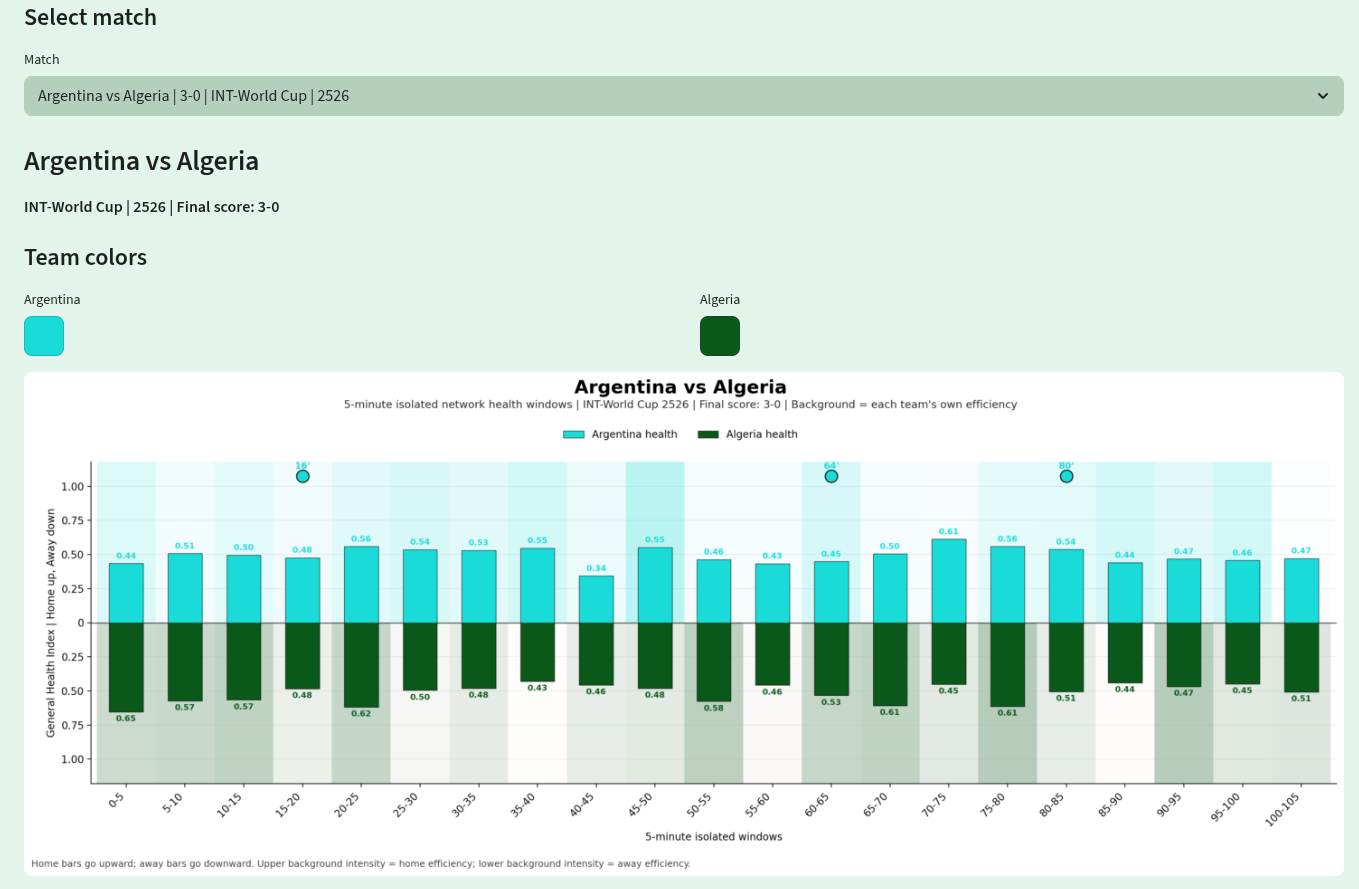
Across isolated five-minute windows, Argentina’s network health remained remarkably stable throughout the game.
Most windows oscillated between approximately:
0.44
0.56
with a peak near 0.61 around the 70–75 minute period.
The most notable dip occurred between 40–45 minutes, when Argentina’s health dropped to approximately 0.34 before recovering almost immediately.
What is striking is that Algeria’s health profile was not dramatically worse.
The Algerian network frequently operated between:
0.43
0.65
with several windows matching or even exceeding Argentina’s values.
This matters.
If network health alone explained football matches, this game would not have ended 3–0.
The data suggests that Algeria was not structurally collapsing.
The Algerian network remained functional for much of the match.
The decisive difference emerged elsewhere.
Argentina consistently converted healthy possession into meaningful progression.
Algeria often converted healthy possession into neutral circulation.
Structural Stability Is Not the Same as Structural Advantage
One of the most important lessons from this match is that stability and superiority are not synonymous.
Algeria’s network frequently remained organized.
Players maintained passing options.
The team preserved shape.
The support structure rarely disappeared entirely.
Yet football is not won merely by maintaining a structure.
Football is won by using that structure to increase positional value.
The distinction becomes obvious when examining how both teams responded after encountering resistance.
When Argentina encountered pressure, the next sequence often preserved or improved value.
When Algeria encountered pressure, the next sequence frequently became a repair operation.
The difference between those two outcomes accumulated throughout the match.
Argentina’s Network: Multiple Routes, Multiple Solutions
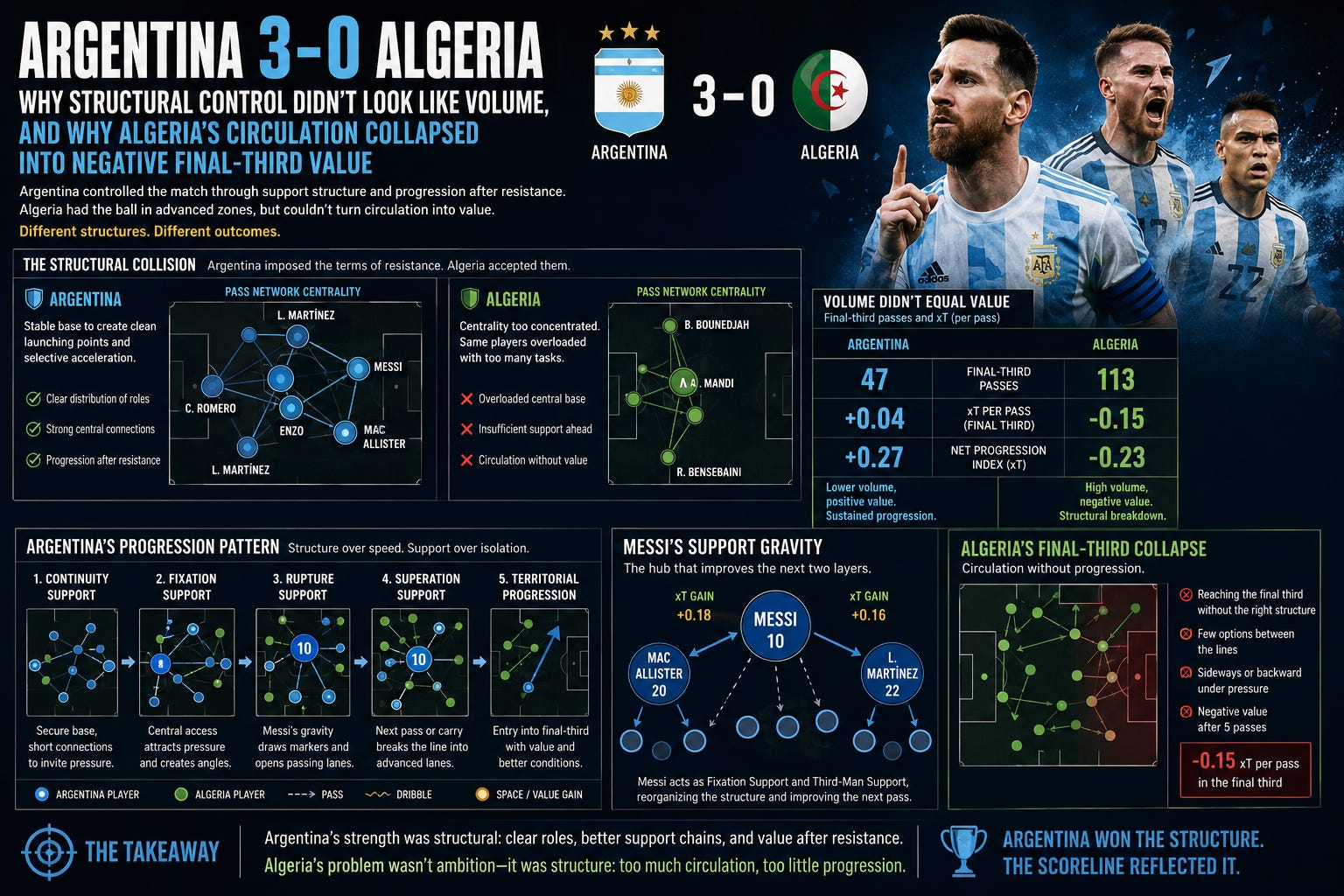
The pass network reveals one of Argentina’s greatest strengths.
The structure did not depend on a single player.
Although Lionel Messi remained a central figure, the network itself was distributed.
Several important hubs emerged:
Enzo Fernández
Alexis Mac Allister
Rodrigo De Paul
Lisandro Martínez
Lionel Messi
Thiago Almada
This is significant because it creates redundancy.
If pressure disrupts one route, alternative routes remain available.
The network retains functionality.
Argentina’s circulation therefore possessed resilience.
The team was not dependent on forcing every progression through the same channel.
This allowed Argentina to preserve attacking continuity even when local pressure successfully interrupted specific routes.
The Role of Enzo Fernández
Among all Argentine players, Enzo Fernández appears as one of the most important connectors.
His positioning allowed him to operate between Security Support and Progression Support functions.
From deeper zones, Enzo frequently acted as the bridge connecting the defensive base with more advanced structures.
His role was not necessarily to produce the final action.
His role was to ensure that progression remained available.
In structural terms, Enzo served as one of the principal mechanisms preventing the network from fragmenting.
When teams lose players capable of performing this function, progression frequently becomes dependent on direct play.
Argentina avoided that problem.
Why Messi’s Influence Goes Beyond Creativity
Many match reports reduce Messi’s influence to assists, chances created, or touches in dangerous areas.
The network perspective reveals something broader.
Messi acted as a structural attractor.
Opponents consistently had to account for his positioning.
This generated organizational consequences throughout the network.
In several sequences, Messi functioned simultaneously as:
Fixation Support
Third-Man Support
His presence altered the geometry of the possession.
Defenders adjusted.
Passing lanes shifted.
Alternative receivers gained access to more favorable spaces.
This is one reason why Argentina’s progression frequently survived resistance.
The possession was not merely moving through Messi.
The possession was reorganizing around him.
Alexis Mac Allister and the Invisible Work of Continuity
One of the recurring themes in advanced network analysis is that the most valuable player is not always the most visible player.
Mac Allister represents that principle.
His contribution frequently appeared in the spaces between actions.
He functioned as a continuity mechanism.
Rather than forcing progression, he frequently enabled progression.
Rather than becoming the final receiver, he frequently became the connecting receiver.
These roles rarely dominate highlight reels.
Yet they often determine whether attacks survive pressure.
Argentina’s network benefited enormously from these stabilizing functions.
Lautaro Martínez and High-Value Occupation
Lautaro Martínez’s contribution extended beyond traditional striker responsibilities.
His occupation of advanced zones created structural effects.
By maintaining fixation pressure on defenders, Lautaro helped preserve valuable spaces behind the first defensive line.
This is particularly important when analyzing progression.
Many attacking sequences depend not only on the player receiving the ball, but also on the players forcing defensive reactions elsewhere.
Lautaro repeatedly fulfilled this role.
The result was a progression environment that remained functional even when direct access to goal was temporarily unavailable.
Algeria’s Network Was Active but Less Redundant
Algeria’s network tells a very different story.
The structure appears more concentrated around a smaller group of players.
Several important nodes emerge:
Aïssa Mandi
Ramy Bensebaini
Hicham Boudaoui
Ibrahim Maza
The issue is not that these players were uninvolved.
The issue is that they were required to perform too many functions simultaneously.
They frequently carried responsibilities related to:
Continuity Support
Security Support
Progression Support
When too many structural tasks become concentrated within the same players, predictability increases.
Pressure becomes easier to organize.
Alternative routes become harder to access.
The network becomes more fragile.
The Left Corridor: Algeria’s Most Frequent Route
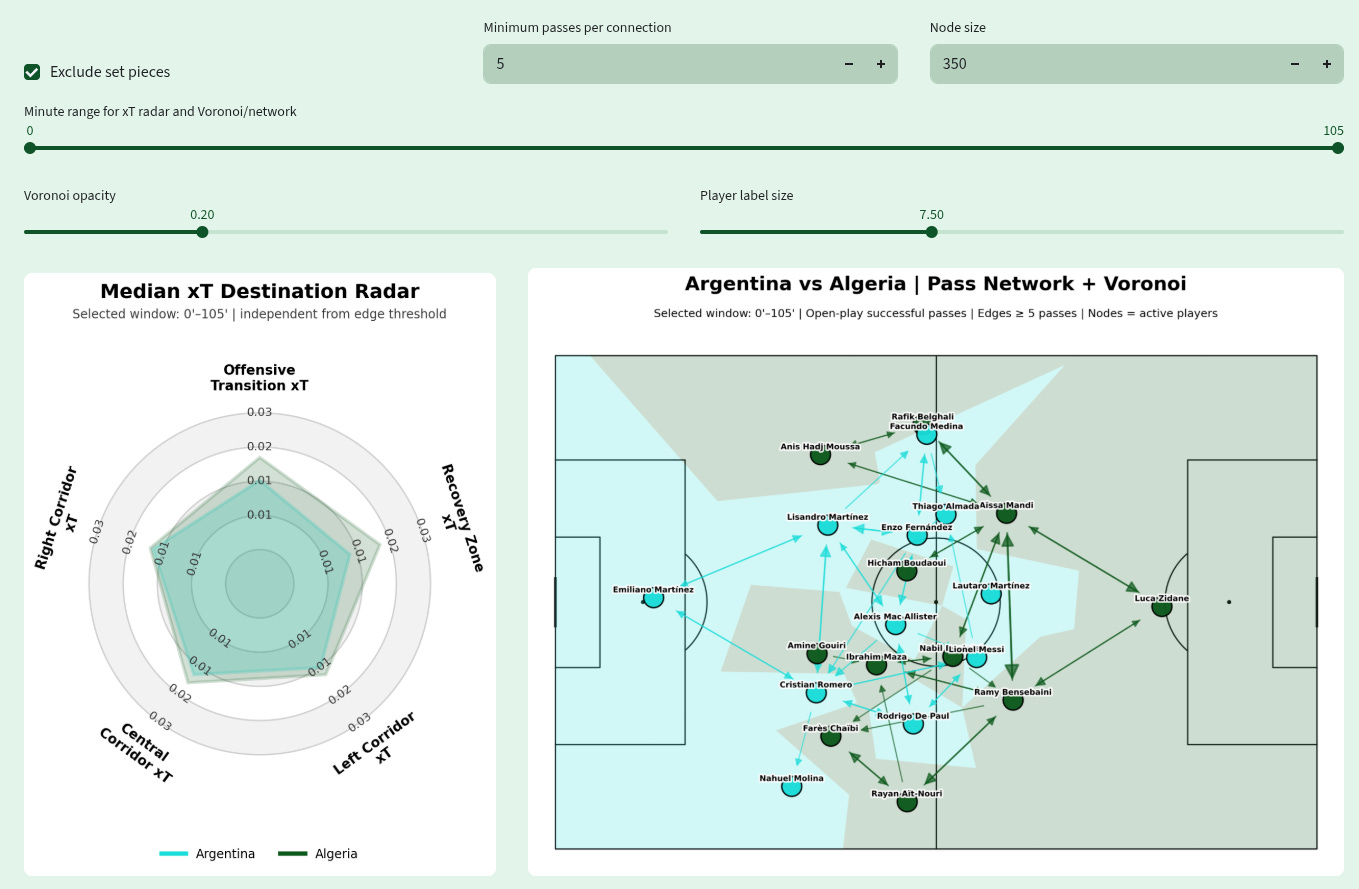
The radar chart and network structure suggest that Algeria repeatedly attempted to progress through left-sided mechanisms.
The combination of:
Bensebaini
Aït-Nouri
Chaïbi
created recurring progression attempts.
The route functioned.
Access was achieved.
Advanced zones were reached.
However, reaching an advanced zone is not the same thing as preserving value within it.
This distinction becomes central to understanding the match.


Recovery Zone xT: Algeria Was More Dangerous Than the Score Suggests
One of the most interesting findings from the radar chart appears in the Recovery Zone xT category.
Algeria actually recorded stronger values here.
This indicates that Algeria frequently recovered possession in zones capable of generating future value.
In many matches, this type of profile becomes the foundation for dangerous transition attacks.
The problem was not the recovery itself.
The problem was what happened next.
Too many Algerian sequences lost value after the recovery event.
The possession was regained in useful locations.
The subsequent progression failed to capitalize on those locations.
Offensive Transition xT Also Favors Algeria
Another surprising finding emerges in Offensive Transition xT.
Algeria again appears slightly stronger.
At first glance, this may seem incompatible with a 3–0 defeat.
It is not.
Transition value measures opportunity generation.
It does not guarantee successful conversion.
Algeria repeatedly generated conditions capable of supporting attacks.
What the team struggled to do was maintain progression quality after entering those situations.
The attack frequently stalled.
The support chain weakened.
The sequence lost value.
Argentina, by contrast, preserved value more consistently.
Why Final-Third Presence Can Be Misleading
Football discourse often treats final-third occupation as evidence of attacking superiority.
This match demonstrates why that assumption can be dangerous.
A team can enter advanced zones repeatedly and still generate relatively little value.
The key question is not:
“Did the team reach the final third?”
The key question is:
“What happened after the team reached the final third?”
The Algerian structure frequently succeeded in transporting possession into advanced areas.
The difficulty emerged after arrival.
Progression slowed.
Options narrowed.
Pressure increased.
Possession often became circulation rather than advancement.
This created the illusion of pressure without producing equivalent danger.
The Voronoi Map Reveals Spatial Differences
The Voronoi visualization provides another layer of context.
Argentina’s occupation appears more compact and interconnected.
Players maintain relatively efficient distances between one another.
Support options remain accessible.
The structure encourages continuity.
Algeria’s Voronoi profile suggests larger territories in several areas.
At first glance, larger territories may seem beneficial.
In practice, they often imply greater distances between players.
Longer distances increase risk.
Passing chains become more fragile.
Support arrives later.
Pressure becomes more effective.
These spatial characteristics align closely with the patterns observed in the network itself.
Argentina’s Control Was Surgical Rather Than Overwhelming
Perhaps the most important conclusion from the entire dataset is this:
Argentina did not win because they overwhelmed Algeria structurally.
Argentina won because they managed structure more efficiently.
The difference sounds subtle.
It is not.
Many dominant victories emerge from overwhelming territorial superiority.
This match does not fit that profile.
The data instead suggests a team capable of:
preserving progression under pressure,
maintaining attacking continuity,
converting stable possession into meaningful value.
Meanwhile, Algeria frequently achieved:
stable possession,
organized circulation,
functional recovery.
But struggled to transform those advantages into sustained progression.
The result was a widening gap in efficiency rather than a widening gap in possession.
The Three Events That Stand Out
The health chart highlights important moments around:
16’
64’
80’
These moments coincide with key match events.
Interestingly, none of them emerge from dramatic spikes in structural health.
This observation reinforces the broader conclusion.
Argentina did not require overwhelming structural dominance to create decisive moments.
The team repeatedly converted moderate structural advantages into meaningful outcomes.
That is often the hallmark of elite sides.
What This Match Teaches About Modern Football
This match offers a valuable lesson for analysts, coaches, and bettors.
Possession alone is not enough.
Territory alone is not enough.
Even structural health alone is not enough.
The decisive factor is frequently what happens after resistance appears.
Can the team preserve value?
Can the team improve value?
Can the team continue progressing?
Argentina repeatedly answered yes.
Algeria repeatedly found itself repairing possession rather than advancing it.
That difference explains far more about this 3–0 result than possession percentages or shot counts ever could.
Final Thoughts
Argentina’s victory was built on structural efficiency.
The network remained stable.
The progression remained functional.
The support hierarchy remained clear.
Most importantly, value survived pressure.
Algeria’s performance deserves more nuance than the scoreline suggests.
The team demonstrated organization.
The team demonstrated recovery capacity.
The team demonstrated transitional potential.
What it could not consistently demonstrate was progression preservation after resistance.
Ultimately, the match became a contest between two forms of possession.
Argentina used possession to create value.
Algeria used possession to recover structure.
Over ninety minutes, that difference proved decisive.
And that is why the scoreboard finished exactly where the underlying structure suggested it would:
Argentina 3 – 0 Algeria.