

Aston Villa’s 2–1 win over Manchester United was not a story of domination.
It was a story of efficiency versus control — and the data makes that crystal clear.
If you only look at the scoreline, you might think Villa imposed themselves throughout the match. But once we dig into metrics like open-play xG per 100 passes, touches in the box, Expected Threat (xT), and pass-network centrality, a more nuanced picture emerges.
Let’s break it down.
Shot Volume Was Balanced — Shot Creation Was Not
From a pure finishing standpoint, the game was relatively balanced. Neither side overwhelmed the other in raw shot counts. However, how those shots were created — and under what conditions — is where the match truly diverged.
Manchester United were more consistent in advancing the ball into threatening zones, while Aston Villa were far more ruthless when opportunities finally appeared.
This distinction is crucial when evaluating performance beyond goals.
Open-Play xG per 100 Passes: United on Top
When we normalize attacking output by possession flow, United actually come out ahead.
📊 Open-play xG per 100 passes favored Manchester United.
This metric removes noise caused by total possession and focuses on efficiency of chance creation relative to ball circulation. United, pass for pass, generated more expected goals from open play than Aston Villa.
In other words:
👉 United needed fewer passes to reach meaningful danger.
Yet, football is not decided by expected values alone.
Stop guessing. Start understanding the game.
Follow my newsletter for football analysis powered by real data, not opinions or narratives.
Efficiency Was Aston Villa’s Real Weapon
Despite producing less open-play xG per 100 passes, Aston Villa were simply more efficient.
They converted key moments with precision and composure, while United’s advantage in territorial play did not translate proportionally into goals.
This is a recurring pattern in football analysis:
Control does not guarantee payoff
Efficiency can outweigh sustained pressure
Villa didn’t need volume — they needed timing.
Touches in the Box per 100 Passes: Territorial Edge for United
Another revealing metric is touches inside the opponent’s box per 100 passes.
Manchester United: 7.39
Aston Villa: 5.7
This gap reinforces the idea that United spent more time in advanced zones and accessed the penalty area more frequently relative to their passing volume.
Yet again, territorial dominance did not equal scoreboard dominance.
Expected Threat (xT): Midfield Control Belonged to United
Across the entire match, Manchester United led in Expected Threat (xT).
xT captures the value of ball progression — how much each action increases the probability of scoring in the future. United consistently moved the ball into higher-value zones, especially through midfield circulation.
This suggests:
Better spatial occupation
Stronger progression through central areas
Sustained pressure via structured buildup
From a process standpoint, United were doing many things right.
Pass Networks and Load Centrality: Who Controlled the Flow?
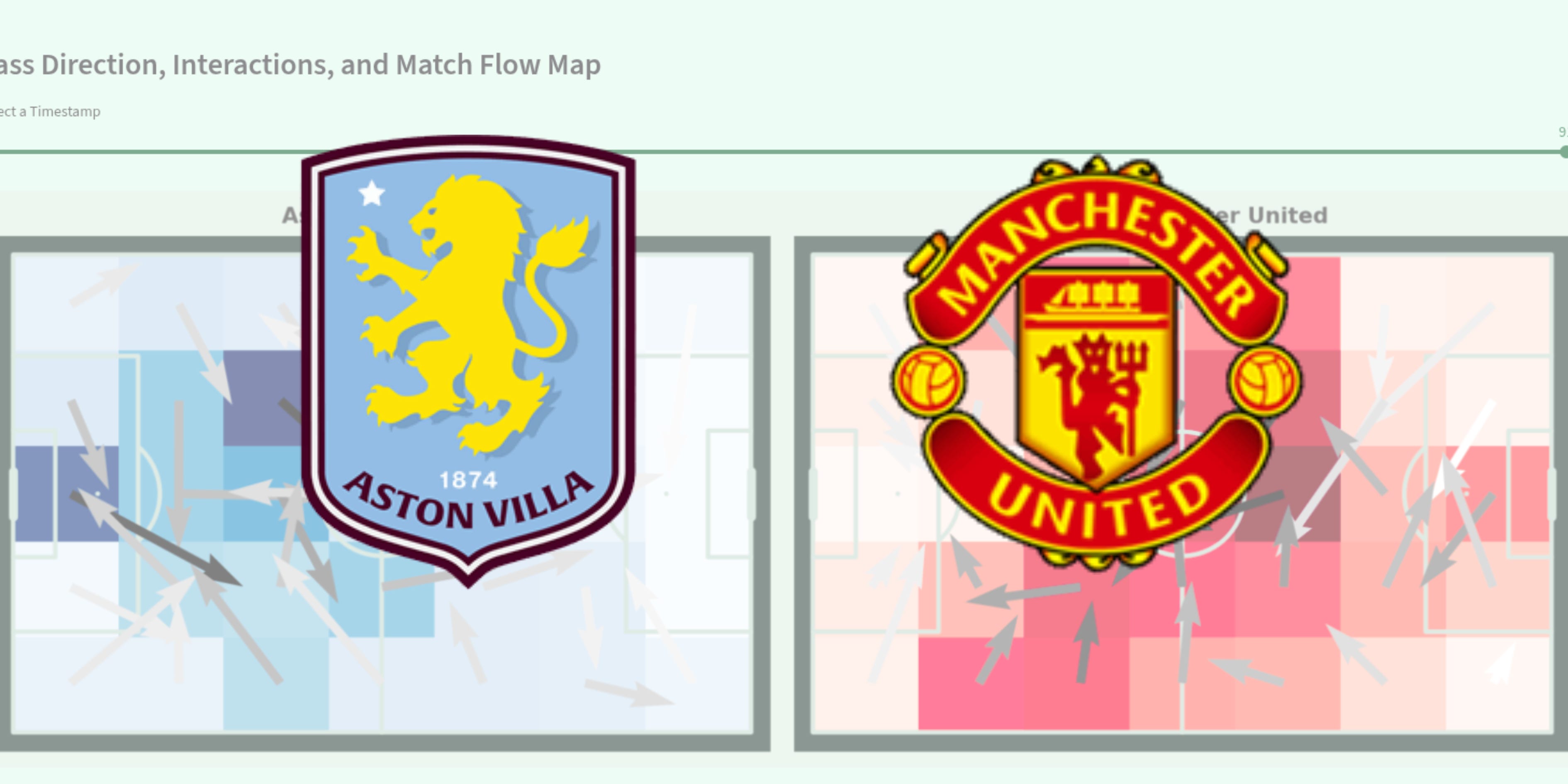
Pass-network analysis adds another layer of clarity.
Manchester United’s passing structure was more evenly distributed, which is reflected in higher load centrality values across multiple players.
🔍 Load centrality measures how responsible a player is for maintaining the flow of passes within the network.
Lower concentration = more shared responsibility = better circulation resilience.
United’s network:
Fewer bottlenecks
More balanced involvement
Stronger collective control of tempo
Aston Villa, by contrast, were more selective and vertical when opportunities arose.
The Big Picture: Control vs Conversion
Put all of this together, and the story becomes consistent across metrics:
United controlled territory
United controlled ball progression
United controlled circulation
Aston Villa controlled efficiency
Football often rewards the team that finishes moments — not the one that accumulates advantages without converting them.
And that’s exactly what happened here.
Why This Match Matters for Data-Driven Analysis
This game is a perfect reminder of why process-based metrics matter more than raw outcomes.
If you only look at:
Goals → you miss control
Possession → you miss efficiency
Shots → you miss context
Metrics like xG per 100 passes, xT, and pass-network centrality allow us to understand why matches unfold the way they do — not just what happened.
Explore the Data Yourself
All of the metrics mentioned here —
✔️ open-play xG per 100 passes
✔️ touches in the box per 100 passes
✔️ xT
✔️ pass networks and load centrality
are available in my free football analytics web app.
👉 You can explore this match — and many others — yourself using real, automatically compiled data.
Want to understand football beyond the scoreline?
Subscribe to my newsletter and get data-driven insights, real metrics, and clear explanations — straight to your inbox.