

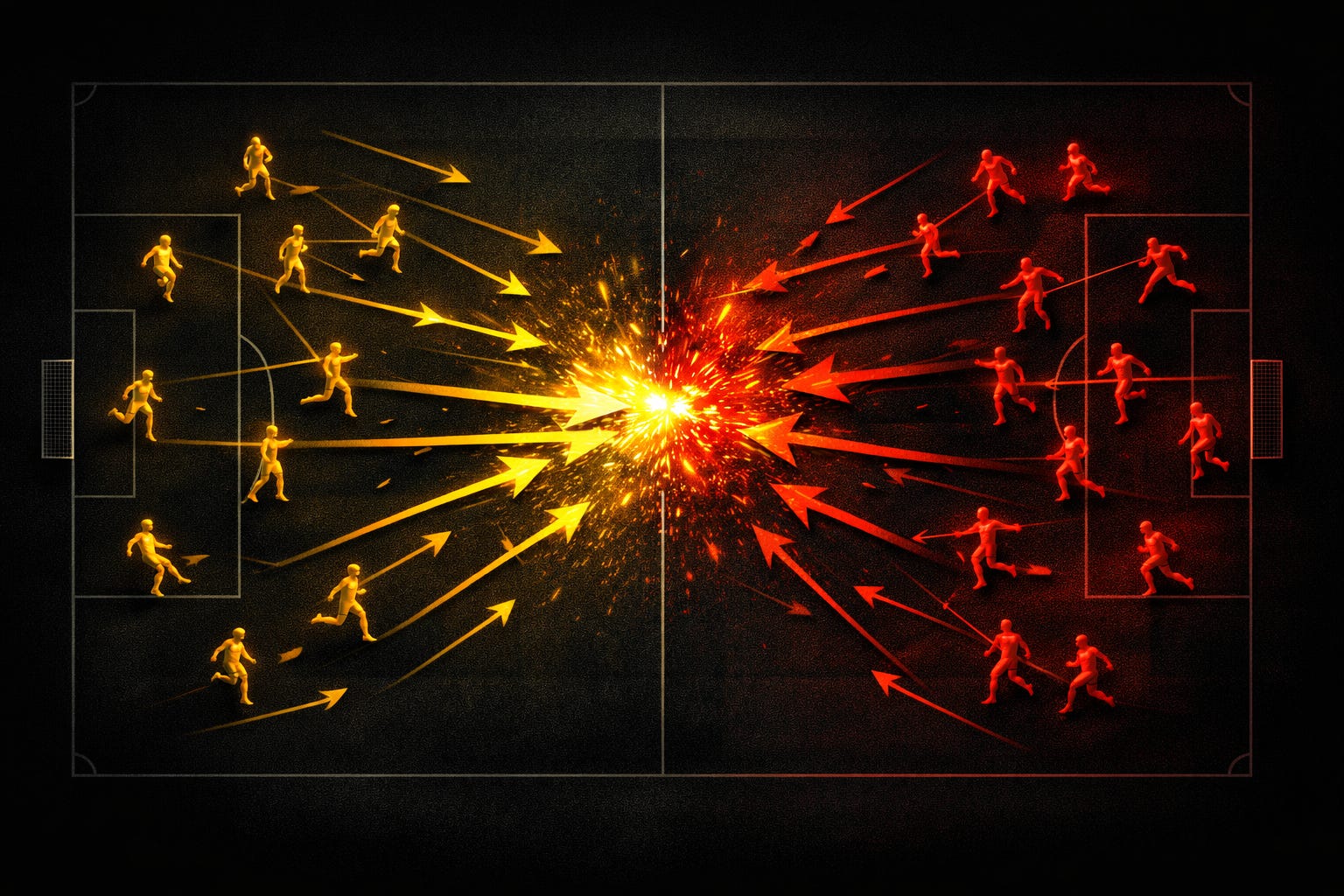
This analysis is derived from a large-scale database where matches are decomposed through pass networks, expected threat (xT), and graph theory centrality metrics.
That allows us to move beyond what most analyses capture.
Because football at this level is not defined by:
possession percentages
shot counts
or isolated chances
It is defined by:
👉 how teams organize space
👉 how they progress through corridors
👉 and how they reproduce attacking patterns under pressure
This is not a ranking battle — this is a structural confrontation
On paper:
Borussia Dortmund → 2nd
Bayer Leverkusen → 6th
But structurally, this game lives in a different dimension.
Dortmund:
stable positional structure
repeatable progression routes
controlled home environment
Leverkusen:
fluctuating structure
inconsistent away identity
reactive spatial behavior
This is not about better vs worse.
👉 It is about structure vs variability
Game environments — what kind of match each team creates
Dortmund at home does not just win games.
They shape them.
high scoring output
low concession rate
consistent defensive control
stable rhythm
👉 their matches become predictable in structure
Leverkusen away:
score enough to compete
concede frequently
fail to stabilize defensive phases
oscillate between control and chaos
👉 their matches become unstable environments
Why environment matters
Because when a structured system meets an unstable one:
👉 the unstable system is forced into uncomfortable states
And that is where structural weaknesses appear.
Build-up origins → final third entry: where the game truly begins
To understand this matchup, we need to connect:
👉 where possession starts
👉 where attacking value is generated
Because progression is not random.
It follows paths.
Dortmund — a directional progression model
Dortmund’s attacking identity is not symmetrical.
It is directional and repeatable.
Build-up origin:
central defensive corridor
left defensive corridor
These zones:
stabilize possession
structure spacing
initiate progression
Final third entry distribution:
Across matches:
right corridor → dominant entry lane
right half-space → consistent secondary channel
central → situational penetration
left → minimal contribution
👉 This creates a very clear pattern:
central/left build-up → diagonal progression → right-side entry
Why this matters more than it seems
Dortmund does not rely on unpredictability.
They rely on:
👉 repetition + efficiency
The same pathways:
are executed repeatedly
become faster
become more precise
This leads to:
consistent final third access
reduced decision friction
structural dominance
Progression chains — where attacking value is concentrated
Dortmund’s key passing dynamics show:
full-backs as vertical accelerators
central defenders as distribution anchors
forwards as terminal nodes
And crucially:
👉 the highest-value actions concentrate on the right corridor and right half-space
This aligns perfectly with their entry distribution.
Midfield — not dominant, but essential
Dortmund’s midfield is often misunderstood.
It does not dominate progression.
Instead, it:
connects phases
stabilizes transitions
supports directional play
👉 value is created after midfield, not within it
Leverkusen — absence of structural repetition
Now the contrast.
From the dataset:
👉 there is no consistent relationship between build-up origin and final third entry
This is critical.
Because it means:
no dominant corridor
no repeatable attacking route
no structural reinforcement
Final third entry behavior:
right corridor → inconsistent
left corridor → inconsistent
half-spaces → irregular
central → occasional
👉 Leverkusen does not arrive in the same spaces consistently
What this means in practice
Without a stable progression route:
attacking patterns do not consolidate
efficiency does not increase
decisions become reactive
This leads to:
👉 variability
👉 unpredictability
👉 and structural fragility
Midfield comparison — continuity vs fragmentation
Dortmund:
integrated midfield
supports progression
maintains continuity
Leverkusen:
inconsistent midfield role
unstable connections
breaks between phases
👉 one connects the game
👉 the other interrupts it
Final third behavior — persistence vs breakdown
Dortmund:
consistent entry zones
low breakdown rate
persistence under pressure
👉 when pressured → they stay in the same corridor
This creates:
overloads
defensive fatigue
eventual structural collapse
Leverkusen:
inconsistent entry zones
higher breakdown rate
reliance on individual actions
👉 attacks are not structurally protected
Resistance vs reaction — how each team behaves under pressure
Dortmund:
attacking corridors → progressive continuation
midfield → recirculation
central attacking zones → high-value progression
👉 pressure does not disrupt structure
Leverkusen:
pressure → fragmentation
progression → unstable
attacks → frequently collapse
👉 pressure breaks their structure
Defensive behavior — disruption vs exposure
Dortmund:
central defensive control
disruption of opponent rhythm
forced low-value actions
In advanced zones:
👉 defensive pressure can collapse entire attacking sequences
Leverkusen:
inconsistent defensive structure
poor transition control
high exposure
👉 they do not control defensive phases
🔒 Premium Section — Tactical Exploitation, Interaction Layer & Where the Game Breaks
From this point forward, we are no longer describing teams.
We are analyzing how they collide.
Because matches like this are not decided by:
who plays better
but by whose structure survives the interaction
