

The Brasileirão Série A table tells us what has already happened. A probabilistic model tries to answer the more difficult question: what is most likely to happen next?
Using a combination of Poisson-based match modelling and Monte Carlo simulations, we estimated the probability of every club finishing in each of the 20 possible league positions. These probabilities were then converted into model-based fair odds, while additional indicators were calculated to measure expected position, average positional movement, rank volatility, entropy and overall table stability.
The result is not merely another projected Brasileirão table. It is a complete map of uncertainty.
At the top, Flamengo and Palmeiras have almost completely separated themselves from the rest of the field. Athletico Paranaense are strongly positioned to finish third but retain only a small outside chance of disrupting the title race. Below them, the competition becomes considerably more volatile, especially among the teams fighting for continental qualification.
At the bottom, Chapecoense face an overwhelmingly difficult situation, while Vasco da Gama, Mirassol and Remo occupy the most dangerous region of the forecast. Santos, Grêmio and Internacional are not safe either, but their probability distributions remain significantly wider.
This distinction is fundamental. A league position is only a photograph; a probability distribution is the full film.
How the Brasileirão Final Table Prediction Model Works
Football is inherently uncertain. A stronger team can dominate a match and still fail to win. A defensive error, a red card, an unexpected finishing performance or a late goal can completely change the result.
For that reason, forecasting the final Brasileirão standings requires more than simply extending the current points-per-game average.
The first component of this analysis is a Poisson model, a mathematical framework widely used to estimate the number of goals that teams may score in football matches. By modelling scoring outcomes, the system can assign probabilities to home wins, draws and away wins across the remaining schedule.
Those probabilities then become inputs for a Monte Carlo simulation.
Instead of predicting the rest of the season only once, Monte Carlo methods simulate it repeatedly. In every simulated season, match outcomes are sampled according to the probabilities generated by the underlying model. Points are accumulated, the final standings are rebuilt and each club receives a finishing position.
When the simulations are aggregated, we can measure:
The probability of each club becoming Brasileirão champion
The probability of finishing in the top four, top six or top eight
The probability of finishing in every individual league position
The risk of relegation
The most likely final position
The average or expected final position
The range of plausible outcomes
The volatility and uncertainty surrounding each club
The model does not claim to know the future. It measures the frequency with which different futures emerge under the assumptions and probabilities used.
That is an important difference. A 55% championship probability does not mean a title is guaranteed. It means that, across the simulated scenarios, that club finished first approximately 55 times out of every 100.
Readers interested in combining probability modelling with deeper football analytics can explore the wider methodology behind Football Hacking, where match analysis, tactical structure and statistical forecasting are brought together in the same analytical environment.
Flamengo Overtake Palmeiras as the Brasileirão Title Favourite
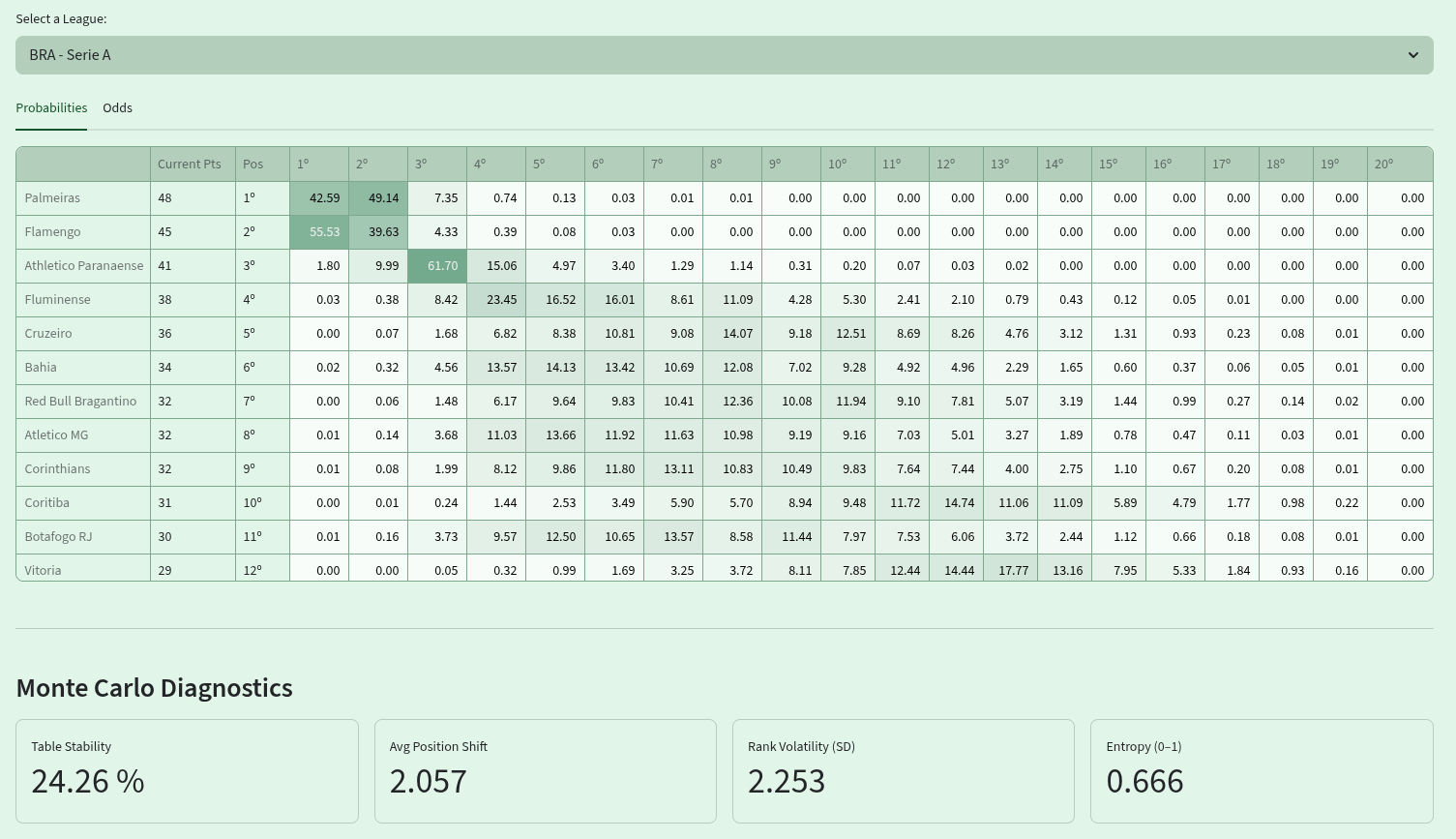
Palmeiras currently lead the championship with 48 points, while Flamengo sit second with 45. Nevertheless, the simulations identify Flamengo as the most likely Brasileirão champion.
Flamengo have a 55.53% probability of finishing first, corresponding to model-based fair odds of approximately 1.80.
Palmeiras have a 42.59% title probability, equivalent to fair odds of approximately 2.35.
Together, Flamengo and Palmeiras account for 98.12% of the championship probability. That leaves only 1.88% for every other club combined.
This is one of the clearest conclusions in the entire model: statistically, the Brasileirão title race has become a duel.
The current league leader is not necessarily the most likely eventual champion because the simulation considers more than the present ordering of the table. The probability of future results influences how often each team preserves, gains or loses ground across the remaining rounds.
Flamengo’s expected final position is 1.50, the best figure in the league. Palmeiras have an expected position of 1.67. These values show that both clubs are overwhelmingly concentrated within the top two, but Flamengo’s probability distribution leans slightly more toward first place.
Palmeiras are actually more likely to finish second than first:
First place: 42.59%
Second place: 49.14%
Third place: 7.35%
Fourth place: 0.74%
Flamengo’s distribution is:
First place: 55.53%
Second place: 39.63%
Third place: 4.33%
Fourth place: 0.39%
Their top-four probabilities are effectively absolute: 99.82% for Palmeiras and 99.88% for Flamengo.
The important point is not that Palmeiras are weak leaders. They are not. Instead, the simulation suggests that Flamengo’s remaining-season outlook is strong enough to compensate for the existing three-point deficit.
Understanding the Fair Odds Behind the Championship Probabilities
The odds presented in this analysis are model-based fair odds, calculated directly from simulated probabilities.
The basic conversion is:
Fair odds = 100 ÷ probability percentage
Therefore, Flamengo’s 55.53% championship probability produces fair odds of approximately 1.80. Palmeiras’ 42.59% probability produces fair odds of approximately 2.35.
These are not bookmaker prices and do not include a commercial margin. They are analytical reference points derived from the model.
This distinction matters. Betting markets generally include an overround, meaning the combined implied probabilities exceed 100%. Fair odds attempt to represent the price at which neither side theoretically has an embedded margin, assuming the model is correctly calibrated.
They should not be interpreted as automatic betting recommendations.
A model can be internally coherent and still be wrong because football performance changes. Injuries, suspensions, transfers, tactical adjustments, fixture congestion and changes in motivation can alter a team’s expected strength. Fair odds are therefore best used as a benchmark for comparison, not as a promise of profit.
Athletico Paranaense Are the Strongest Candidate for Third Place
Athletico Paranaense occupy third place with 41 points, and the simulation strongly supports their current position.
Their probability of finishing third is 61.70%, equivalent to model-based fair odds of approximately 1.62. They also have:
1.80% probability of winning the title
9.99% probability of finishing second
15.06% probability of finishing fourth
4.97% probability of finishing fifth
3.40% probability of finishing sixth
Athletico’s probability of ending the season inside the top four is 88.55%, while their top-six probability reaches 96.92%.
Their expected position is 3.37, very close to their current third place. The average positional shift is only 0.64, suggesting that the model expects limited movement from their present rank.
However, Athletico’s title probability reveals the size of the gap separating the leading pair from the rest of the league. Their 1.80% chance corresponds to fair odds of approximately 55.56.
In other words, third place is highly plausible. The championship is not impossible, but it would require a relatively unusual sequence of events involving both Athletico’s performance and simultaneous setbacks for Flamengo and Palmeiras.
Fluminense Lead a Highly Uncertain Race Behind the Top Three
Fluminense currently sit fourth with 38 points, but their expected final position is 6.10. That is one of the first major signs that the current table and the simulated final table do not necessarily point in the same direction.
Fluminense have the following probabilities:
Third place: 8.42%
Fourth place: 23.45%
Fifth place: 16.52%
Sixth place: 16.01%
Seventh place: 8.61%
Eighth place: 11.09%
Ninth place: 4.28%
Tenth place: 5.30%
Their top-four probability is 32.28%, while their top-six probability rises to 64.81%. The chance of finishing in the top eight is 84.51%.
This is a wide distribution. Fourth place is the single most likely outcome, but it is not the dominant outcome. Fluminense finish outside the top four in more than two-thirds of simulations.
Their average positional shift is 2.28 places, and their rank volatility reaches 2.42. Their entropy score of approximately 0.72 also indicates substantial uncertainty compared with the leading teams.
The broader analytical lesson is straightforward: being the most likely team to finish fourth is not the same as being likely to finish fourth.
A club could have a 23% probability of one specific position and still be distributed across many nearby outcomes. That is why probability ranges are more informative than a single predicted table.
Bahia, Atlético Mineiro and Botafogo Could Outperform Their Current Positions
The middle-to-upper section of the Brasileirão contains several clubs whose expected positions are better than their current rankings.
Bahia are currently sixth with 34 points, but their expected final position is 7.31. Despite that small projected decline, their top-four probability of 18.47% is higher than Cruzeiro’s, even though Cruzeiro currently sit fifth.
Bahia’s top-six probability is 46.02%, and their top-eight probability reaches 68.79%. Their most likely individual finishing position is fifth, at 14.13%, closely followed by fourth at 13.57% and sixth at 13.42%.
Atlético Mineiro sit eighth with 32 points but have an expected final position of 7.67. Their top-four probability is 14.86%, their top-six probability is 40.44%, and their top-eight probability is 63.05%.
Botafogo are even more striking.
Currently 11th with 30 points, Botafogo have an expected final position of 7.93. Their top-four probability is 13.47%, while their chances of reaching the top six and top eight are 36.62% and 58.77%, respectively.
That means Botafogo’s current league position may significantly understate their simulated upside.
The club’s average positional shift is approximately 3.68 places, among the largest in the competition. This does not mean Botafogo will definitely climb four positions. It means their simulated final rankings are, on average, far removed from the position they occupy today.
For anyone following the Brasileirão through a combination of results, probability distributions and tactical performance, the analytical tools available through Football Hacking offer a more complete perspective than the standings alone can provide.
Cruzeiro, Red Bull Bragantino and Corinthians Occupy the Most Crowded Region
Cruzeiro are fifth with 36 points, but their expected position is 8.63. Their top-four probability is only 8.57%, while their top-six probability is 27.76%.
Their distribution spreads across a large portion of the table:
Eighth place: 14.07%
Tenth place: 12.51%
Sixth place: 10.81%
Ninth place: 9.18%
Seventh place: 9.08%
Eleventh place: 8.69%
Fifth place: 8.38%
Cruzeiro’s average positional shift is 3.84 places, the largest recorded in this snapshot. Their entropy is approximately 0.82, confirming that their final position remains highly uncertain.
Red Bull Bragantino, currently seventh, have an expected position of 8.68. Their probability of finishing in the top four is 7.71%, while their top-six probability is 27.18%. Their top-eight probability is almost exactly balanced at 49.95%.
Corinthians sit ninth but have a slightly better expected position of 8.26. They have:
10.20% probability of a top-four finish
31.86% probability of a top-six finish
55.80% probability of a top-eight finish
Their single most likely finishing position is seventh, at 13.11%.
This group illustrates why the central portion of a league table is difficult to predict. Small differences in team strength, match variance and future points can generate large ranking changes because so many clubs are separated by narrow margins.
São Paulo Have More Upside Than Their Current 13th Place Suggests
São Paulo currently have 27 points and occupy 13th place. However, their expected final position is 9.84, a projected improvement of more than three positions.
Their probability of finishing ninth is 13.52%, the largest individual value in their distribution. They also retain:
3.90% probability of finishing in the top four
15.87% probability of finishing in the top six
32.97% probability of finishing in the top eight
Only 1.09% probability of relegation
São Paulo’s average positional shift is 3.61, and their rank volatility is approximately 3.11, the highest value among the 20 clubs.
This combination describes a team with a broad range of possible outcomes. São Paulo are not strongly anchored to 13th place. The simulations frequently move them into the upper half, although the probability is dispersed across several positions rather than concentrated around one specific destination.
Coritiba and Vitória present different profiles.
Coritiba, currently tenth, have an expected position of 11.24, with a 2.97% relegation probability. Vitória, currently 12th, have an expected position of 12.01, almost identical to their present rank, and a 2.93% relegation probability.
Vitória’s most likely finishing position is 13th at 17.77%, while Coritiba’s distribution is concentrated more heavily between 11th and 14th.
Santos, Grêmio and Internacional Are in the Relegation Conversation
The traditional clubs positioned just above the relegation zone cannot be described as safe.
Santos currently occupy 14th place with 25 points. Their expected final position is 14.51, and their probability of relegation is 23.30%.
Their most likely positions are:
15th: 15.78%
16th: 15.66%
14th: 15.49%
17th: 10.59%
13th: 10.40%
Grêmio, also on 25 points but currently 15th, have a 27.38% probability of relegation. Their expected final position is 14.95, almost exactly aligned with their present standing.
Internacional sit 16th with 24 points and face a 28.44% relegation probability, the highest among this group. Their expected position is 14.90, meaning they are projected to improve slightly on average, but their downside remains significant.
These numbers require careful interpretation.
Internacional can have an expected position close to 15th while still facing a 28.44% relegation probability because the mean compresses multiple outcomes into one value. A team may finish safely in a large number of simulations but fall into the bottom four in a substantial minority of them.
Expected position is useful, but it should never be read without the accompanying probability distribution.
Vasco da Gama Face the Highest Relegation Risk Outside Chapecoense
Vasco da Gama currently sit 19th with 22 points. The simulation assigns them a 79.60% probability of relegation.
Their distribution is heavily concentrated around the bottom:
19th place: 38.81%
18th place: 22.58%
17th place: 16.52%
16th place: 8.09%
15th place: 6.40%
20th place: 1.69%
Vasco’s expected final position is 17.61. This suggests some improvement from their current 19th place, but not enough to make survival the most probable overall scenario.
Their probability of finishing 19th corresponds to fair odds of approximately 2.58, while their probability of ending 18th translates into fair odds close to 4.43.
Mirassol have a 74.46% relegation probability and an expected position of 17.34. Their most likely outcomes are 19th at 28.68% and 18th at 26.99%.
Remo’s situation is more balanced. They currently sit 18th but have an expected final position of 16.54, indicating meaningful potential to climb. Their relegation probability is still high at 58.30%, but survival occurs in 41.70% of the simulations.
Remo’s most likely positions are:
17th: 21.67%
18th: 20.69%
19th: 15.55%
16th: 15.31%
15th: 11.69%
Unlike Vasco and Mirassol, Remo’s distribution extends more strongly toward survival. They remain more likely to be relegated than to stay up, but their situation is not as heavily concentrated in the bottom three.
Chapecoense Are Almost Completely Anchored to 20th Place
Chapecoense’s forecast is the most extreme in the league.
With only 11 points and currently in 20th place, the club have a 96.53% probability of finishing last. Their fair odds for 20th place are approximately 1.04.
Their total relegation probability is 99.96%.
The expected final position is 19.96, while the average positional shift is only 0.04. Their rank volatility is 0.26, and their table stability reaches 0.9653, the highest value in the dataset.
Normally, stability sounds positive. In this context, it is not.
Chapecoense are stable because almost every simulation produces the same negative outcome. There is very little uncertainty about their expected position.
This is why volatility must always be interpreted alongside direction. A low-volatility forecast can describe a team securely positioned at the top, but it can also describe a team firmly trapped at the bottom.
What Table Stability, Rank Volatility and Entropy Tell Us
The projection includes several measures designed to describe uncertainty more precisely.
Expected Position
Expected position, or xPos, is the probability-weighted average of all 20 possible finishing positions.
Flamengo’s xPos of 1.50 indicates that their simulated outcomes are concentrated between first and second. Fluminense’s xPos of 6.10 reflects a wider distribution around the European qualification positions. Vasco’s xPos of 17.61 places them inside the projected relegation zone.
Average Positional Shift
Average positional shift measures how far a club tends to finish from its current position.
Cruzeiro have the largest value at approximately 3.84 positions. Botafogo follow at 3.68, with São Paulo at 3.61. These are teams whose current ranking provides an incomplete picture of their simulated destination.
Chapecoense’s value of 0.04 indicates almost no expected movement.
Rank Volatility
Rank volatility measures the dispersion of possible finishing positions.
São Paulo lead the league at approximately 3.11, followed by Coritiba at 3.08, Botafogo at 3.05 and Red Bull Bragantino at 3.01.
High rank volatility means a broader range of plausible outcomes. It does not automatically mean improvement or decline.
Entropy
Entropy measures how widely probability is distributed across the available positions.
A low-entropy team has its probability concentrated in a small number of outcomes. A high-entropy team has many plausible finishing positions.
Chapecoense’s entropy is only 0.06, reflecting the overwhelming concentration on 20th place. Flamengo and Palmeiras also have relatively low entropy, but for a completely different reason: their outcomes are concentrated within the top two.
Coritiba have the highest entropy at approximately 0.84, closely followed by São Paulo, Red Bull Bragantino and Cruzeiro. These teams inhabit the most uncertain portion of the forecast.
The full combination of Poisson projections, Monte Carlo outcomes, position probabilities and volatility indicators is available through the Football Hacking project, built for readers who want to move beyond surface-level league tables.
The Most Important Brasileirão Predictions from the Model
The current simulation produces several clear conclusions.
First, the championship is overwhelmingly concentrated between Flamengo and Palmeiras. Flamengo are the favourites despite currently trailing Palmeiras by three points, with title probabilities of 55.53% and 42.59%, respectively.
Second, Athletico Paranaense are strongly favoured to finish third. Their 61.70% probability for that position is one of the most concentrated forecasts outside the top two and bottom club.
Third, the battle behind the leading trio is highly volatile. Fluminense are the strongest immediate candidate for fourth place, but their probability of actually finishing fourth is only 23.45%. Bahia, Atlético Mineiro and Botafogo all retain meaningful top-four and top-six upside.
Fourth, current position can be misleading. Cruzeiro are fifth but have an expected position of 8.63, while Botafogo are 11th but have an expected position of 7.93. São Paulo are 13th and project closer to tenth.
Fifth, the relegation battle has several different levels of danger. Chapecoense are almost certain to go down. Vasco and Mirassol face extremely high risks, while Remo remain endangered but possess a more realistic survival path. Santos, Grêmio and Internacional form the next vulnerable group.
Final Assessment of the Brasileirão Série A Forecast
The Brasileirão final table prediction is simultaneously clear and uncertain.
It is clear at the extremes. Flamengo and Palmeiras dominate the championship probabilities, while Chapecoense are overwhelmingly projected to finish bottom. Vasco da Gama and Mirassol are in severe danger.
It is uncertain through the middle. Clubs between the continental qualification places and the lower half remain separated by overlapping probability distributions. A short sequence of wins or losses could produce a substantial change in the final standings.
That is precisely why probabilistic forecasting is valuable.
A conventional table assigns every team one position. A Monte Carlo model assigns every team a probability for every position. Poisson modelling provides the match-level foundation, while repeated season simulations reveal how individual uncertainties interact over the remaining schedule.
The purpose is not to eliminate uncertainty. Football would be far less compelling if that were possible.
The purpose is to measure uncertainty, identify where the forecast is concentrated and distinguish genuine probabilities from the illusions created by a single league table.
At this stage of the Brasileirão Série A, Flamengo are the statistical title favourites, Palmeiras remain extremely close, Athletico Paranaense are strongly positioned for third, and almost everything below them remains open to meaningful movement.
The table shows where the clubs stand today. The simulations show how many different places they could still end up tomorrow.