

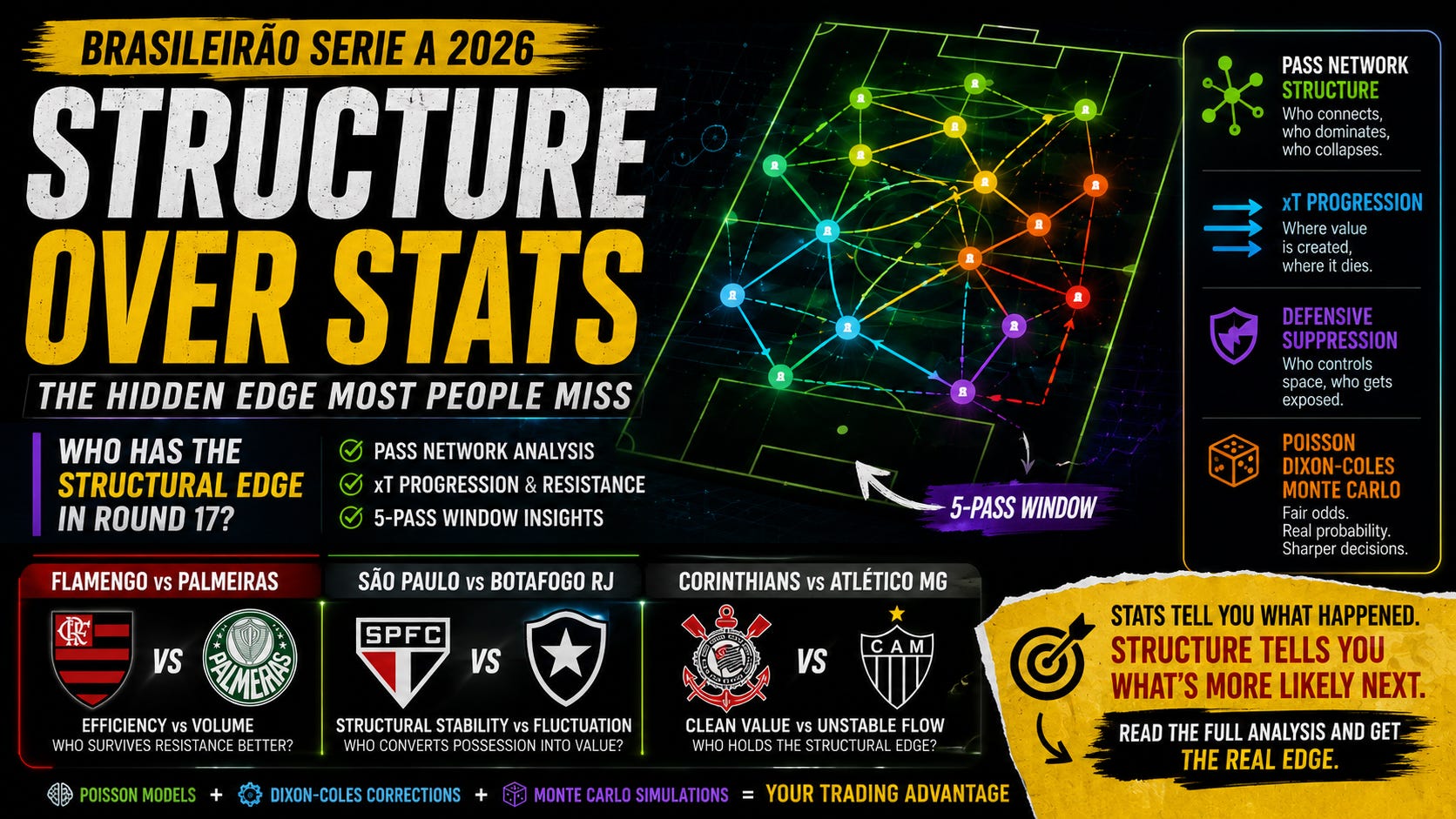
This article was built exclusively from pass-network structure analysis and xT-based progression data. Every interpretation in the report comes from structural relationships inside possession sequences: corridor occupation, post-resistance behavior within the 5-pass window, support-chain stability, defensive suppression zones, progression efficiency, and positional value generation through xT. No traditional metrics such as shots, xG totals, possession percentage, or narrative-based assumptions were used to shape the analysis. The objective is to understand how each team structurally behaves under pressure, how attacks survive resistance, and how network organization influences the probability of sustaining territorial and positional advantage throughout the match.
The European season is approaching its end, but Brasileirão Serie A is now fully alive — and, more importantly for predictive modeling and structural analysis, the league has finally accumulated enough matches to generate more stable and reliable interpretations.
That changes the quality of prediction completely.
At the beginning of a season, football models often operate inside unstable environments. Corridor occupation changes rapidly, support chains are inconsistent, defensive suppression fluctuates heavily, and progression efficiency still suffers from sample volatility. But once the calendar advances, structural identities begin to stabilize.
And that is exactly where Brasileirão Serie A currently stands.
This round presents three fascinating clashes from a structural perspective:
Flamengo vs Palmeiras
São Paulo vs Botafogo RJ
Corinthians vs Atlético MG
All three matchups reveal something deeper than simple possession numbers or offensive volume. These games expose the difference between circulation and structural value.
Some teams are generating possession that survives resistance.
Others are generating possession that collapses after contact.
That distinction matters enormously for live trading, betting interpretation, and tactical reading because modern football is not only about who reaches advanced territory. It is about which structures preserve positional value after defensive interaction.
That is where pass-network structure, xT progression, defensive suppression, and post-resistance behavior become extremely powerful analytical tools.
And when those layers are combined with probabilistic models like Poisson distributions, Dixon-Coles adjustments, and Monte Carlo simulations, the result becomes a much more complete betting and trading framework.
The Football Hacking web app combines those elements into a single environment, allowing users to analyze fair odds, probability distributions, and structural network behavior simultaneously. In chaotic leagues like Brasileirão Serie A, that combination becomes especially valuable because raw possession numbers often hide structural fragilities.
Flamengo vs Palmeiras: When Possession Survives Resistance
Among the three featured games, Flamengo arrive with the clearest structural advantage.
But this edge is not simply about attacking talent or territorial pressure. The difference lies in how Flamengo preserve attacking continuity after resistance appears in midfield.
This is a clash between an efficiency-first home side and a flow-first away side.
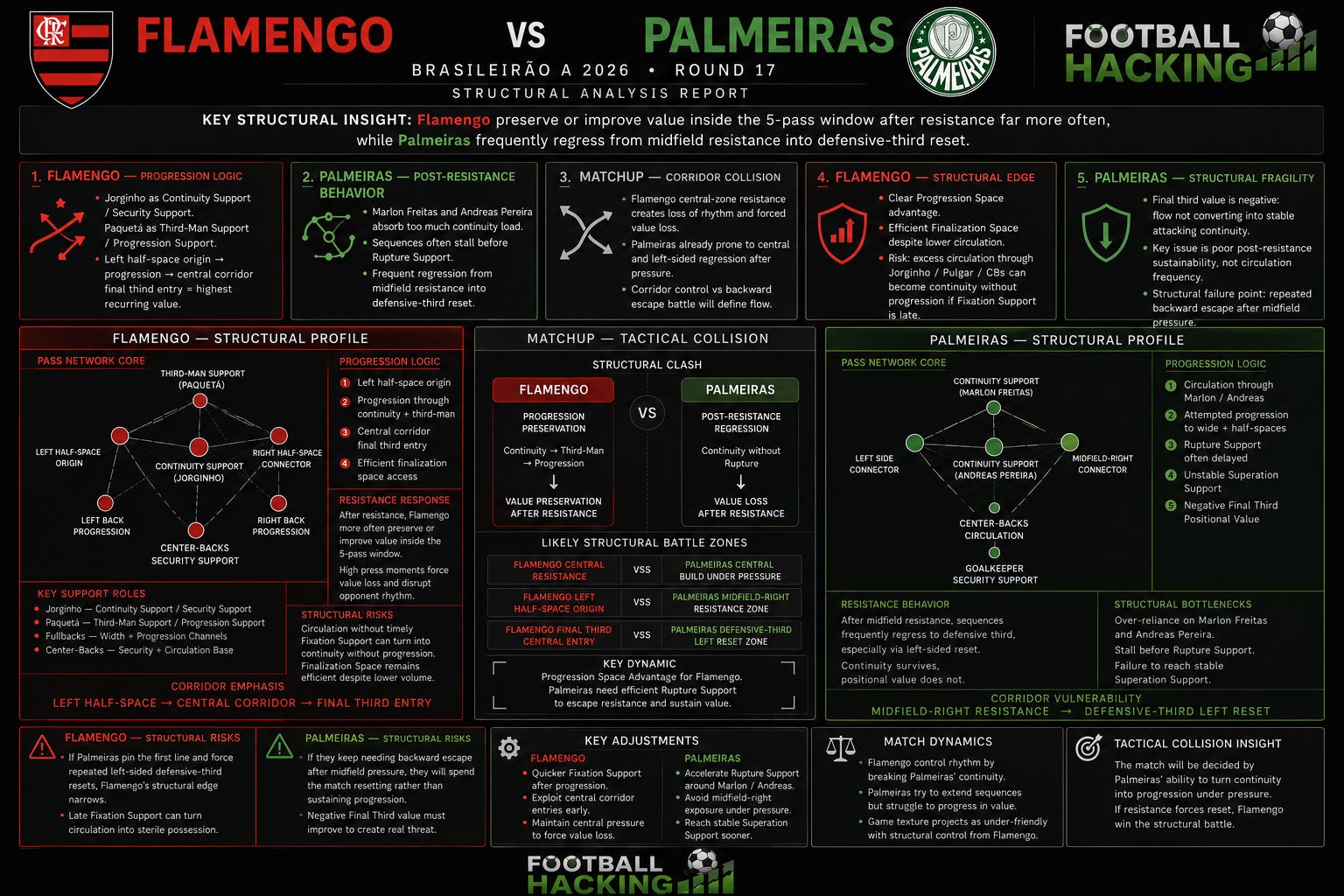
Flamengo’s structure currently operates through selective acceleration. Palmeiras, meanwhile, continue to rely more heavily on circulation volume and territorial presence. The problem for the away side is that their circulation frequently loses value after the first defensive interaction.
That becomes obvious inside the 5-pass framework.
Both teams show bottlenecks in Progression Space, especially through midfield zones. But Flamengo repeatedly transform pressure into continued progression, while Palmeiras too often transform pressure into reset sequences.
That is the decisive difference.
Flamengo’s xT generation per 100 passes is significantly stronger, their final-third value per pass remains positive, and their efficiency index is clearly ahead. Palmeiras, by contrast, enter this match with negative net progression and negative final-third net per pass.
This is not merely a statistical gap.
It is a structural gap.
Jorginho functions as the central stabilizer of Flamengo’s structure. His role inside Initiation Space and early Progression Space combines Security Support and Continuity Support. Léo Pereira also carries major structural responsibility in the left-central base, while Lucas Paquetá operates as a secondary progression connector capable of preserving rhythm under pressure.
What makes Flamengo dangerous is not endless circulation. It is their ability to recover value after recycling possession.
Several lower-value routes inside Flamengo’s structure actually hide an important strength. Sequences involving Jorginho, Erick Pulgar, and Léo Pereira often look conservative initially, but inside the 5-pass window Flamengo repeatedly recover progression afterward. Midfield left half-space resistance can still become attacking-third progression with strong xT growth.
That means the support chain survives contact.
And that is the critical point.
Flamengo’s strongest attacking route begins in the left half-space before accelerating centrally or toward the right side. The structure constantly searches for interior-to-central conversion rather than empty wide circulation. Arrascaeta becomes essential here, acting simultaneously as Third-Man Support and Superation Support.
Pedro serves as the primary Fixation Support in Finalization Space, anchoring defenders and allowing Flamengo to destabilize central density indirectly. Emerson Royal appears as a crucial progression release point capable of transforming right-sided acceleration into rupture.
Palmeiras, however, arrive with a more unstable post-resistance profile.
The away side still presses aggressively and still generates territorial occupation, but their progression chains frequently collapse after the opponent survives the initial action.
Marlon Freitas and Andreas Pereira form the core of Palmeiras’ progression structure, yet the relationship between them appears overloaded. Several recurring sequences involving Gustavo Gómez, Marlon Freitas, and Andreas Pereira produce negative territorial outcomes after resistance.
The issue is not the individual pass.
The issue is what happens next.
Too often, Palmeiras move from progression into recirculation without ever stabilizing fixation before attempting the next vertical action. Their attacks frequently reach midfield progression phases but fail to preserve structural coherence once central pressure appears.
That fragility becomes even clearer inside Finalization Space.
When resistance appears in attacking-third central zones, Palmeiras repeatedly lose positional value through forced lateralization or backward escapes. They arrive in dangerous territory, but their attacks do not survive contact.
That is why Flamengo’s defensive profile becomes especially dangerous in this matchup.
Flamengo’s defensive suppression inside central zones is one of the strongest structural elements in the entire comparison. Their defensive-third central pressure repeatedly forces opponents into neutral reactions, delayed progression, or structural collapse.
And Palmeiras want to attack precisely through those central channels.
This creates a potentially uncomfortable interaction for the away side.
If Palmeiras cannot establish stronger Fixation Support before entering central density, Flamengo’s defensive structure is likely to break the sequence before progression stabilizes.
The likely match pattern therefore becomes clear.
If the game settles into structured possession phases, Flamengo should progressively gain control because their attacks survive resistance more efficiently. Palmeiras may still generate stretches of territorial pressure, especially through left-sided circulation and central probing, but unless their support chains stabilize after contact, those possessions are likely to end in recirculation rather than sustained danger.
Palmeiras benefit more from disruption.
Flamengo benefit more from structural rhythm.
And that distinction gives the home side the clearer edge entering the matchup.
The probabilistic side becomes even more powerful when combined with these structural reads. On the Football Hacking web app, users can compare fair odds generated through Poisson, Dixon-Coles, and Monte Carlo simulation. That combination creates an extremely powerful live trading framework.
São Paulo vs Botafogo RJ: Efficient Structure Against Volatile Progression
São Paulo arrive with another meaningful structural edge, although the matchup dynamics differ considerably from Flamengo vs Palmeiras.
This game revolves around a simpler contrast:
One team converts circulation into value.
The other often converts circulation into exposure.
São Paulo’s current profile is built around selective efficiency. Botafogo RJ, meanwhile, generate more volatile progression patterns capable of producing sharp moments but far less capable of sustaining attacking continuity after resistance appears.
The structural contrast begins immediately in Progression Space.
São Paulo show a stable midfield bottleneck with enough route diversity to avoid predictability. Botafogo’s bottlenecks, however, split between midfield and attack, revealing a structure that can access dangerous zones but struggles to stabilize value afterward.
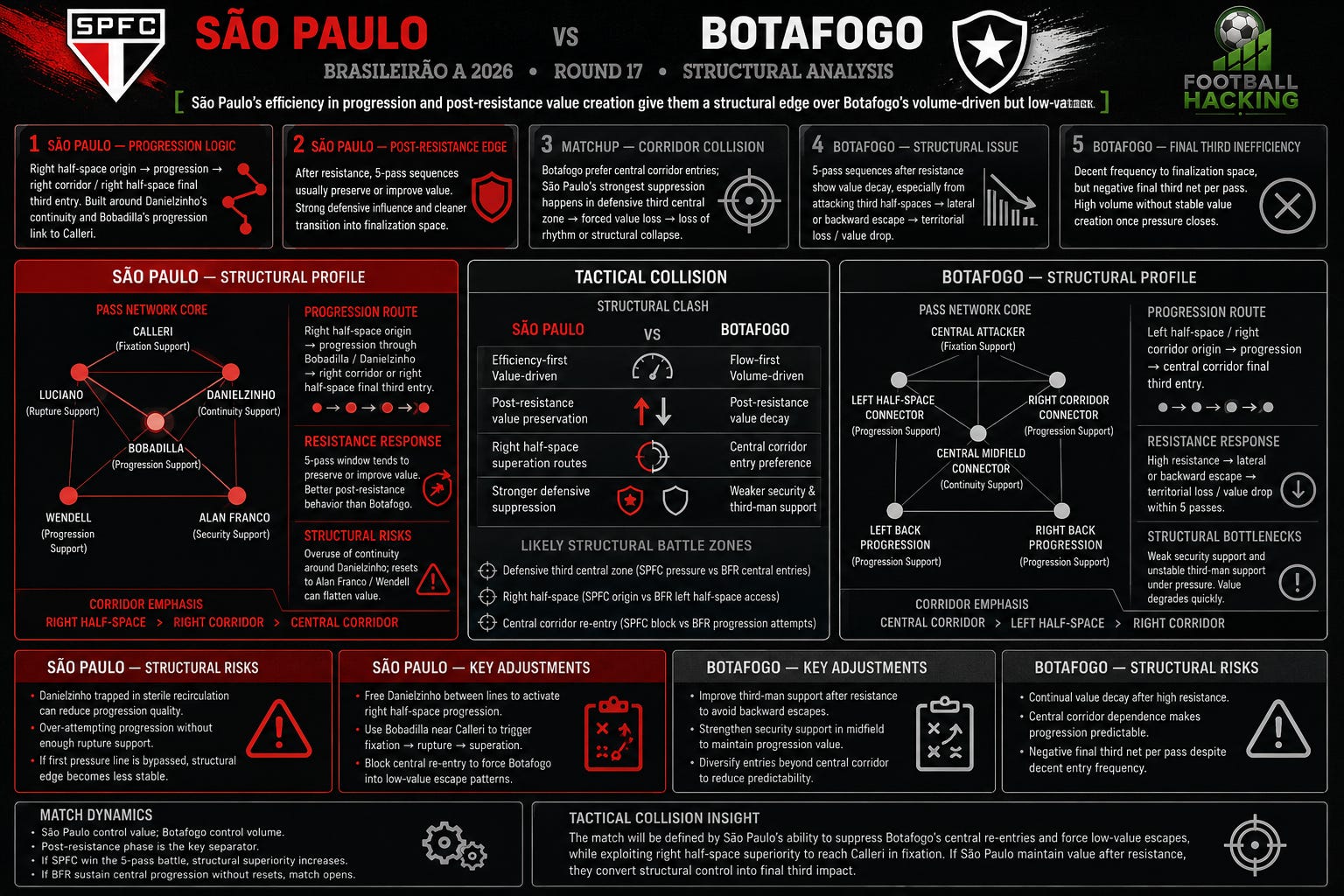
São Paulo’s progression routes combine local continuation and cross-structure transfer. The team repeatedly moves through left half-space progression into the left corridor, while also generating useful switches from right-sided progression into opposite corridors.
This reveals a very important tactical behavior.
São Paulo are not merely circulating possession.
They are using corridor changes to search for cleaner progression windows after fixation.
Inside the support framework, the sequence often follows:
Continuity Support → Fixation Support → Superation Support → Corridor Transfer.
That creates more stable attacking continuity.
Botafogo’s progression map looks different.
Their strongest attacking routes overwhelmingly target the central corridor in advanced zones. Left half-space into central progression, right corridor into central progression, and left corridor into central progression all appear repeatedly.
On paper, several of those routes carry strong value.
The problem is what happens after resistance.
Botafogo repeatedly demonstrate extreme instability once attacks enter dense defensive territory. When resistance appears in attacking-third half-spaces, sequences often collapse backward with massive territorial and xT losses.
That becomes the defining diagnosis of the away side:
Botafogo can arrive.
But they do not sustain.
This explains why their final-third pass volume remains high while their final-third net per pass stays sharply negative. The issue is not access. The issue is maintaining attacking coherence after defensive interaction.
Alexander Barboza emerges as the dominant centrality figure, functioning as the main Security Support and early Progression Support reference from deeper zones. Raul appears as an important continuation connector higher up the structure.
But many of Botafogo’s recurring sequences eventually return backward toward Barboza or defensive references after pressure arrives.
That creates a familiar loop:
Central progression → pressure → backward reset → incomplete re-entry.
Against São Paulo, that becomes dangerous because São Paulo’s defensive structure aligns almost perfectly against Botafogo’s preferred attacking routes.
Botafogo want central progression in advanced zones.
São Paulo defend those zones exceptionally well.
The home side’s defensive-third central suppression repeatedly forces neutral reactions, rhythm loss, and negative opponent value. Even more importantly, São Paulo generate structural attacking breakdowns when pressing high in attacking-third central zones.
That interaction matters enormously because Botafogo’s structure already struggles to preserve continuity after first resistance.
São Paulo’s own structure is not flawless.
The home side can still flatten under central pressure during first construction phases, especially when Danielzinho-led circulation becomes overly repetitive without enough Rupture Support afterward. Some progression sequences advance territorially while still losing positional value inside the 5-pass window.
But São Paulo compensate through better sequence management overall.
Danielzinho acts as the dominant organizer of attacking continuity, combining Continuity Support and Security Support responsibilities. Bobadilla functions more heavily as Progression Support, while Marcos Antônio operates as a linking connector inside midfield circulation.
Luciano and Calleri become important advanced fixation references capable of stabilizing attacking density before rupture actions occur.
The structural edge therefore becomes relatively stable if the game settles into rhythm.
Botafogo benefit more from chaos and repeated re-attacks.
São Paulo benefit more from organized progression.
If the match stabilizes, São Paulo should progressively find cleaner value routes through selective acceleration and corridor variation. Botafogo may still create dangerous isolated moments through sharp right-sided entries into central zones, but sustaining those attacks after resistance remains their biggest structural challenge.
Corinthians vs Atlético MG: Cleaner Structural Value Against Unstable Flow
Corinthians vs Atlético MG may ultimately become the most tactically interesting game of the three.
This is not a simple possession-versus-transition matchup.
It is a clash between cleaner structural value and unstable flow.
Corinthians arrive with stronger general health, stronger efficiency, superior xT generation, and a more reliable defensive influence profile. Atlético MG, meanwhile, continue to generate active circulation and progression attempts but struggle to maintain structural coherence once resistance appears.
Corinthians are not a high-volume domination side.
Their progression model is selective.
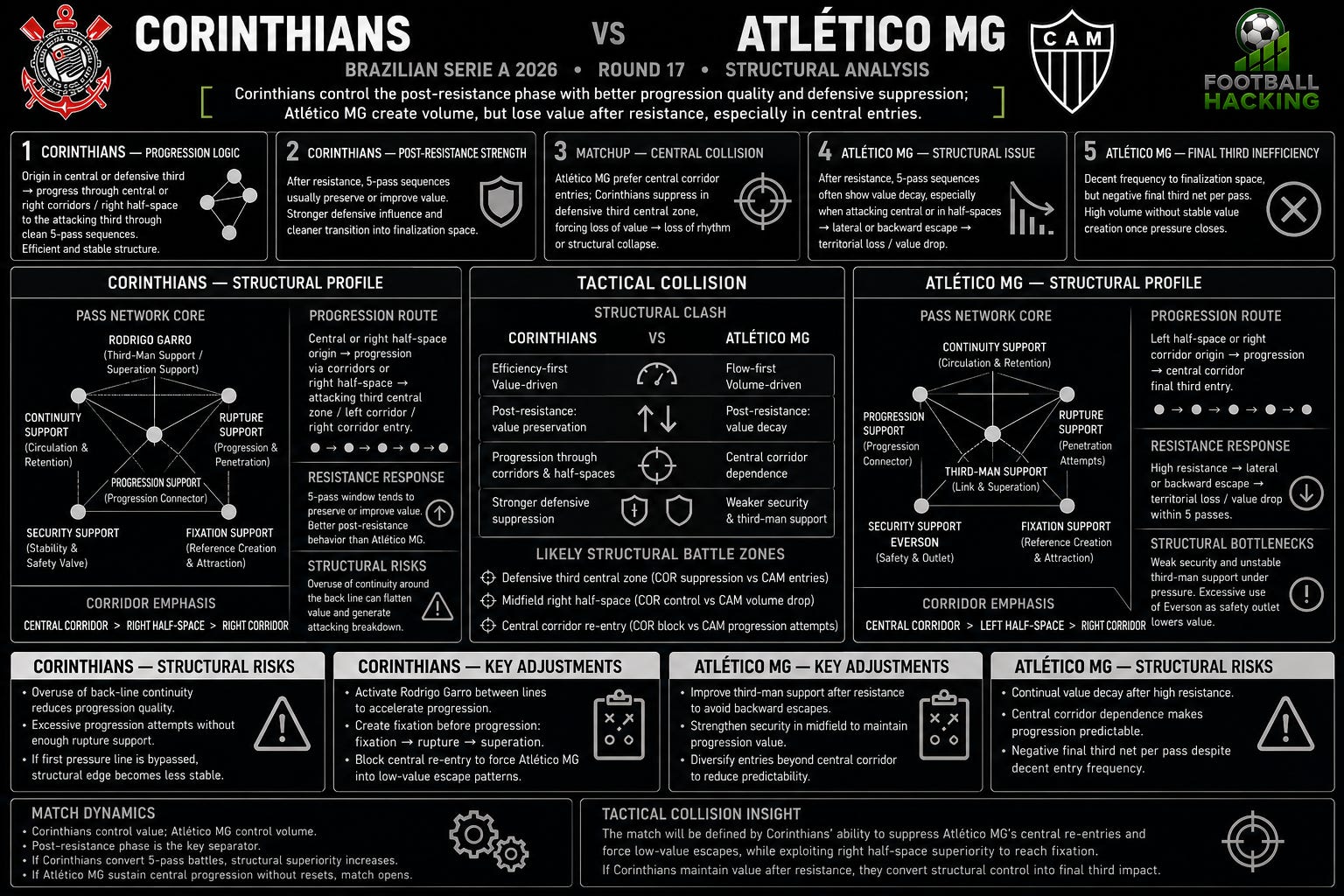
The team’s net progression index remains only slightly positive, meaning they do not overwhelm opponents through endless territorial accumulation. Instead, they focus on cleaner progression sequences capable of extracting higher value from fewer possessions.
That becomes visible in their corridor structure.
Corinthians repeatedly progress through both left and right corridors, but their most dangerous routes often involve cross-structure acceleration. Right half-space progression into the left corridor and central progression into the right corridor generate some of their strongest value gains.
This reveals a structure capable of using fixation on one side before destabilizing the opposite corridor.
Gabriel Paulista acts as the main Security Support reference inside Initiation Space, stabilizing first construction phases. Rodrigo Garro becomes the more decisive progression organizer higher up the pitch, functioning simultaneously as Third-Man Support, Progression Support, and indirect fixation reference after pressure appears.
Garro’s importance is enormous because Corinthians’ main bottleneck sits fully inside Progression Space.
The team can initiate attacks reliably.
The question is whether they can transform those attacks into sustained territorial value often enough.
The encouraging sign is their post-resistance behavior.
When resistance appears deep inside their own structure, Corinthians still repeatedly escape into advanced territory with positive value. Defensive-third central pressure can still become attacking-third progression through selective acceleration, especially when Garro becomes involved as the structural connector after the first defensive interaction.
That is where the home side hold a meaningful advantage over Atlético MG.
Atlético’s structure is much more fragile after resistance.
The away side still generate dangerous moments through direct half-space progression and sudden central acceleration, but their support chains often break immediately after contact.
Their corridor entries frequently begin in half-spaces before attacking central zones quickly, especially from the left half-space into central progression. The problem is repeatability.
Many of Atlético’s strongest routes appear more episodic than structurally stable.
Once resistance appears, the structure often collapses backward.
Midfield resistance can trigger retreats all the way into defensive-third corridors. Advanced central resistance frequently destroys attacking continuity entirely. Even lateral escapes inside midfield often carry little or negative value.
This creates a dangerous dependency on flow without stable post-resistance organization.
Everson becomes the clearest symbol of that instability.
The goalkeeper dominates Atlético’s centrality profile because the structure repeatedly resets through him after pressure appears. Defenders and wide references consistently return possession backward toward Everson, who functions as an overloaded Security Support reference.
Again, backward circulation itself is not automatically weakness.
The problem is what follows.
Too often, Atlético’s resets fail to recover positional value afterward. The structure preserves the ball but not progression quality.
Renan Lodi’s profile reinforces the same issue. Several recurring left-sided progression routes involving him carry negative value outcomes because progression arrives before fixation stabilizes the next action. The team reaches the lane without ever securing the advantage.
Defensively, Atlético still generate meaningful territorial pressure, especially high and centrally. Their attacking-third central pressing can disrupt opponent rhythm effectively.
That matters because Corinthians themselves can flatten when forced into repetitive low-line circulation under pressure.
So Atlético absolutely possess a disruptive pathway into the match.
But the larger structural advantage still belongs to Corinthians because the home side survive resistance more coherently.
That difference becomes especially important when corridor interaction is analyzed.
Atlético’s preferred attacking routes often target the same zones where Corinthians generate their strongest defensive suppression. Corinthians repeatedly disrupt attacks inside defensive-third right-sided zones — precisely where Atlético frequently attempt to progress.
That interaction heavily favors the home side.
The likely match pattern therefore becomes clear:
If the game stabilizes, Corinthians should generate fewer but cleaner attacks, preserving progression quality more effectively after resistance. Atlético may still create dangerous moments through disruptive transitions and direct half-space acceleration, but sustaining those attacks structurally remains the away side’s biggest challenge.
Corinthians can be slowed.
Atlético can be broken.
Those are very different structural realities.
Why Structural Analysis Matters More and More in Brasileirão Serie A
One of the biggest mistakes in football analysis is confusing movement with control.
A team can circulate heavily without preserving value.
A team can dominate territory without sustaining progression after resistance.
A team can even reach the final third repeatedly while structurally collapsing after the first defensive answer.
That is exactly why pass-network structure, support chains, defensive suppression, and xT progression matter so much.
Modern football is increasingly decided not by who attacks first, but by who survives contact better.
And Brasileirão Serie A, with its chaotic transitions, emotional swings, and aggressive rhythm changes, becomes one of the best leagues in the world for this type of structural interpretation.
At this point of the season, those identities are becoming clearer.
Flamengo currently look like the most structurally stable side among the three featured teams because their progression chains survive resistance consistently.
São Paulo look increasingly efficient because their sequence management remains coherent even without overwhelming territorial dominance.
Corinthians appear selective but structurally reliable once Garro becomes involved in progression.
Meanwhile, Palmeiras, Botafogo RJ, and Atlético MG all show versions of the same danger:
active circulation without stable post-resistance continuation.
That does not mean they cannot win.
Football is not deterministic.
But structurally, it means they currently depend more heavily on disruption, chaos, and isolated sequence success rather than sustained progression coherence.
And that difference becomes incredibly valuable for live trading interpretation.
Because sometimes the market sees possession.
But structure sees fragility.