

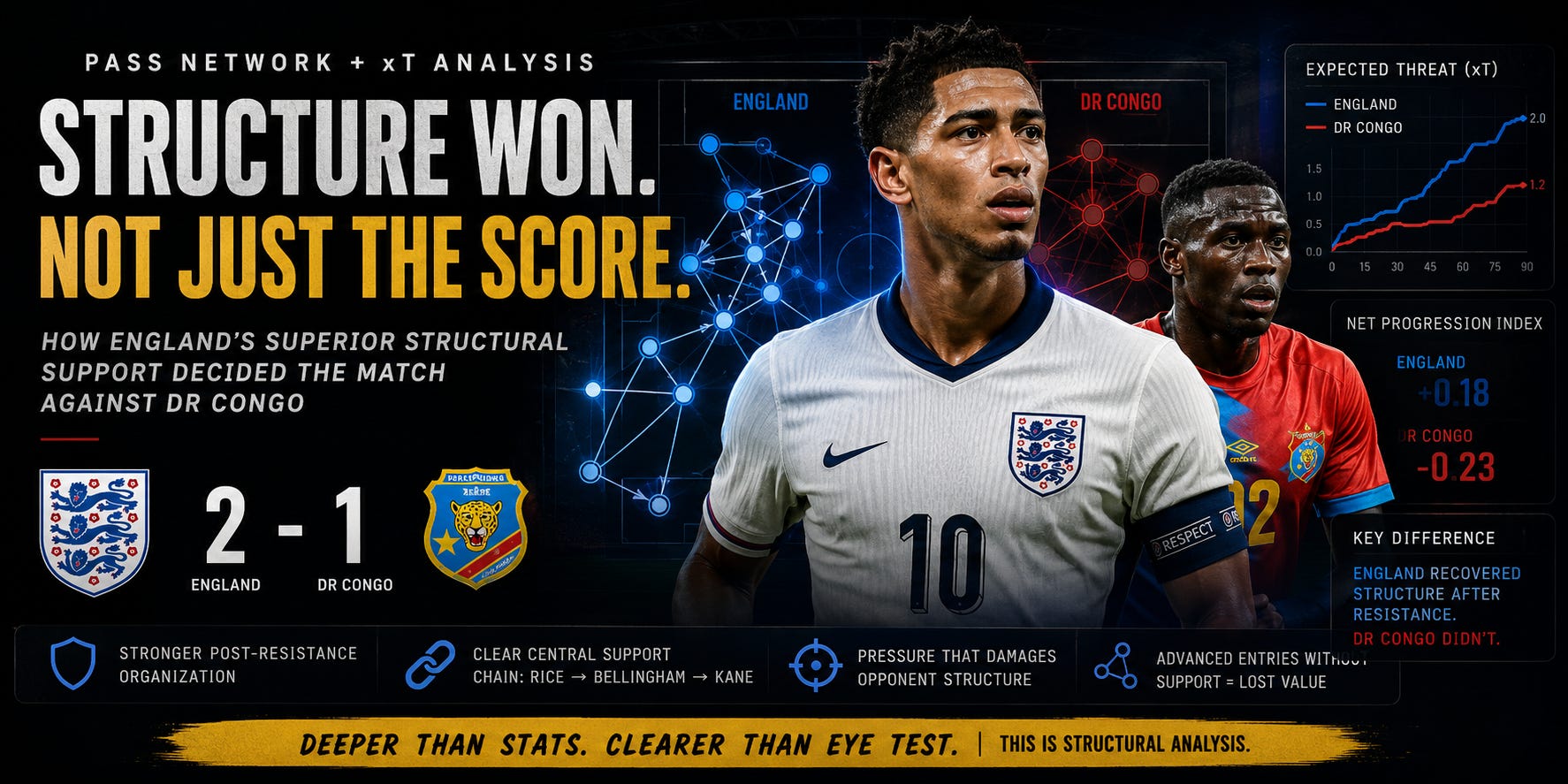
Disclaimer: This entire match analysis was conducted exclusively through pass network structure and Expected Threat (xT) data generated from both teams during the match. No video footage, broadcast images, individual highlights, traditional match statistics, or subjective tactical observations were used at any stage of this analysis. Every conclusion presented below derives solely from structural network behavior and xT evolution across the different phases of possession.
England’s 2–1 victory over DR Congo cannot be fully understood through possession percentages, isolated attacking moments, or the final score alone. From a structural perspective, this match was primarily determined by which team could preserve attacking value after encountering defensive resistance.
Rather than asking which side reached advanced areas more frequently, the structural question is considerably more demanding: which network remained capable of sustaining progression after the opponent successfully disrupted the initial attacking sequence?
That distinction ultimately separated the two teams.
England did not control every phase of possession with uninterrupted fluency. Their circulation frequently slowed during the first phases of build-up, and territorial progression was often measured rather than aggressive. However, the critical difference lay in their ability to reconnect progression after resistance interrupted the first attacking route.
DR Congo, on the other hand, demonstrated the capacity to access advanced areas during several possessions, particularly through specific left-sided progression patterns. The problem emerged immediately after England challenged those routes. Once resistance arrived, DR Congo repeatedly struggled to preserve attacking continuity across the following phases of possession.
Within the framework of functional spaces, England consistently maintained stronger coherence between Initiation Space and Progression Space, while DR Congo frequently entered Finalization Space with weakened continuity, lower support density, and reduced structural stability.
The scoreline reflected this structural imbalance.
Structural Collision: The Match Was Decided After Resistance, Not Before It
The defining collision between both teams did not occur during the initial stages of progression.
Instead, it emerged immediately after each side encountered defensive pressure.
England entered the match with stronger structural indicators and superior defensive metrics, and those characteristics remained visible throughout the ninety minutes.
Their control should not be confused with permanent territorial domination.
Several periods of circulation, especially involving the defensive line and the first midfield line, generated only modest net progression. England’s overall Net Progression Index remained only slightly positive, illustrating that the team was not continuously increasing territorial value with every possession.
Yet this modest progression should not be interpreted as structural inefficiency.
Instead, England consistently connected possession with recoverable value.
When progression temporarily stalled, the network usually retained enough organization to rebuild the attack within the following sequence.
Dead possession was comparatively rare.
That distinction is fundamental.
Possession without recoverable structural value often becomes little more than circulation for its own sake.
England repeatedly avoided that outcome.
DR Congo presented an almost opposite profile.
Their Expected Threat generation per one hundred passes remained lower, while their Net Progression Index finished in negative territory.
Structurally, this combination typically characterizes a team capable of reaching advanced zones without consistently preserving positional value after resistance.
The match reproduced precisely that behavior.
The Congolese structure initiated several promising attacks, particularly through the left corridor and selected central progression routes.
However, once England introduced pressure into the following phase, those sequences frequently suffered one of several recurring outcomes:
rhythm loss,
territorial regression,
circulation reset,
or disconnection between successive support functions.
Rather than continuing progression, possessions increasingly returned toward lower-value zones.
England’s greatest structural superiority originated from the center of the network.
Declan Rice became the principal regulator throughout the match.
Within Initiation Space, he repeatedly fulfilled both Continuity Support and Security Support responsibilities, ensuring that England could recycle possession without immediately sacrificing structural integrity.
As progression lanes emerged, Rice simultaneously assumed Progression Support responsibilities by linking possession toward Jude Bellingham and Harry Kane.
This transition proved decisive.
Bellingham consistently functioned as England’s principal bridge into Progression Space.
His structural importance extended well beyond advancing possession.
He repeatedly acted as Third-Man Support while simultaneously providing Superation Support whenever England successfully opened vertical lanes through central occupation.
Harry Kane’s contribution should likewise be understood beyond his traditional role as the highest forward.
Structurally, Kane continuously generated Fixation Support while simultaneously offering Third-Man Support whenever England required central occupation capable of connecting left-sided entries or right half-space progression.
These functions allowed England’s circulation to survive defensive contact significantly more often than their opponents’.
DR Congo’s centrality profile told a very different story.
Their network concentrated primarily around Axel Tuanzebe, Lionel Mpasi, and Chancel Mbemba.
Centrality itself is not inherently positive or negative.
However, in this particular case, the concentration occurred predominantly within deep zones.
That profile reflected a network forced to perform repeated stabilization actions inside Initiation Space rather than sustaining progression further ahead.
Their deepest players accumulated structural importance because the attack repeatedly needed rebuilding after resistance.
Instead of preserving attacking continuity, the network continually returned toward its own defensive organization.
The consequence became increasingly evident as the match progressed.
England consistently transformed defensive pressure into renewed progression.
DR Congo consistently transformed defensive pressure into structural restart.
That distinction explains the broader flow of the match far more accurately than the scoreline itself.


England’s Progression Structure: Stable Central Organization Before Controlled Expansion
England’s most frequent attacking route originated inside the central corridor before expanding toward the left corridor.
More than half of all final-third entries beginning centrally ultimately reached the left side during progression.
On a superficial level, this may simply appear to represent left-oriented attacking preference.
Structurally, however, the sequence reveals considerably more.
England repeatedly organized possession through central occupation before releasing pressure into wider areas.
Rice frequently initiated these sequences, allowing subsequent progression toward Bukayo Saka or nearby supporting connections once defensive attention had already shifted centrally.
Importantly, this route was not England’s highest-value progression.
It was their most stable progression.
The distinction matters enormously.
Its effectiveness depended upon the preservation of functional order throughout the sequence.
Rice first provided Continuity Support.
Central occupation then established Fixation Support.
Movement ahead of possession supplied Rupture Support.
Finally, once passing lanes emerged, Superation Support converted structural stability into renewed territorial advancement.
The outcome was rarely an immediate breakthrough.
Instead, England repeatedly generated sustainable progression capable of surviving resistance.
Their highest-value progression followed another pattern.
The most productive Expected Threat increases emerged when possession traveled from the left half-space into the central corridor.
These sequences frequently involved Jude Bellingham before connecting toward Harry Kane.
Here, England’s structural superiority became particularly visible.
Bellingham did not merely carry the ball into advanced territory.
He consistently received possession inside zones capable of transforming previous Fixation Support into central Superation Support.
Kane then completed the structural chain by occupying central defenders while simultaneously providing either continuation or immediate access into Finalization Space.
Within functional phase terminology, this represented England’s clearest structural bridge between Progression Space and Finalization Space.
England also generated productive right-sided progression.
However, those patterns appeared more selectively than consistently.
Useful Expected Threat frequently emerged through combinations involving Ezri Konsa, Noni Madueke, Declan Rice, and Jude Bellingham.
Unlike the dominant left-oriented release, these right-sided routes produced greater value per action despite occurring less frequently.
This difference illustrates an important structural principle visible throughout England’s attacking organization.
Frequency and value did not coincide.
Their most repeated progression pattern was not necessarily their most dangerous one.
Instead, stable circulation repeatedly created the structural platform from which higher-value sequences later emerged.
This distinction becomes especially important when interpreting individual passes that appear negative from a purely territorial perspective.
Several circulation sequences across England’s defensive line, or inward movements originating from wide defenders, produced immediate reductions in Expected Threat.
Evaluated in isolation, these passes might appear unproductive.
The structural framework, however, evaluates progression over the subsequent five passes rather than through a single action.
Many of these backward or neutral movements ultimately stabilized possession sufficiently for Rice or Bellingham to reopen more valuable progression routes shortly afterward.
The backward pass itself therefore was not structurally harmful.
Its importance depended entirely upon whether it preserved or degraded the surrounding support structure.
England more frequently achieved preservation than degradation.
Nevertheless, their attacking organization remained imperfect.
One recurring structural loop repeatedly appeared during lower-value possessions.
Progression frequently advanced through the right corridor or right half-space before encountering immediate defensive pressure.
From there, possession often returned toward central defenders.
Circulation then reset across the back line before another progression attempt began.
This cycle did not necessarily destroy the attack.
However, it frequently reduced final-third value whenever movement ahead of possession developed too slowly.
In those moments, England accumulated excess Continuity Support without generating sufficient Rupture Support further ahead.
Possession remained secure.
Structure remained coherent.
Yet the opponent’s defensive organization remained comparatively stable as well.
England continued controlling the architectural framework of possession.
They simply produced fewer immediate destabilizations during those sequences.
DR Congo’s Progression Pattern: Reliable Initial Access Without Sustainable Continuity After Resistance
DR Congo’s primary attacking route developed through the left corridor.
From a frequency perspective, this was clearly the team’s preferred progression pattern and one of its strongest routes in terms of generated value. Arthur Masuaku and Axel Tuanzebe repeatedly participated in these sequences, making the left corridor the most consistent entry point toward advanced territory.
However, structural access should never be confused with structural control.
The route consistently allowed DR Congo to approach advanced zones, but maintaining attacking value after reaching those areas proved considerably more difficult.
When the left-sided progression functioned at its best, Masuaku assumed the role of Progression Support while Tuanzebe provided Continuity Support behind the action. Advanced teammates occasionally supplied either Fixation Support or short continuation options capable of extending the sequence.
Yet this functional chain rarely remained complete throughout the following phases.
The first progression often succeeded.
The second phase frequently did not.
Support density after entry regularly became insufficient.
Rupture Support appeared inconsistently, while Third-Man Support under defensive pressure remained too limited to preserve structural continuity after England challenged the progression.
As a result, many attacks reached promising locations before gradually losing positional value over the following actions.
The team’s highest isolated Expected Threat values originated from another progression pattern.
Several of the most explosive individual sequences emerged from the left half-space before entering the central corridor, with Chancel Mbemba playing a significant role.
These actions demonstrated that DR Congo possessed the capacity to generate meaningful progression under specific structural conditions.
However, those sequences remained isolated exceptions.
They never evolved into the team’s dominant attacking identity.
Instead, the broader attacking profile continued to rely upon circulation that repeatedly struggled once resistance appeared.
The resistance-response data illustrates this structural limitation with particular clarity.
Whenever England successfully applied defensive pressure inside the midfield left half-space, DR Congo’s predominant reaction became recirculation rather than continued advancement.
Possession often remained under control.
Territorial value did not.
Vertical gain became minimal.
Expected Threat frequently stagnated.
Sometimes it declined.
This pattern reveals one of the most decisive structural characteristics of the match.
One of DR Congo’s principal progression zones simultaneously became one of its principal collapse points.
Whenever England interrupted the first progression line inside this area, DR Congo repeatedly failed to convert defensive contact into either successful superation or structurally stable continuation during the following five passes.
The diagnosis through support roles therefore becomes increasingly straightforward.
The Congolese structure possessed meaningful Continuity Support within deeper zones.
Progression Support occasionally appeared through the left corridor.
What remained consistently insufficient was the combination of Security Support and Third-Man Support immediately after resistance occurred.
Without those layers surrounding the pressured player, progression became dependent upon isolated first actions rather than sustainable attacking structures.
Consequently, many entries into advanced territory remained structurally superficial.
The final-third efficiency data reinforces this interpretation.
A negative final-third net value per pass should not simply be interpreted as inefficient execution.
Instead, it generally reflects entries occurring without adequate structural support behind the action.
Too many attacks entered Finalization Space without sufficient continuity behind possession, insufficient fixation ahead of possession, or insufficient capacity to sustain a second action after the opponent’s first defensive intervention.
For that reason, DR Congo consistently appeared capable of entering advanced territory without ever fully inhabiting it.
The attack reached the destination.
The structure rarely survived long enough to establish meaningful occupation.
Frequency Versus Value: England’s Most Dangerous Actions Were Not Their Most Repeated Ones
This match provides an excellent demonstration of why attacking volume should never be mistaken for attacking impact.
England’s most frequent progression pattern originated centrally before expanding toward the left corridor.
That route mattered primarily because it offered repeatable structural access into advanced territory.
Its average Expected Threat value, however, remained below several less frequent progression patterns.
The highest-value actions consistently emerged through left half-space progression toward the central corridor, particularly those connecting Jude Bellingham and Harry Kane.
Additional high-value sequences also developed through selected right-sided combinations involving Declan Rice, Ezri Konsa, and Noni Madueke.
Consequently, England’s attacking organization displayed two complementary structural layers.
One group of routes primarily maintained continuity.
Another generated decisive increases in Expected Threat.
This represents a healthy structural relationship.
Frequent circulation supplied the platform.
Selective progression produced the decisive value.
England repeatedly succeeded in using stable organization to prepare fewer but considerably more dangerous attacking moments.
DR Congo demonstrated the opposite tendency.
Several progression routes produced respectable isolated Expected Threat values, especially those beginning inside the left half-space before entering central areas.
However, those actions occurred too infrequently to define the overall attacking structure.
The team’s most common circulation patterns remained concentrated within deeper zones and along the left side.
Those frequent actions rarely translated into sustained territorial value after defensive pressure appeared.
Activity remained high.
Sustained payoff remained comparatively limited.
This distinction becomes even clearer when examining the network edges carrying the greatest Expected Threat.
England’s most valuable structural connections repeatedly involved Declan Rice progressing possession toward Jude Bellingham or Harry Kane.
These passes carried significance extending well beyond numerical Expected Threat.
Structurally, they linked Initiation Space directly with Progression Space before continuing toward Finalization Space through clearly defined functional responsibilities.
Rice consistently acted as the source of Security Support and Progression Support.
Bellingham and Kane then transformed those stable foundations into meaningful advancement through combinations of Third-Man Support, Fixation Support, and Superation Support.
The Congolese network displayed a very different profile.
Several of the largest positive Expected Threat edges involved passes directed toward Lionel Mpasi.
At first glance, this may appear surprising.
Structurally, however, the explanation becomes straightforward.
Those passes frequently represented attempts to restore organizational stability rather than advance the attack.
Although individual passes occasionally generated local Expected Threat context, the broader structural picture revealed something quite different.
Mpasi’s outgoing connections—particularly toward Tuanzebe and Mbemba—produced heavily negative Expected Threat values.
Rather than extending progression, these actions repeatedly restarted possessions from lower-value areas following defensive pressure.
The consequence is significant.
England concentrated structural value within progression and conversion.
DR Congo concentrated structural activity within maintenance and recovery.
Those are fundamentally different attacking identities.


At this stage of the analysis, one broader observation naturally emerges.
Patterns like these become considerably easier to recognize when pass network relationships are evaluated together with Expected Threat evolution instead of relying exclusively on conventional match statistics or isolated events. The Football Hacking project explores exactly this type of structural analysis, focusing on how network organization influences progression, resistance, and attacking continuity across different matches and competitions. More information about the methodology and the project is available at
Defensive Reaction: England Damaged Structure, While DR Congo Mostly Delayed It
England’s defensive organization represented one of the decisive structural factors behind the outcome.
The most influential defensive behavior consistently occurred inside the attacking-third central zone.
Whenever England successfully applied pressure in that area, DR Congo frequently experienced immediate loss of structural value followed by attacking breakdown.
The significance extends beyond simple ball recoveries.
England repeatedly disrupted the opponent’s support chain itself.
Even when DR Congo survived the initial defensive challenge, the following sequence often continued losing Expected Threat across the next five passes.
The recurring pattern remained remarkably consistent.
England introduced pressure.
DR Congo responded through value loss.
The attack gradually collapsed.
This sequence characterizes pressure that lands directly upon weak support architecture rather than merely slowing circulation.
England also produced meaningful defensive disruption inside its own defensive-third central zone and within the defensive left half-space.
The consequences differed slightly there.
Rather than producing immediate territorial gains, those interventions more commonly generated rhythm loss.
Structurally, however, rhythm loss remained highly valuable.
It prevented DR Congo from transforming central and left-sided access into sustained attacking continuity.
England did not always recover possession immediately.
Instead, they repeatedly denied the opponent’s ability to preserve structural coherence across successive phases.
DR Congo likewise generated moments of effective high pressure.
Several interventions inside England’s attacking-third central zone forced temporary rhythm loss and redirected circulation.
The difference lay not in the existence of pressure but in its consequences.
Congolese pressure usually delayed England’s attacks.
English pressure regularly damaged the attacks themselves.
England repeatedly absorbed defensive contact through stronger Security Support and more reliable reset mechanisms centered around Declan Rice, the central defenders, and subsequent connections toward Jude Bellingham or Harry Kane.
That distinction separated the two defensive performances.
One team disrupted tempo.
The other disrupted structure.
An additional structural layer also deserves attention.
England’s superiority extended beyond the first defensive action.
The organization behind pressure repeatedly controlled second balls and preserved spacing after challenges.
DR Congo frequently recovered possession only to discover that neutral reactions represented their best available option.
The immediate surroundings rarely offered sufficient angles or support density to continue progression.
Many Congolese attacks therefore died not during the first defensive duel, but one or two passes afterward, when the surrounding network proved incapable of sustaining the sequence.
Maintaining Attacking Continuity: England Sustained Progression, While DR Congo Struggled to Sustain Occupation
England’s attacking continuity was not built upon uninterrupted fluency.
Instead, it depended upon preserving enough structural organization to continue progression after resistance interrupted the initial attacking sequence. This distinction became one of the defining characteristics of the match.
The team’s strongest possessions repeatedly followed a recognizable functional sequence.
Build-up began through central organization or inside the half-spaces within Initiation Space.
Declan Rice provided Security Support while simultaneously maintaining Continuity Support behind the first progression.
Once pressure attracted defensive attention, Jude Bellingham or Harry Kane frequently became the next structural reference.
Operating as Third-Man Support, they converted stable circulation into renewed progression before England entered the final third through either the left corridor or the central corridor.
The importance of this sequence cannot be overstated.
England did not necessarily remain inside advanced zones longer than their opponents.
Rather, they consistently remained close enough to valuable territory that defensive resistance rarely forced complete territorial regression.
When progression temporarily stalled, the structure usually stabilized possession before quickly attempting another entry.
Sustainability, therefore, should not be understood as prolonged possession in attacking areas.
It should instead be understood as the ability to preserve positional value after resistance and successfully re-enter progression within the following actions.
England repeatedly demonstrated exactly that capability.
One recurring positive structural loop appeared throughout the match.
Central progression encountered defensive pressure.
Rice immediately restored organizational stability.
Bellingham or Kane then received possession between defensive lines.
England subsequently launched another progression attempt.
This sequence did not always generate immediate Expected Threat.
However, it consistently preserved the attack itself.
Structurally, it represented an excellent example of strong Continuity Support combined with effective Third-Man Support under pressure.
England nevertheless exhibited one recurring vulnerability.
Whenever progression expanded toward the flanks before adequate interior support had fully developed, the attack became significantly more predictable.
The sequence repeatedly followed a similar pattern.
Possession reached the right corridor.
England immediately encountered defensive pressure near the touchline.
A backward pass returned possession toward Rice or one of the central defenders.
Circulation shifted laterally across the defensive line.
Another progression attempt followed shortly afterward.
The underlying issue was not the existence of the reset.
Resets can preserve structural value.
The problem emerged because Rupture Support had not yet fully developed before the ball moved wide.
England occasionally advanced possession without first fixing enough defenders centrally.
As a result, wide progression generated lower returns despite preserving overall structural organization.
Control remained.
Destabilization became more difficult.
DR Congo displayed a markedly different attacking profile.
Their possessions repeatedly collapsed after resistance, particularly following left-sided progression.
The most common structural loop unfolded in a remarkably consistent manner.
Progression advanced through the left corridor.
England applied pressure in the next defensive line.
Possession moved backward or entered forced recirculation.
Deep defenders attempted to restart the attack.
Final-third occupation weakened.
This sequence represents a textbook example of structural attacking breakdown.
Importantly, the team did not always lose possession immediately.
Instead, positional value gradually disappeared while the attack lost both density and continuity.
The primary cause extended beyond England’s pressure alone.
Support layering surrounding the pressured player remained insufficient.
The initial receiver frequently lacked an effective Third-Man Support option.
Likewise, Security Support behind the action rarely supplied enough structural backing to preserve progression across the following passes.
Progression Support often existed.
The structural framework necessary to sustain it frequently did not.
This explains why DR Congo repeatedly entered advanced territory without establishing lasting attacking occupation.
Their entries became events.
England’s entries became structures.
The Central Players and Their Structural Functions After Resistance
Declan Rice emerged as the single most influential structural reference within the match.
Describing him merely as England’s Security Support or Continuity Support inside Initiation Space would only capture part of his contribution.
His greatest influence consistently appeared after England encountered defensive resistance.
Whenever pressure interrupted progression, Rice repeatedly restored structural stability without forcing England to abandon territorial ambition.
His connection with Jude Bellingham became the most significant structural edge observed throughout the match.
Together, they repeatedly transformed recovery and reset into renewed progression.
Bellingham fulfilled several complementary functions simultaneously.
He operated as Third-Man Support.
He supplied Progression Support.
He selectively generated Superation Support whenever defensive organization became sufficiently stretched.
His importance therefore extended well beyond advancing possession through carrying or receiving.
Repeatedly, he converted structurally preserved possessions into genuinely dangerous ones.
Harry Kane completed England’s central functional chain.
He consistently supplied Fixation Support through central occupation while simultaneously acting as Third-Man Support whenever the attack required continuity after progression.
Receiving high-value passes from Rice and Bellingham, Kane repeatedly enabled England to enter Finalization Space with considerably greater structural control than DR Congo managed throughout the match.
The Congolese network presented a contrasting picture.
Axel Tuanzebe occupied an important structural position.
However, his centrality reflected responsibility more than control.
He repeatedly shouldered extensive Continuity Support duties inside zones where stronger progression links ahead of possession were actually required.
Chancel Mbemba likewise contributed to several promising progression sequences, particularly those beginning within the left half-space.
Yet the surrounding support structure remained inconsistent.
His actions often lacked the functional continuity necessary to sustain progression after resistance.
Lionel Mpasi’s role proved especially revealing.
He repeatedly functioned as Security Support because the surrounding structure required continual stabilization.
Paradoxically, that necessity itself exposed one of the team’s principal structural weaknesses.
Too much organizational repair occurred one line deeper than would ideally be required.
In summary, England’s principal players repeatedly connected functional phases.
DR Congo’s principal players repeatedly repaired disrupted phases.
That distinction captures the structural balance of the match remarkably well.
Why the Match Progressively Tilted Toward England
Four structural mechanisms collectively explain why England gradually established the decisive advantage.
The first concerned post-resistance organization.
After encountering defensive contact, England consistently demonstrated greater capacity to preserve or rapidly restore positional value across the following five passes.
DR Congo repeatedly failed to achieve the same level of continuity.
Second, England possessed a considerably clearer central support chain.
Declan Rice, Jude Bellingham, and Harry Kane collectively covered the essential functional responsibilities of Continuity Support, Security Support, Third-Man Support, Fixation Support, and selective Superation Support in a coherent structural order.
DR Congo demonstrated fragments of those relationships.
England demonstrated a complete chain.
Third, England’s defensive interventions inside advanced central zones repeatedly damaged DR Congo’s structural organization instead of merely delaying attacking rhythm.
This distinction transformed numerous Congolese possessions into low-value restarts rather than sustained attacks.
Finally, DR Congo consistently entered the final third without stable structural backing.
Their access routes—particularly through the left corridor—were genuine.
Their occupation of Finalization Space remained comparatively fragile.
For that reason, although the score remained relatively close, the deeper structural dynamics consistently favored England.
This was not a match defined by overwhelming superiority in territorial domination or complete suppression of attacking opportunities.
It was defined by superiority in the architecture governing progression and resistance management.
The final score broadly reflected that underlying structural reality.
If anything, the scoreline slightly understated England’s control over the deeper mechanisms shaping the match.
Final Structural Insight
One dominant structural pattern ultimately defined the entire encounter.
England repeatedly survived defensive resistance while preserving sufficient support coherence to restart progression.
DR Congo repeatedly reached resistance without possessing the surrounding support chain necessary to keep the attack alive.
That distinction represents the principal lesson emerging from the data.
DR Congo’s primary weakness did not concern finishing quality or isolated chance creation.
Instead, too many attacking sequences entered Finalization Space following incomplete functional sequencing.
Progression Support frequently appeared without sufficient Fixation Support.
Advanced entries often lacked adequate Rupture Support.
Moments immediately following defensive pressure repeatedly unfolded without the Security Support or Third-Man Support required to sustain structural continuity.
Under similar structural conditions, the same attacking fragilities would likely reappear.
England, meanwhile, demonstrated that perfect attacking fluency was unnecessary.
Their structure remained sufficiently coherent to keep the match consistently tilted in their favor.
Live Betting Checklist
The structural indicators below summarize the most important patterns observed throughout the match and should be monitored whenever similar dynamics emerge.
Watch England building through Declan Rice before immediately connecting with Jude Bellingham or Harry Kane. This pattern generally indicates that England’s Continuity Support remains intact and that the next progression phase is capable of generating meaningful structural value.
Observe whether England’s wide progression is preceded by central fixation. When the ball reaches either corridor after central occupation has already fixed defenders, the progression route becomes structurally alive. When width is accessed too early, the attack is considerably more likely to finish with a reset.
Watch where England performs its defensive actions inside the attacking-third central corridor. Recoveries or successful disruptions in this area frequently indicate that the opponent is entering structural attacking breakdown rather than simply experiencing temporary pressure.
Evaluate England’s speed of re-entry following resets. Sequences moving from central reset to Rice before immediately connecting with Bellingham or Kane indicate that structural health remains intact. Extended circulation across the defensive line without interior access suggests increasingly sterile possession.
Pay attention to second-ball control following England’s high pressure. If England consistently secures the second action after pressing, its structural superiority becomes increasingly actionable. If DR Congo begins sustaining the following three to five passes after those duels, the structural balance of the match starts to shift.