

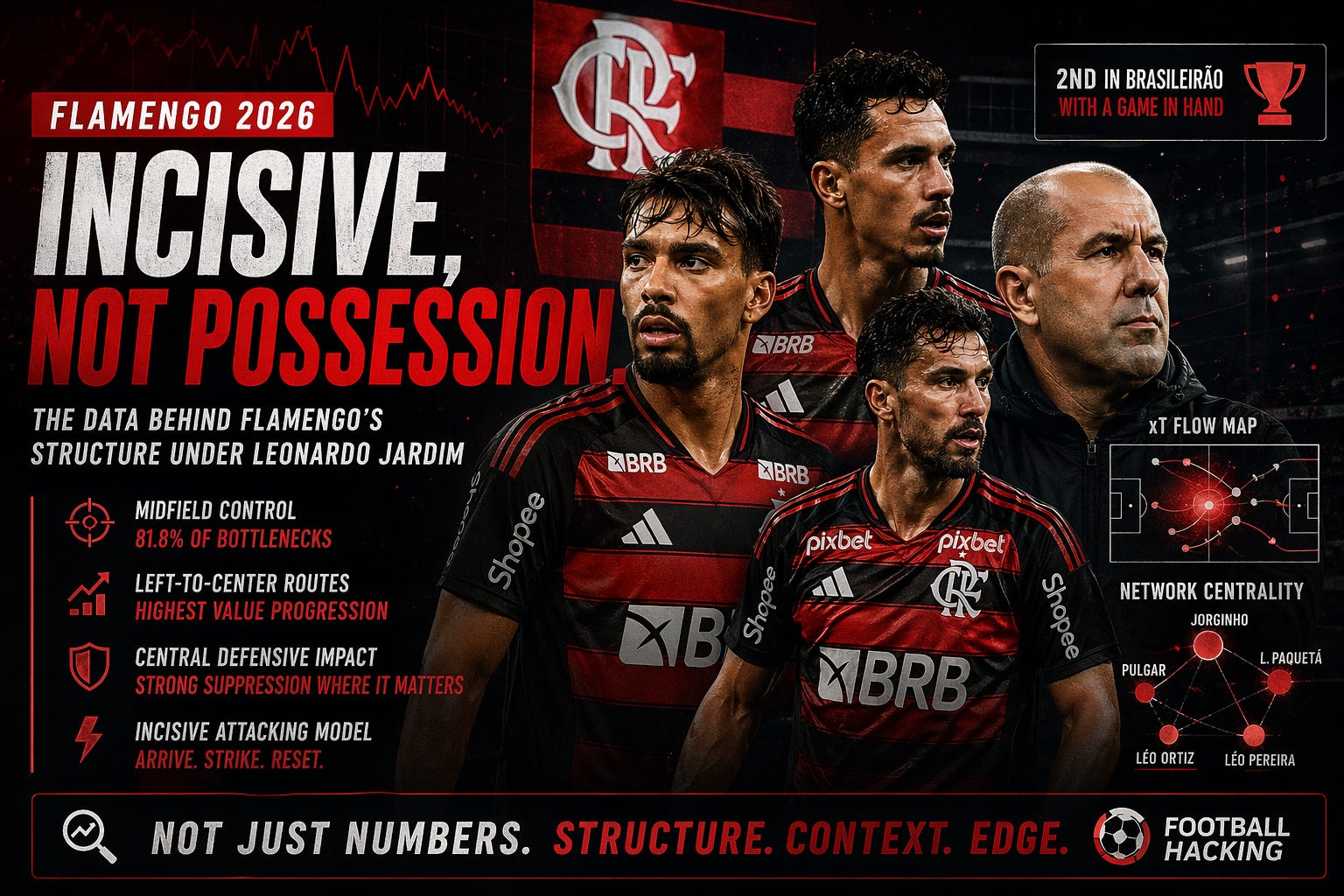
This analysis is grounded in a data-driven framework built on pass network structures and Expected Threat (xT). Rather than relying on surface-level metrics, it evaluates how each team organizes possession, how value flows through their passing network, and how attacking sequences evolve under pressure. By combining network centrality, progression patterns and xT dynamics, the objective is to translate what is typically seen qualitatively on the pitch into measurable, repeatable insights — revealing not just where teams play, but how and why their structure generates or destroys value
Flamengo sit second in the Brasileirão with a game in hand, and the shift since the managerial change from Filipe Luís to Leonardo Jardim has been immediate and meaningful. The team looks more structured, more territorially dominant, and defensively more reliable.
But to understand Flamengo properly in 2026, you need to correct a very common misread:
Flamengo are not a team that fails to sustain possession in the final third.
Flamengo are a team that chooses not to — because they are built to be incisive, not circulatory.
This distinction changes everything.
This analysis is built on pass network structure, centrality metrics, and xT flow, removing subjective bias and focusing on how Flamengo actually function across phases of play.
And what emerges is not a flawed attacking team — but a deliberately vertical one, with specific structural trade-offs.
Tactical Identity: Incisiveness Over Circulation
Flamengo’s attacking identity is often misunderstood if you look only at:
Possession duration
Final-third pass volume
Surface-level control metrics
Because this is not a positional-play team in the classic sense of:
Long attacking sequences
Constant ball circulation near the box
Slow probing for openings
Instead, Flamengo operate with a different logic:
Arrive with advantage → attack quickly → reset if necessary
That’s not inefficiency.
That’s design.
Structure First: Why the Base Is So Stable
The team’s structural indicators confirm a strong foundation:
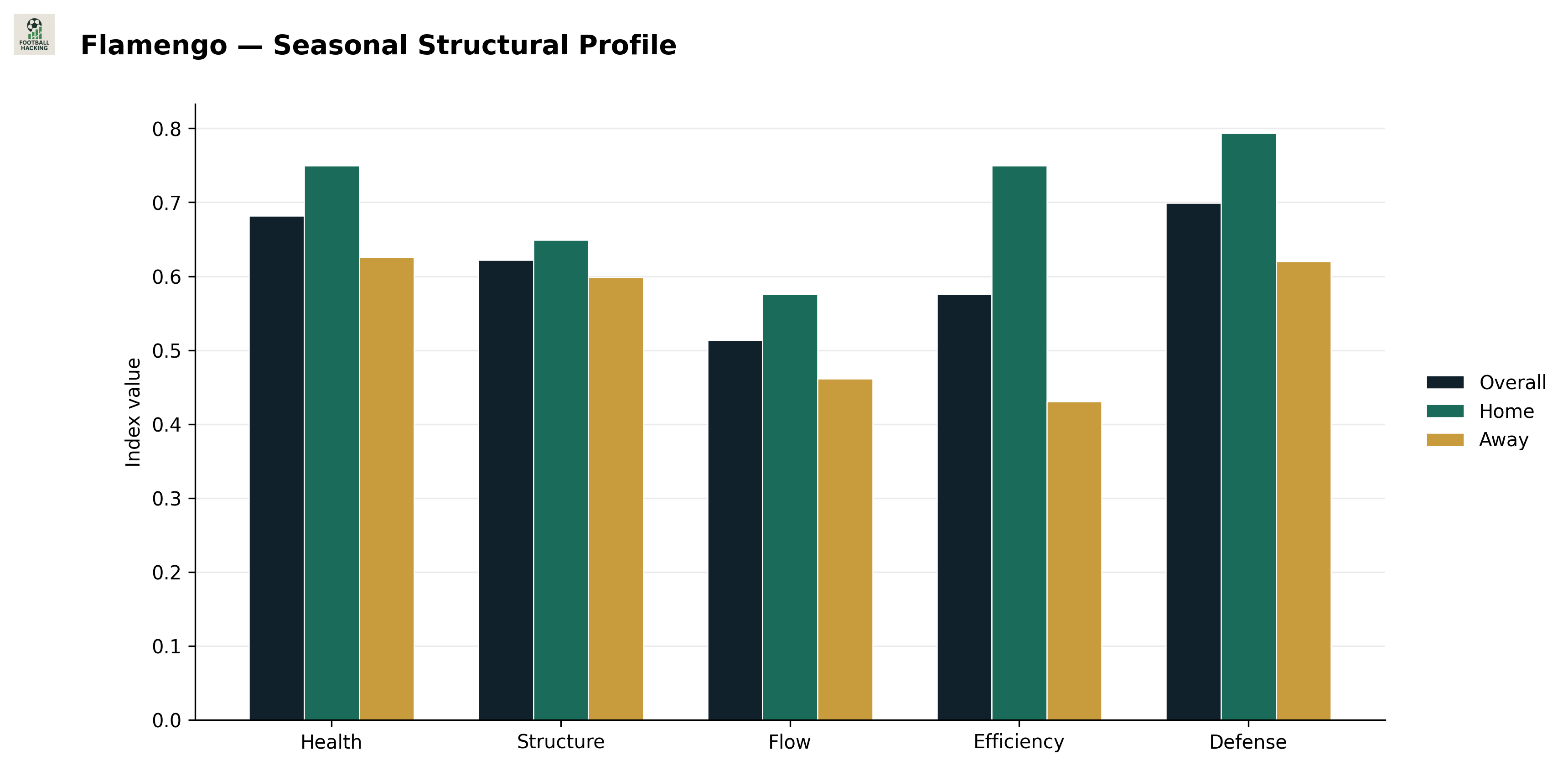
High structure index (~0.62)
Strong defensive influence (~0.70)
Midfield dominance (81.8% of bottlenecks)
This is not chaos football.
Flamengo:
Control where the game is played
Win territory through midfield occupation
Apply pressure in central zones
This is the platform that enables their incisiveness.
Without this base, verticality becomes randomness.
With this base, it becomes controlled aggression.
Progression Model: Direct, Diagonal, Purposeful
Flamengo’s most valuable attacking route is clear:
Left half-space → central corridor
This is the core mechanism of the team.
Why it works:
Breaks defensive symmetry
Creates central access with forward momentum
Connects progression with immediate attacking threat
This is not passive progression.
This is attack-oriented progression.
Right Side: Volume Without Intent Is Not the Goal — It’s the Outlet
A lot of the criticism around Flamengo comes from the right side:
High volume
Lower xT return
But this needs to be interpreted correctly.
The right side is not designed to be the primary weapon.
It functions as:
A release valve
A rebalancing mechanism
A fallback progression route
So when Flamengo shift right:
It often means the primary left-to-center route was blocked
The team is resetting structure, not trying to create immediately
This is crucial.
Because what looks like:
“sterile circulation”
is often actually:
controlled reset before the next incision
Player Roles: The Engine Behind the Structure
This system only works because player roles are clearly defined — and complementary.
Jorginho — The Regulator
Leads load centrality and pagerank
Controls tempo and volume
Decides when to accelerate vs reset
He is not there to force progression.
He is there to stabilize structure and choose moments.
When his passes go backward:
It’s not failure
It’s decision-making under structure constraints
Lucas Paquetá — The Connector
High closeness centrality
Links phases together
Connects midfield to attack
Paquetá is the key to continuity.
If he receives:
Facing forward → Flamengo accelerate
Under pressure → Flamengo reset
So his role is not just technical.
It’s structural continuity under pressure.
Léo Ortiz & Léo Pereira — The Structural Base
High eigenvector centrality
Embedded in the network, not isolated
They are not passive defenders.
They:
Sustain circulation
Provide progression support
Maintain positional structure
When they appear frequently in passing chains, it’s not necessarily negative.
It often means:
The team is reorganizing shape before the next vertical action
Pulgar — The Pressure Absorber
Pulgar’s role is often misinterpreted because:
Some of his connections show negative progression
But this is context-driven.
He operates:
Under pressure
In constrained spaces
As a link between phases
So his job is:
Not to create value — but to prevent structural collapse


Defensive Structure: Central Suppression as a Weapon
Flamengo’s defensive strength is very specific.
They are not just aggressive.
They are directionally effective.


Most impactful zones:
Central defensive third
Central pressing in attacking third
What happens there:
Opponents lose rhythm
Progression slows
Possession becomes neutral
This is not random pressing.
This is targeted suppression of high-value zones.
Resistance Phase: Why Flamengo Can Be Both Dangerous and Stable
Under pressure, Flamengo don’t collapse.
They show two controlled responses:
1. Progressive Escape
Break lines
Generate vertical gain
Maintain attacking potential
2. Structural Reset
Backward pass
Reorganization
Rebuild from base
And here’s the key insight:
Resetting is not failure in an incisive team.
It’s part of the cycle.
Because forcing continuation in bad conditions:
Breaks structure
Increases turnover risk
Flamengo avoid that.
Final Third: Why “Lack of Continuity” Is Misread
The data shows:
Negative final-third net per pass
At first glance, this suggests inefficiency.
But in context, it reflects:
Short attacking cycles rather than sustained pressure
Flamengo:
Don’t aim to hold the ball endlessly near the box
Aim to attack quickly once advantage is created
So sequences end faster.
Which naturally:
Reduces accumulation metrics
Increases volatility
This is the trade-off of incisiveness.
Home vs Away: Same Idea, Different Execution
The identity doesn’t change:
Still territorial
Still midfield-driven
Still incisive
What changes is:
Execution quality
Support timing
Structural precision
At home:
Shorter distances
Faster support
Cleaner continuation
Away:
Slight delays
More resets
Lower efficiency
This doesn’t mean the system fails.
It means:
The margin for incisiveness becomes thinner.
The Real Risk: When Incisiveness Turns Into Predictability
Flamengo’s biggest vulnerability is not lack of possession.
It’s when:
Left-to-center route is blocked
Right-side becomes overused
Resets become too frequent
At that point:
The team still controls territory
But loses unpredictability
And incisiveness without unpredictability becomes easier to defend.
Tactical Summary
Flamengo 2026 are:
Structurally strong → control territory and midfield
Defensively effective → especially in central zones
Incisive in attack → prioritize fast advantage exploitation
Context-sensitive → execution drops away from home
They are not:
A positional team focused on long final-third possession
A team that builds through slow circulation
They are:
A team that arrives to attack, not to stay
Why This Matters (For Coaches, Analysts, and Bettors)
Most models — and most eyes — misread Flamengo because they expect:
Possession → control → chance
But Flamengo operate differently:
Structure → progression → incision
That shift creates inefficiencies in:
Tactical interpretation
Market pricing
And that’s where edge lives.
Want to Read Games Like This Before the Market Adjusts?
The Football Hacking web app gives you:
Fair odds (Poisson + Dixon-Coles)
Monte Carlo scenario simulation
Structural diagnostics like this
👉 If you’re betting without structural context, you’re missing the real signal.
And If You Want This Depth Weekly…
The newsletter delivers:
Matchup breakdowns
Structural diagnostics
Tactical + betting edge combined
👉 Subscribe and stay ahead of the curve.
Final Thought
Flamengo don’t fail to sustain attacks.
They refuse to waste them.
And once you understand that…
You stop asking why they don’t circulate —
and start understanding why they choose to strike.