

Football analysis is evolving.
For years, the conversation around data-driven football betting and tactical analysis has been dominated by metrics like xG, possession, shots, field tilt, PPDA, and expected points. Those tools are valuable. But they often describe what happened rather than how the structure of the game functioned underneath the surface.
That is where pass-network structural analysis changes the conversation entirely.
Over the past months, I have been developing and testing a structural metric called Network Health Index, built from pass-network diagnostics, centrality distributions, progression efficiency, spatial balance, defensive influence, and xT progression dynamics.
The goal was simple:
Can the structural health of a football team’s passing network be statistically associated with actual match outcomes?
The answer was yes.
And not just slightly.
Using more than 5,200 team-match observations across multiple leagues and competitions, the results showed consistent statistical association between structural superiority and:
Higher win rates
More goals scored
Fewer goals conceded
Better goal difference
More points per match
This article explains:
what Network Health actually measures,
why structure matters for football trading and betting,
what the statistical findings revealed,
and why this may become one of the most powerful complementary layers for football analysis.
What Is “Football Network Health”?
Most football analytics still focus heavily on event outputs:
shots,
xG,
possession,
dangerous attacks,
touches in the box.
But football structure begins much earlier than the final action.
Before a shot exists, there is:
circulation,
spacing,
support,
progression,
resistance handling,
corridor variation,
third-man access,
pressure escape.
That underlying structure is what pass-network analysis attempts to capture.
The Network Health Index was designed to measure how healthy, stable, efficient, and progressive a team’s collective structure is during possession.
It combines several structural dimensions, including:
network robustness,
progression efficiency,
xT progression quality,
spatial balance,
pass-network connectivity,
defensive influence,
centrality concentration,
flow sustainability.
Rather than focusing on isolated actions, it attempts to measure whether the collective structure itself is functioning efficiently.
In simple terms:
Is the team structurally healthy on the pitch?
Why Traditional Football Metrics Miss Important Structural Information
One of the biggest problems in football analysis is that many metrics are highly reactive.
A team may:
generate xG,
create shots,
dominate possession,
while still having an unstable underlying structure.
And unstable structures eventually collapse.
This happens constantly in football.
A team can win three matches in a row while:
overloading one corridor excessively,
relying on a single progression connector,
failing to resist pressure consistently,
showing unstable recirculation patterns.
The scoreboard may hide those problems temporarily.
But the structure often reveals them earlier.
That is exactly why structural analysis matters so much for:
football betting,
football trading,
live analysis,
tactical scouting.
The Study: More Than 5,200 Team-Match Observations
To test whether structural health actually mattered statistically, I analyzed:
2,624 matches
5,248 team-match observations
across multiple leagues and competitions.
For each team-match entry, the model calculated:
general health index,
opponent health index,
structural superiority differential,
goals scored,
goals conceded,
points,
win/loss outcome.
The key variable became:
health_diff
Which simply means:
team_health - opponent_health
This turned out to be extremely important.
Because football is not played in isolation.
Football is structural confrontation.
A team with a “good” structure may still struggle against an even healthier structure.
That is why relative superiority matters more than absolute values.
The Statistical Results
The findings were remarkably consistent.
Higher structural health was positively associated with:
wins,
points,
goals scored,
goal difference.
And negatively associated with:
goals conceded.
The strongest relationship came from:
health_diff
or structural superiority.
Teams With Structural Superiority Performed Better
When teams had positive structural superiority:
health_diff > 0
they produced:
MetricStructurally SuperiorStructurally InferiorWin Rate44.5%30.8%Goals Scored1.591.25Goals Conceded1.251.59Goal Difference+0.34-0.34Points Per Match1.581.17
That is not random noise.
It suggests that healthier structures are associated with real competitive advantages.
Why This Matters for Football Betting
This does NOT mean:
“Bet every time a team has higher Network Health.”
That would be simplistic.
Football is still highly chaotic and probabilistic.
However, the findings strongly suggest that structural health contains real informational value.
And that matters enormously for betting and trading.
Because betting is not about certainty.
It is about informational edges.
The Biggest Edge: Detecting Structural Fragility Before the Market Does
This is where structural analysis becomes incredibly powerful.
Many teams look strong statistically because:
they recently won matches,
accumulated points,
scored goals,
generated xG.
But underneath the surface, their structure may already be deteriorating.
Examples:
unstable buildup,
excessive dependence on one player,
weak pressure resistance,
poor corridor variation,
declining progression sustainability,
rising destruction rates,
centrality overload.
Traditional metrics may not capture this early enough.
Pass-network structure often does.
That is exactly why structural diagnostics can become such a powerful complementary layer for football trading.
The Relationship Between Structure and Goals
One of the most interesting discoveries from the study was this:
Higher Network Health improved:
offensive production,
defensive stability,
overall goal difference.
Simultaneously.
That is rare.
Most football metrics tend to explain only one side of the game.
For example:
attacking metrics explain goals scored,
defensive metrics explain goals conceded.
But structural health appeared associated with both.
This suggests that Network Health may be capturing something deeper:
systemic collective quality.
Why the R² Values Actually Matter
Some people may look at the regression results and say:
“R² of 0.04 is small.”
That interpretation misunderstands football.
Football is an extremely noisy sport.
Trying to explain:
wins,
goals,
points,
with a single aggregated structural variable is already difficult.
And remember:
This model did NOT include:
market odds,
Elo ratings,
payroll,
xG,
squad valuation,
injuries,
schedule congestion,
rest days,
weather,
contextual match variables.
Nothing.
Despite that, the model still found statistically significant association.
That matters.
Structural Football Analysis Is Not About Replacing xG
This is important.
I do NOT believe Network Health replaces:
xG,
Poisson models,
Monte Carlo simulations,
market odds.
Instead, it complements them.
That is where the real power appears.
Because structure may reveal:
sustainability,
fragility,
tactical imbalance,
pressure instability,
progression weakness,
before traditional outputs fully reflect them.
Why This Can Be Extremely Powerful for Live Trading
This is probably where Network Health becomes most valuable.
Especially when combined with:
tactical observation,
phase-space theory,
support identification,
third-man recognition,
corridor variation analysis.
Pre-match Network Health creates a structural baseline.
Then live analysis reveals:
whether the structure is holding,
collapsing,
adapting,
or deteriorating under pressure.
That combination can become an enormous edge for football traders.
The Football Hacking Web App Now Includes Network Health
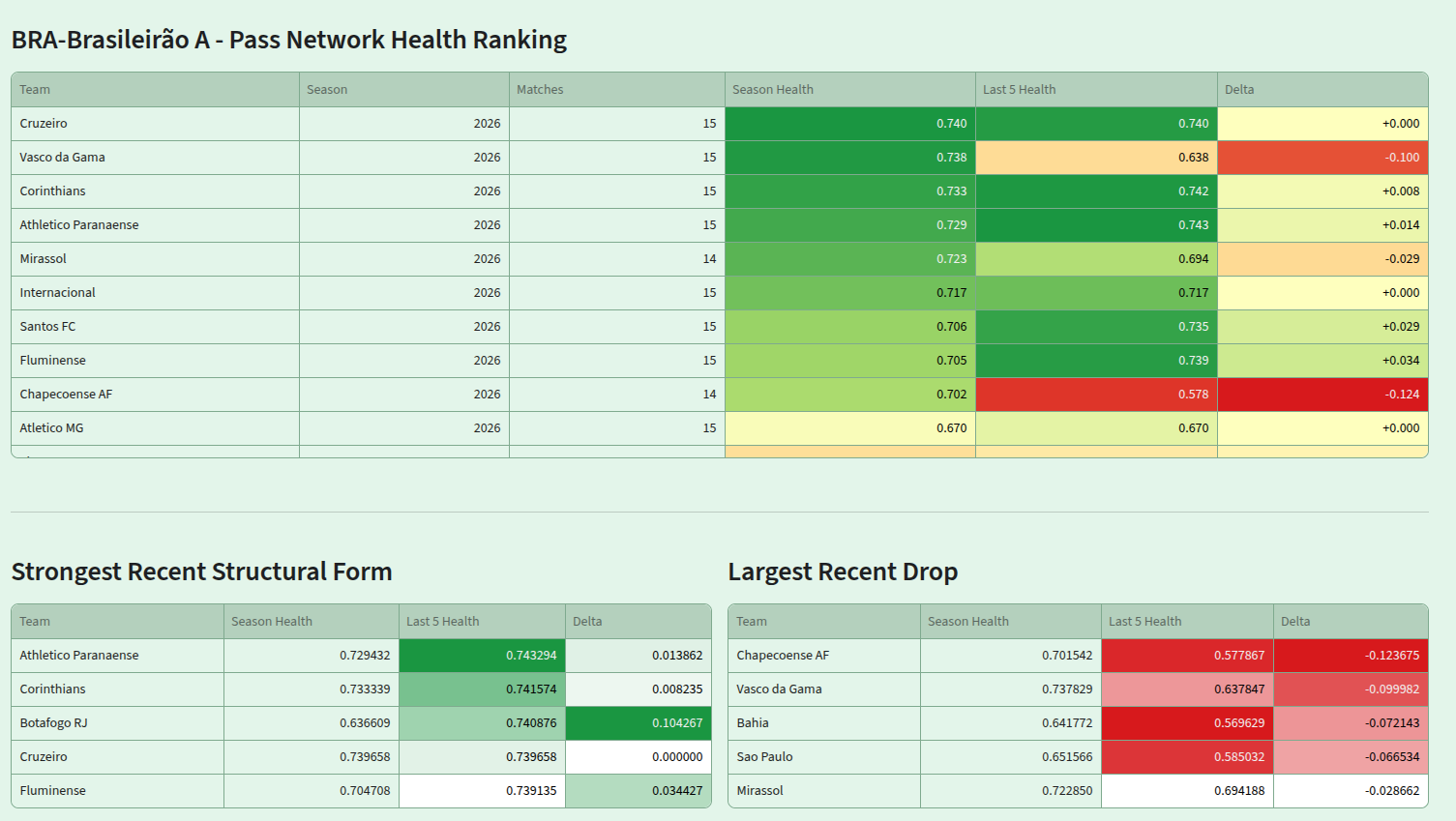
One of the biggest updates to the Football Hacking web app is the inclusion of Network Health diagnostics across major leagues.
The platform now allows users to monitor:
season structural health,
recent structural trends,
health variation,
structural superiority signals.
Alongside:
Poisson probabilities,
Dixon-Coles adjustments,
Monte Carlo simulations,
fair odds,
league dispersion metrics,
betting diagnostics.
You can explore the platform here:
If you are serious about football betting, football trading, or tactical analysis, combining probabilistic models with structural diagnostics can dramatically improve contextual understanding.
Why Pass Networks Matter More Than Most People Think
Pass networks are not simply pretty visualizations.
They reveal:
progression routes,
overloaded corridors,
unstable circulation,
isolated connectors,
buildup asymmetry,
pressure escape patterns,
collective support relationships.
And perhaps most importantly:
They reveal tendencies before the final actions occur.
That is an enormous advantage.
Because football markets often react AFTER visible outputs appear.
Structure often changes first.
The Difference Between Results and Sustainability
This is one of the most important concepts in football analytics.
Results are not always sustainable.
A team may:
win several matches,
outperform xG,
convert difficult chances,
while its underlying structure gradually deteriorates.
Eventually:
pressure resistance breaks,
buildup becomes unstable,
progression efficiency falls,
defensive balance weakens.
Network Health attempts to measure those deeper collective dynamics.
Why Relative Structural Superiority Matters More Than Absolute Health
One of the strongest conclusions from the study was this:
Absolute health matters less than relative superiority.
In football, confrontation is relative.
A team with a health score of:
0.72
may dominate against:
0.58
but struggle badly against:
0.76
That is why:
health_diff
became the most important variable.
And that is highly aligned with real football logic.
What Still Needs To Be Tested
Although the findings are promising, this is not a finished predictive model yet.
Several important steps still need to be explored:
out-of-sample testing,
cross-season validation,
calibration curves,
betting ROI testing,
comparison against closing market odds,
interaction with xG models,
league-specific structural behavior.
That next stage is extremely important.
Because the ultimate question becomes:
Does Network Health contain information the market is not fully pricing yet?
That is where genuine betting edges emerge.
Why This Is So Interesting for Football Trading
For football traders specifically, the implications are huge.
Because traders are not necessarily trying to predict:
exact scores,
exact outcomes.
They are trying to identify:
momentum shifts,
structural deterioration,
sustainability,
pressure instability,
tactical mismatches.
And structure tends to evolve before the scoreboard reacts.
That timing advantage matters enormously.
The Future of Football Analytics Is Structural
Football analytics is slowly moving away from pure event counting.
The next frontier is understanding:
interaction,
connectivity,
support,
occupation,
collective dynamics,
spatial relations.
That is why pass-network analysis has so much long-term potential.
Not because it looks sophisticated.
But because football itself is fundamentally relational.
Final Thoughts
The most important conclusion from this study is not:
“Network Health predicts football perfectly.”
No metric does.
The important conclusion is this:
Structural superiority is statistically associated with better football outcomes.
That alone is already highly valuable.
Especially because the metric is:
tactically interpretable,
statistically significant,
structurally grounded,
and operationally useful for traders and analysts.
And honestly?
We are probably still only scratching the surface of what structural football analysis can reveal.
Explore Network Health Inside the Football Hacking Web App
The Football Hacking platform now includes Network Health diagnostics for major leagues alongside:
Poisson models,
Monte Carlo simulations,
fair odds,
betting diagnostics,
league dispersion analysis,
and structural football intelligence.
Explore the platform here:
If you want to combine:
probabilistic betting models,
structural pass-network analysis,
tactical football intelligence,
and quantitative diagnostics,
this is exactly what the platform was built for.