

Disclaimer:
This analysis is based exclusively on network structure data and expected threat (xT) patterns. No images, screenshots, visualizations, or video frames were used as analytical inputs.
When most football fans see Norway and France on opposite sides of a fixture list, the immediate reaction is predictable.
France are viewed as one of the global superpowers of international football. Norway are often seen as a dangerous outsider built around elite individual talent.
But beneath the surface, this matchup is far more intriguing than reputation alone suggests.
Norway enter this game with a clearly identifiable attacking structure, a defined progression model, and one of the most coherent player interaction networks among emerging European sides. More importantly, they possess something that often creates problems for elite teams: a repeatable pathway from midfield control into high-value attacking situations.
The key question is not whether Norway have talent.
The key question is whether Norway can consistently access their strongest progression routes against one of the world’s most talented squads.
The answer may surprise many observers.
Norway’s Real Strength Is Not Possession
Many teams are labeled as possession-based because they complete a large number of passes.
Norway are different.
Their strength is not possession for the sake of possession.
Their strength is progression.
This distinction matters.
A possession-focused team often prioritizes ball retention above all else. Norway, however, use possession as a vehicle to reach dangerous zones. Their attacks are designed to generate territorial gain and move the game closer to goal rather than simply circulate the ball.
This creates a profile that is significantly more dangerous than many casual observers realize.
The Norwegian attack consistently generates value through forward progression, final-third entries, and coordinated movement between midfield creators and attacking finishers.
When those mechanisms are functioning properly, Norway become extremely difficult to contain.
Martin Ødegaard Is The Engine Of Everything
Every successful attacking system has a central reference point.
For Norway, that player is Martin Ødegaard.
His influence goes far beyond assists, key passes, or chance creation.
Ødegaard acts as the connective tissue that links every phase of the Norwegian attack.
He is:
The primary progression facilitator
The main connector between defensive buildup and attacking play
The central organizer of possession sequences
The player responsible for maintaining attacking continuity
When Norway build momentum, Ødegaard is almost always involved.
His positioning allows him to receive under pressure, connect multiple passing lanes, and accelerate attacks toward more valuable areas of the pitch.
Against France, his role becomes even more important.
If Norway are going to create meaningful attacking opportunities, Ødegaard must receive facing forward rather than being forced into deeper reset situations.
The more frequently he can operate between lines, the more dangerous Norway become.
Erling Haaland Is More Than A Goalscorer
The popular narrative around Erling Haaland focuses almost exclusively on finishing.
That view misses a huge part of his tactical importance.
Haaland serves two critical functions within Norway’s structure.
First, he acts as a fixation point.
Defenders constantly adjust their positioning around him. Entire defensive units become occupied by his movement.
Second, he acts as a rupture mechanism.
His runs create instability.
His positioning forces defensive decisions.
His movement opens spaces for teammates.
This means Norway’s attack is not simply a matter of Ødegaard creating and Haaland finishing.
Instead, both players participate in a dynamic interaction that repeatedly creates value.
When the pair successfully combine, Norway become capable of producing dangerous sequences against any opponent in world football.
Including France.
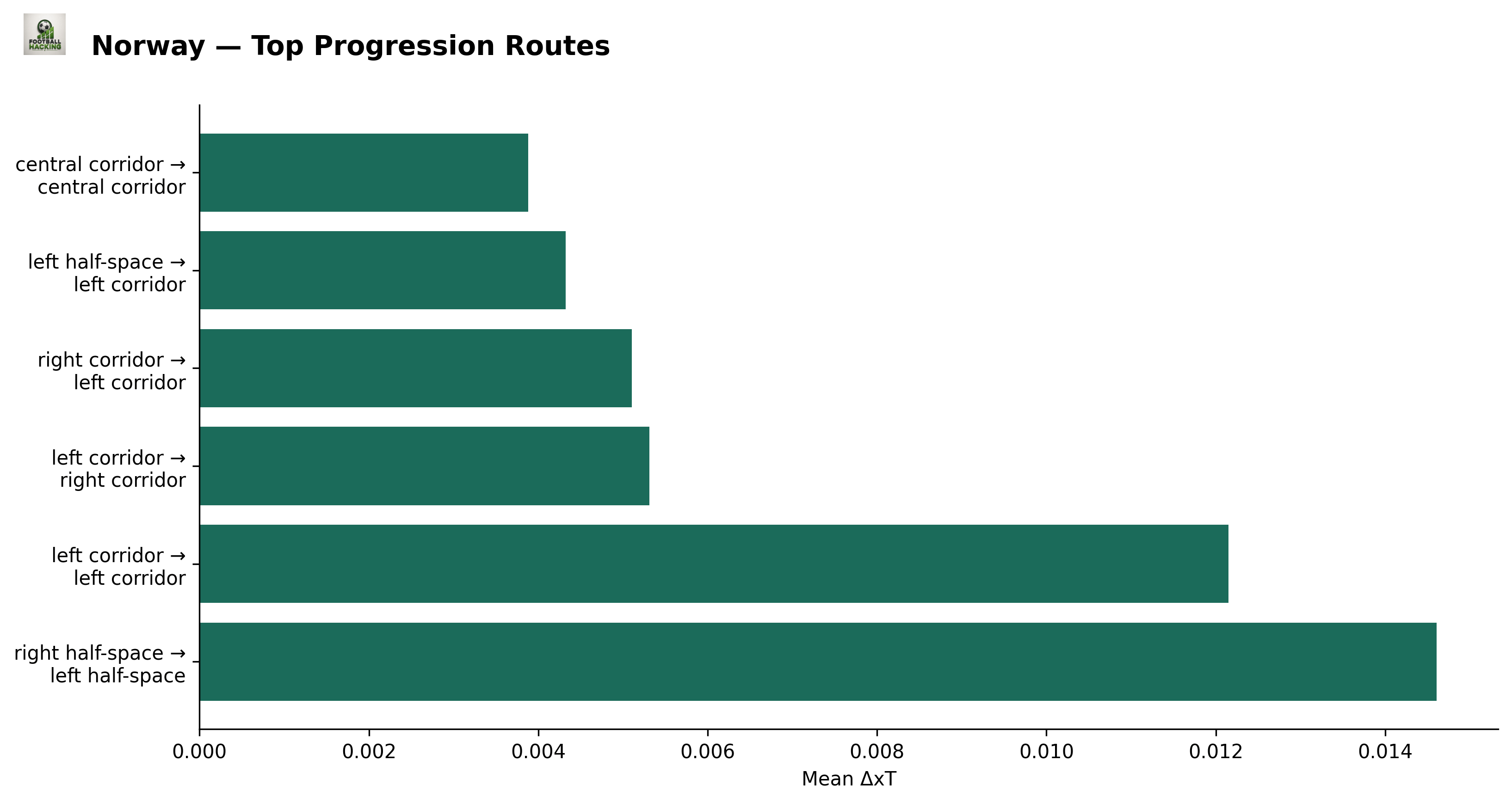
The Route France Must Fear
Every attacking team has preferred patterns.
Norway’s most valuable attacking route follows a very specific pathway.
The attack frequently begins in the right interior channel.
Pressure is attracted toward that side.
Once the defensive structure shifts, Norway exploit the opposite side.
The attack then progresses toward the left half-space or left corridor in advanced areas.
This cross-field progression pattern repeatedly generates positive attacking value.
The reason it works is simple.
Defenses naturally compress around the ball.
Norway use that reaction against them.
They lure pressure into one area before exploiting the newly created space elsewhere.
Against elite opponents, creating numerical superiority is difficult.
Creating positional superiority is much easier.
Norway understand this concept exceptionally well.
Why The Right Half-Space Is Norway’s Most Dangerous Zone
Modern football is increasingly decided in half-spaces.
Norway are no exception.
The right half-space serves as the launch pad for many of their most dangerous attacks.
Several factors make this area so important:
Better passing angles
Players receive more options than they would near the touchline.
Superior progression opportunities
Forward passes become easier to execute.
Increased unpredictability
Defenders struggle to determine whether the attack will continue centrally, move wide, or switch play.
Faster access to final-third spaces
Attacks can accelerate rapidly from this zone.
Norway’s strongest sequences frequently begin here before transitioning into more advanced areas.
If France allow repeated access to this region, they may find themselves defending far more dangerous situations than expected.
Norway’s Midfield Battle Could Decide The Match
The heart of this game will likely be midfield.
Not because Norway dominate possession.
Not because France dominate possession.
But because Norway’s progression system depends heavily on midfield stability.
When Norwegian midfielders establish rhythm, the attack becomes fluid.
Passing networks strengthen.
Progression accelerates.
Final-third entries increase.
Attacking pressure accumulates.
When midfield control disappears, the entire structure becomes harder to sustain.
That makes the central battle one of the most important tactical themes of the match.
Sander Berge’s Hidden Importance
Martin Ødegaard receives most of the headlines.
Erling Haaland receives most of the attention.
Sander Berge may be the player who quietly determines whether Norway’s system functions.
Berge absorbs a massive amount of responsibility during buildup phases.
He provides security.
He stabilizes circulation.
He allows attacking players to position themselves higher.
In many ways, he acts as the foundation beneath Norway’s more visible stars.
Against France’s athletic midfielders, his ability to maintain structure could prove decisive.
If you found this breakdown valuable, you’ll love Football Hacking.
Our platform goes beyond traditional stats, combining network analysis, expected threat (xT), tactical diagnostics, and performance modeling to reveal hidden patterns inside every match.
Norway’s Alternative Route Through Alexander Sørloth
Elite teams need multiple solutions.
Norway possess one.
Alexander Sørloth offers a completely different pathway into attack.
Rather than progressing exclusively through midfield combinations, Norway can bypass pressure and attack directly.
This creates tactical flexibility.
If France successfully disrupt central buildup, Norway are still capable of advancing through longer connections toward Sørloth.
His physical presence allows Norway to:
Retain possession higher up the pitch
Win aerial duels
Create second-ball situations
Generate attacking continuity without extended buildup
This alternative route prevents opponents from focusing exclusively on Ødegaard and Haaland.
The Defensive Side Of Norway’s Identity
Norway’s reputation is often centered around attack.
That overlooks a major strength.
They are surprisingly effective at disrupting opponent rhythm.
Their defensive approach frequently slows attacking sequences and reduces continuity.
This matters against elite teams because many world-class attacks depend on rhythm.
Break the rhythm.
Slow the tempo.
Force additional decisions.
Create hesitation.
Those small disruptions can dramatically reduce attacking efficiency.
Norway have shown an ability to impose exactly this type of defensive discomfort.
How Norway Can Create Problems For France
If Norway are going to win, several tactical conditions must emerge.
1. Ødegaard Must Receive Facing Forward
Everything begins here.
Forward-facing receptions allow Norway to accelerate progression and create instability.
2. Haaland Must Occupy Multiple Defenders
The more defensive attention Haaland attracts, the more space becomes available elsewhere.
3. The Right Half-Space Must Remain Accessible
This is Norway’s most productive launching zone.
Repeated access dramatically increases attacking value.
4. Cross-Field Switches Must Be Effective
Norway’s strongest progression routes often involve moving pressure to one side before attacking the other.
5. Midfield Stability Must Be Preserved
Without midfield continuity, Norway’s attack becomes far less dangerous.
Why This Match Could Be Closer Than Expected
Many previews focus primarily on talent disparities.
Football rarely works that way.
Matches are often decided by structural interactions rather than individual reputation.
Norway possess:
Elite attacking talent
Clear progression mechanisms
Strong midfield connectivity
Defined attacking routes
Multiple methods of advancing play
Those characteristics create a team capable of challenging superior opponents.
Especially in tournament football.
Especially in single-match scenarios.
Especially when momentum begins to shift.
The Haaland-Ødegaard Partnership Could Define The Group
Few national teams possess a creator-finisher partnership as dangerous as Norway’s.
The combination of:
Ødegaard’s vision
Haaland’s movement
Norway’s progression routes
Midfield support underneath
creates a foundation capable of generating high-quality opportunities against elite opposition.
This partnership remains Norway’s most powerful weapon.
And France will spend significant portions of the match trying to disrupt it.
Can Norway Actually Beat France?
The answer is yes.
Not because Norway are superior.
Not because France are vulnerable.
But because Norway possess a tactical framework that can generate meaningful attacking value against high-level opposition.
Their best pathway is clear:
Control progression through midfield.
Use Ødegaard as the central connector.
Allow Haaland to destabilize defensive structures.
Exploit the right half-space.
Attack the far side.
Maintain attacking continuity.
When these elements align, Norway become far more than an underdog.
They become a legitimate threat.
And if they can consistently access those patterns, France may discover that this is not the routine group-stage fixture many expect.
It could become one of the most fascinating tactical battles of the tournament.