

👉 Quick note before we dive in:
If you want to move beyond intuition and start thinking like a data-driven bettor, subscribe to the Football Hacking newsletter and explore the Football Hacking Web App.
Everything you’re about to read—Poisson modeling, Dixon-Coles adjustments, Monte Carlo robustness—is already being applied there in real scenarios.
And one important detail:
this is an ongoing research process.
More leagues are constantly being studied, refined, and added—so the insights you’ll see here are just the beginning of a much deeper framework that keeps evolving.
The Hidden Layer Most Bettors Ignore
Most people think they’re analyzing matches.
They’re not.
They’re reacting to narratives, recent results, or market movement.
But if you’re using a Poisson model—especially with a Dixon-Coles adjustment—you’re already operating at a different level. And once you introduce league-specific base and slope parameters, you unlock something even more powerful:
You stop modeling matches… and start modeling league behavior.
And that changes everything.
The Core Idea (Without Overcomplicating It)
At the heart of this approach is a simple but profound adjustment:
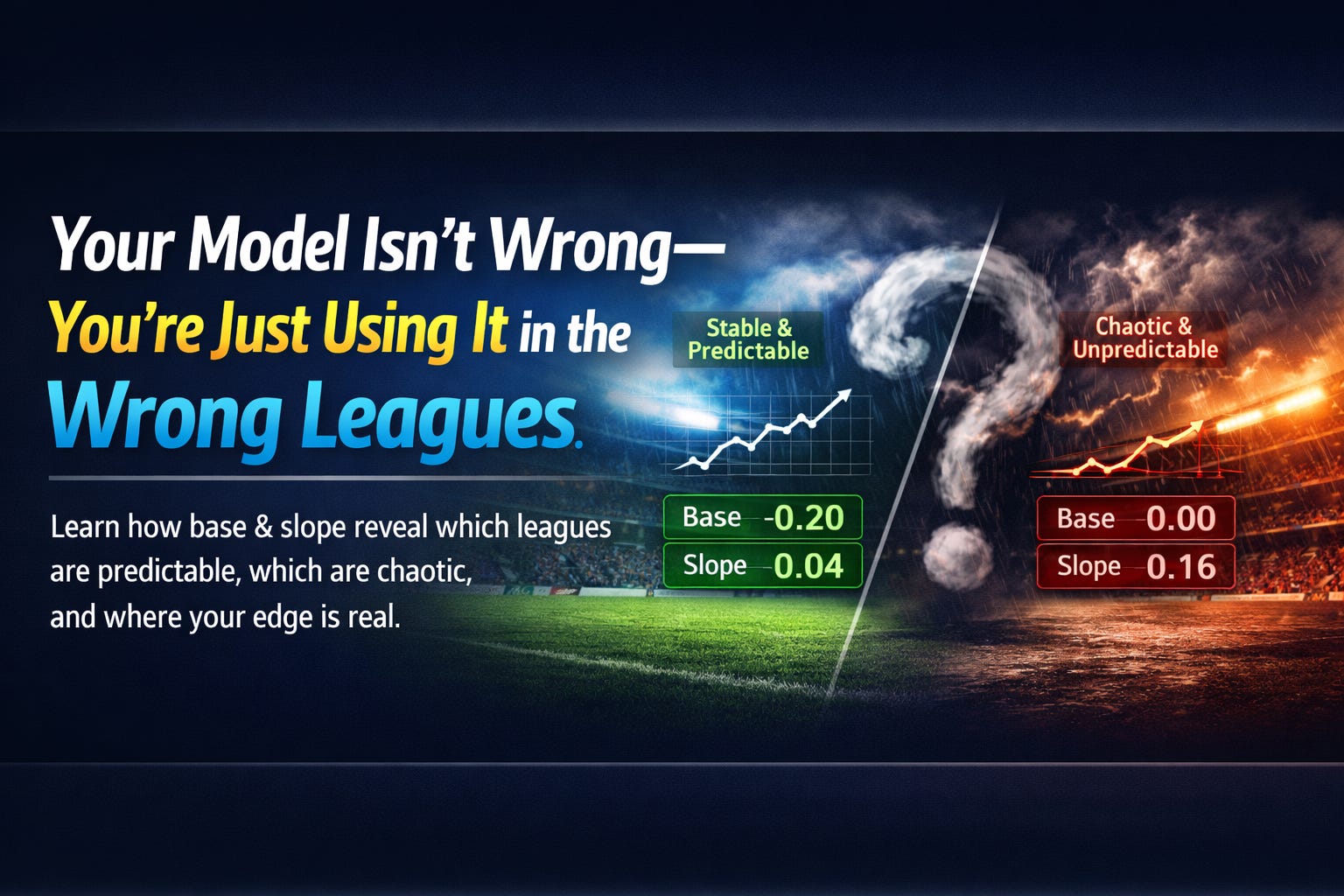
rho = base + slope * (d_total_goals - 1)This is not just math—it’s interpretation.
Base tells you how structured a league is
Slope tells you how that structure reacts to instability
Together, they define:
Predictability
Stability
Reliability of your model
And ultimately:
Whether your edge is real—or just noise.
Base: The Structural DNA of a League
Think of base as the league’s personality when everything is “normal.”
When dispersion is around 1 (i.e., matches behave close to Poisson expectations), base defines how much low-score outcomes deviate from independence.
What the Data Tells Us
Across the leagues you’ve calibrated, a pattern emerges very clearly:
🔹 Strongly Negative Base (≈ -0.20)
Leagues like:
LaLiga
Serie A
Ligue 2
Eredivisie
These are leagues with strong structural discipline.
Matches tend to:
Follow tactical expectations
Respect game state
Produce more “controlled” outcomes
👉 In practical terms:
These leagues are predictable—not in outcomes, but in distribution of outcomes.
