

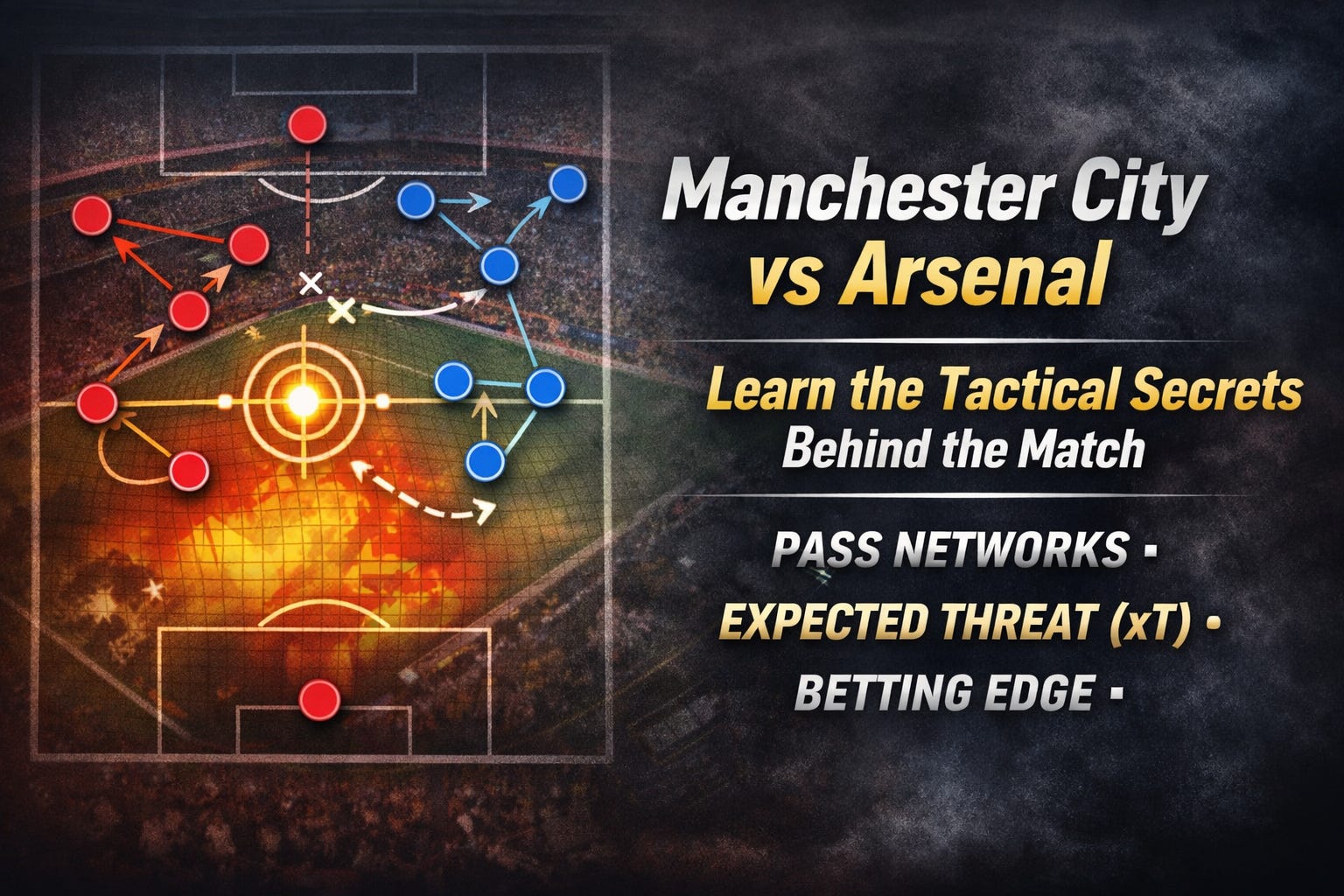
This analysis is grounded in a data-driven framework built on pass network structures and Expected Threat (xT). Rather than relying on surface-level metrics, it evaluates how each team organizes possession, how value flows through their passing network, and how attacking sequences evolve under pressure. By combining network centrality, progression patterns and xT dynamics, the objective is to translate what is typically seen qualitatively on the pitch into measurable, repeatable insights — revealing not just where teams play, but how and why their structure generates or destroys value.
Most people will watch Manchester City vs Arsenal trying to answer a simple question:
Who is playing better?
That question is not just incomplete — it actively leads you to the wrong conclusion in this type of match.
Because this is not a game where territorial dominance, possession share, or even isolated chance creation will give you a reliable read. Both teams will have control phases. Both teams will reach their preferred zones. Both teams will produce moments that look like superiority.
And yet, the match will not be decided there.
It will be decided in something much more fragile:
What happens when structure meets resistance.
This is a game where control is constantly tested, where attacking sequences are repeatedly challenged, and where the difference between sustained threat and structural collapse often comes down to a single moment of pressure.
And that is exactly what you should be tracking live.
At the end of this article, there is a live betting checklist designed to help you identify when the match is actually shifting — not when it simply looks like it is.
Poisson probabilities and fair odds
Before getting into the structural layer, the probabilistic baseline already tells you something critical — and it goes against the intuitive narrative.
From the Poisson matrix:
Manchester City win: 42.00%
Draw: 32.86%
Arsenal win: 25.13%
Fair odds:
Manchester City: 2.38
Draw: 3.04
Arsenal: 3.98
This is not a dominant-favorite game.
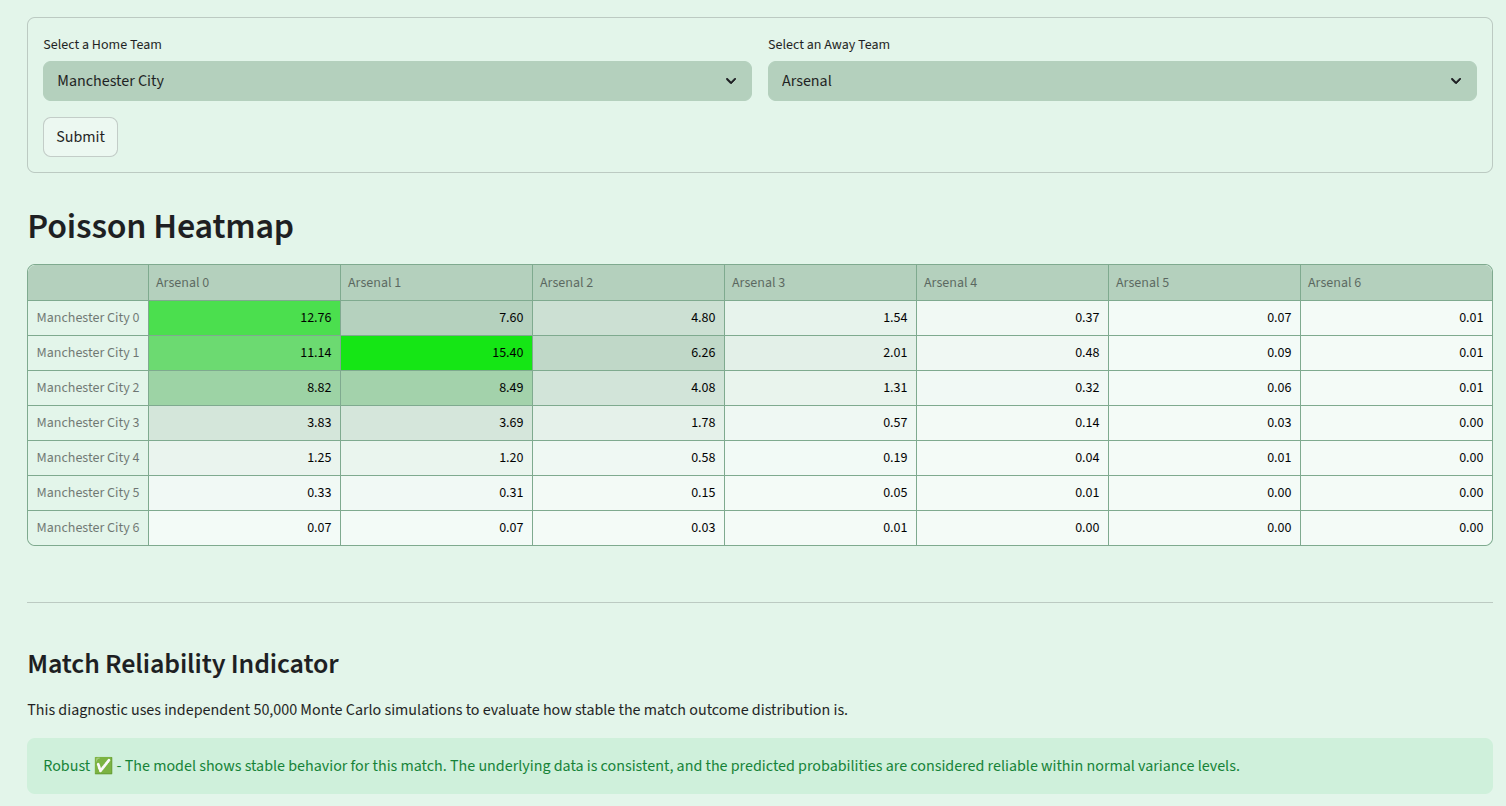
The draw probability is extremely high, which usually signals a very specific type of match:
prolonged control phases
structural cancellation
limited clean separation
In other words, a match where both teams can impose their structure — but neither can consistently convert that structure into value without something breaking first.
That’s the key dynamic:
This match is structurally stable… until it isn’t.
And when that break happens, it tends to be decisive.
If you want to explore full score distributions and simulation layers, the complete model is available here:
https://app.footballhacking.com
Structural collision
This is not a matchup defined by stylistic opposition in the simple sense of possession versus control.
It is a matchup between two teams that both want to regulate the game through structure, but do so with different value maps.
Manchester City arrive as the more efficient attacking system and the more forceful defensive influence. Arsenal arrive as the more conservative progression structure, with a clearer commitment to central access in the final-third approach, but with weaker attacking conversion from that access.
Both teams show a midfield bottleneck profile, which means the match is likely to be decided less by raw territorial occupation and more by what happens when circulation reaches congestion.
The key question is not who has the ball.
It is which team can preserve value after first resistance.
Structural collision in practice: left vs center
City’s attacking map is tilted toward the left corridor as the main final-third entry lane.
That does not mean they are purely left-sided; it means their possession structure repeatedly finds its most stable route into advanced territory there. They can originate from the left corridor and remain on the left, or begin centrally and still finish on the left. The left corridor is therefore not just a wing outlet but a destination corridor for the whole structure.
Arsenal, by contrast, prefer to progress into the final third through the central corridor. Their highest-frequency and one of their highest-value patterns both terminate centrally, and their strongest value route comes from the right half-space into the central corridor.
Structurally, Arsenal want the game to narrow near the box.
City want to stretch it first and often land on the left before deciding whether to attack the box or recycle.
So the collision is clear:
City want to draw Arsenal across the width and then stabilize on the left corridor.
Arsenal want to protect central access and use central occupation as their own launch point.
Resistance should therefore appear in two main zones.
First, Arsenal will try to compress City’s access once City circulate through midfield and begin leaning toward the left corridor.
Second, City will try to suffocate Arsenal’s central progression before it can become a stable final-third platform.
What happens after resistance is where the matchup separates.
Response to resistance: the central asymmetry
City’s resistance-response profile is mostly constructive.
Even under pressure, they still produce progressive escapes, especially from the right half-space or central defensive zones into advanced territory. That tells you their structure can absorb pressure and still re-emerge facing forward.
Arsenal’s response profile is less stable.
Under resistance in midfield-right or advanced central zones, they are more likely to produce forced value loss, lateral escape, or backward escape.
In structural terms, Arsenal can still reach their preferred zones, but they are less reliable at preserving attacking continuity when the opponent contests the route.
That is the central asymmetry of the match.
Progression pattern
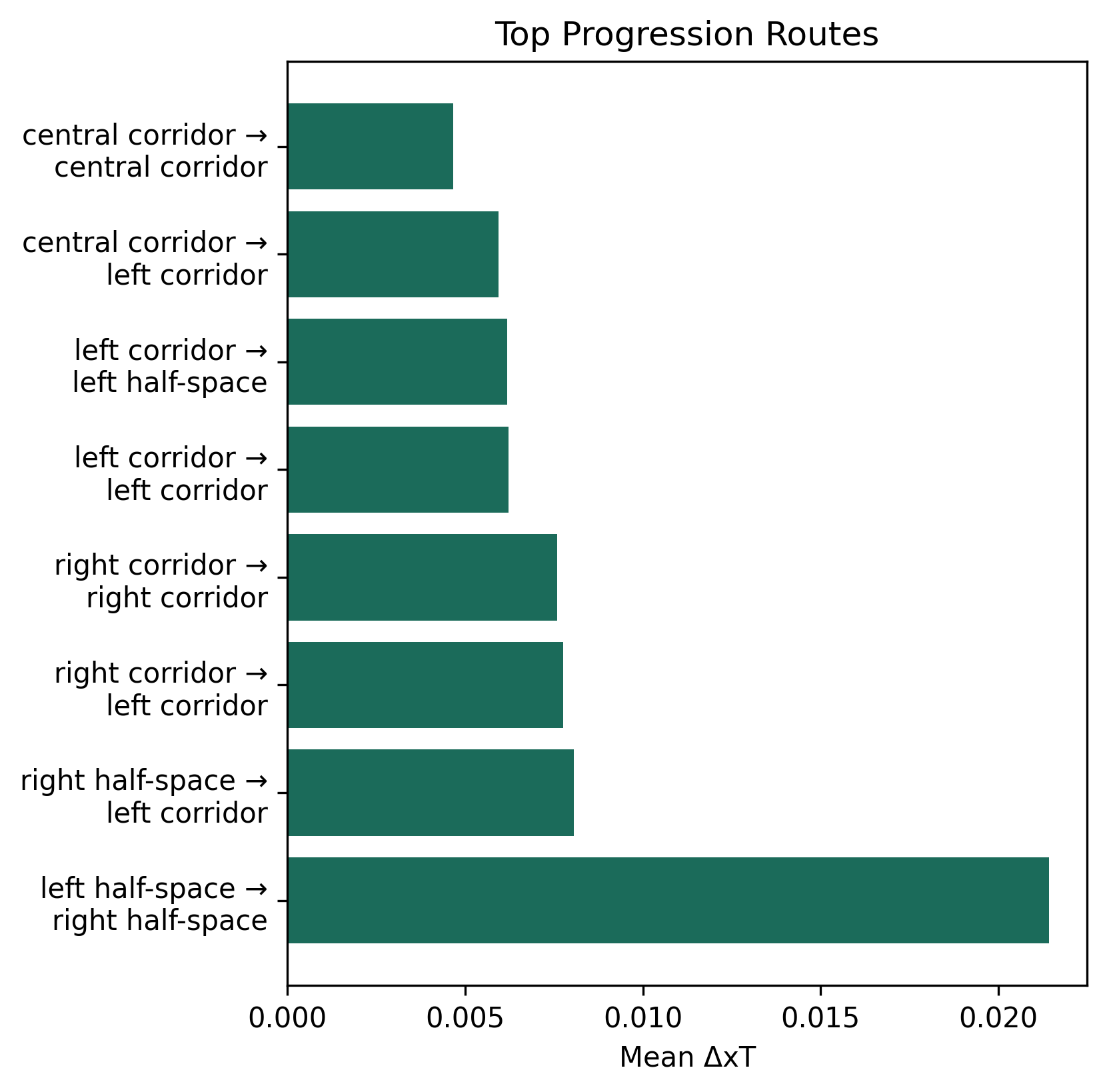
City’s progression pattern is built around recurrence rather than one direct lane.
The most frequent route is left corridor to left corridor, followed closely by central corridor to left corridor. That indicates a system that uses central circulation as a drawing mechanism and the left corridor as the release point.
There is also an important cross-structure pattern:
left half-space → right half-space
This carries very high value relative to its frequency.
That suggests City are not merely wing-loading; they are using one side to disorganize the block and then attacking the far half-space with greater threat.
So City’s underlying pattern looks like this over time:
circulation forms → pressure invited → ball reaches left corridor → second wave → structural relocation
The key point is continuity.
The first entry is often not the decisive one.
The decisive action is frequently the next structural relocation.
Arsenal progression pattern
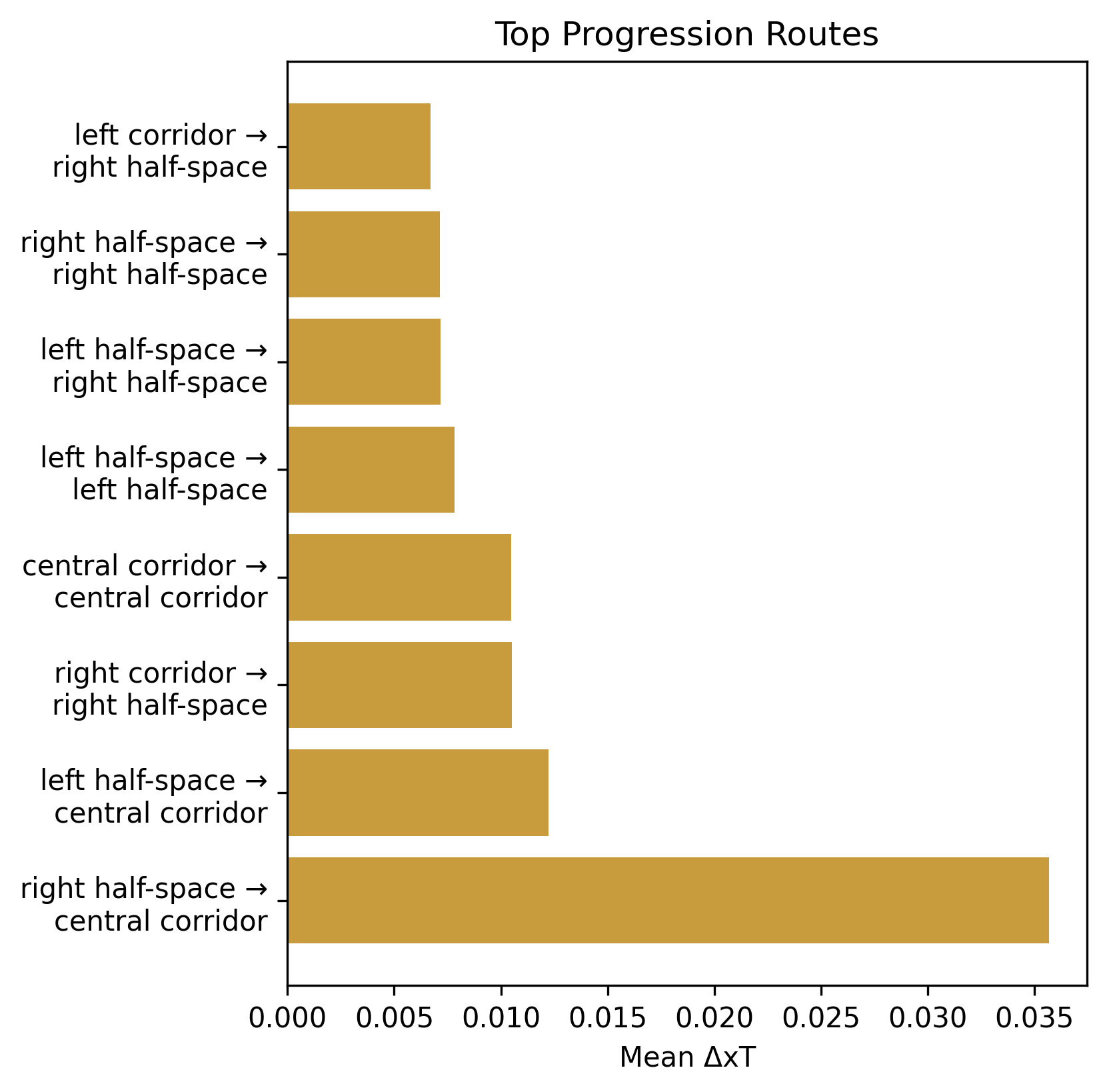
Arsenal’s progression pattern is narrower and more vertical in intent.
Central corridor to central corridor is their dominant route by volume, and it also carries solid value.
But the most important pattern is right half-space to central corridor, which generates by far the highest value among their listed routes.
That means Arsenal’s best attacking progression is not simply “through the middle.”
It is created when the right half-space becomes the launching pad for central access.
There is also a strong left half-space to central corridor route, so the system can feed the center from either interior lane.
But the right-to-central connection appears to be the sharper one.
🔒 Continue reading to unlock the full breakdown of frequency vs value, defensive reactions, attack continuity and the live betting checklist for this match.
