

Manchester United’s 2025/26 season tells a very specific story — one that doesn’t show up in traditional stats, league tables, or even most tactical breakdowns.
On the surface, this is a team that:
progresses the ball consistently
reaches the final third at high volume
imposes territorial control
But underneath, there’s a structural contradiction:
United can arrive in dangerous zones. They just can’t consistently stay there.
That single idea explains almost everything about their season.
Where Manchester United Stand in the Table (Probabilistic View)
Manchester United currently sit 3rd in the table with 55 points, but their position becomes much more interesting when we look at probabilistic outcomes rather than just the standings.
According to the model:
Title probability: 0.0%
2nd place: 0.68%
3rd place: 33.48%
4th place: 37.05%
5th place: 18.29%
6th place: 6.80%
Lower positions quickly become negligible.


What this actually means
United are not in a title race.
They are in a tight distribution around Champions League qualification.
The model concentrates ~70% of outcomes between 3rd and 4th place.
That’s crucial.
Because it tells us:
The team is structurally competitive
But lacks the consistency to break into the top tier (Arsenal/City level)
The key interpretation
This is not a volatile team.
It’s a bounded team.
Their performance distribution is narrow — but capped.
They are very likely to:
stay in the top 4 fight
finish near their current position
But very unlikely to:
collapse
or overperform into a title push
Why this matters for the analysis
This probabilistic profile perfectly matches what we see in the structure:
Strong progression → keeps them competitive
Weak final-third continuity → prevents elite jump
In other words:
The table is not lying.
It’s just incomplete without structure.
⚡ Want to see this before the match even starts?
If you’re reading this and thinking “this is exactly the kind of edge I need pre-match” — that’s literally what the Football Hacking app is built for.
👉 https://app.footballhacking.com/
Inside the app you get:
Poisson + Dixon-Coles probabilities (not xG guesses — actual betting-grade modeling)
Monte Carlo robustness analysis (is the edge stable or fragile?)
League-specific calibration (ρ adjustment) — no generic models
Full probability matrices (correct score, match odds, BTTS, totals)
This isn’t just prediction.
It’s decision support under uncertainty.
Structural Identity: Multi-Entry, Center-Finishing
Manchester United are not predictable in how they build.
They are predictable in where the move becomes dangerous.
The data shows:
Central → Central progression
62.4% of entries
+0.0203 ΔxT
Left half-space → Central
+0.0184 ΔxT
Right half-space → Central
+0.0224 ΔxT
This creates a very clear identity:
Multiple entry points. One payoff zone: the central corridor.
That’s actually a good thing.
It means:
flexibility in buildup
consistency in attacking intention
But it also creates a hidden risk…
What is ΔxT (Delta Expected Threat)?
ΔxT measures how much a single action increases or decreases a team’s probability of creating a goal.
In simple terms:
Positive ΔxT → the action moves the ball into a more dangerous area
Negative ΔxT → the action reduces attacking potential
Unlike basic stats, ΔxT doesn’t just track possession — it tracks how valuable that possession becomes over time.
The Real Problem: Final-Third Instability
United average:
95.8 final-third passes per match
That’s elite territory access.
But:
Final-third net value: negative
This is where things break.
They:
arrive well
circulate poorly after arrival
lose attacking value after first contact
This is not a creativity issue.
It’s a continuity problem.
Progression Patterns That Actually Work
1. Central progression is real (not cosmetic)
This isn’t sterile possession.
High frequency + high ΔxT means:
United genuinely break lines through the middle.
2. Left half-space = decision hub
From this zone, United can:
go inside (high value)
go wide (low value)
recycle
But here’s the key:
Inside continuation is ~3x more valuable than wide continuation.
That’s a decision-making bottleneck, not a structural one.
3. Right side only works if it collapses inward
Right-sided play becomes dangerous only when:
it feeds the central corridor
Otherwise, it becomes:
possession without threat
width without penetration
The Network: Bruno Fernandes Is the System
This isn’t subtle.
Bruno dominates:
Load centrality → 9 matches
Closeness → 14
Eigenvector → 13
PageRank → 15
That’s not influence.
That’s structural dependency.
What that means in practice
Bruno = organizer
Casemiro = stabilizer
Shaw / Lisandro = left-side continuity
Dalot = outlet
This is a hierarchical network, not a distributed one.
And that matters because:
When Bruno is disrupted, the entire system loses coherence.
Hidden Mechanism: Progression via Reset
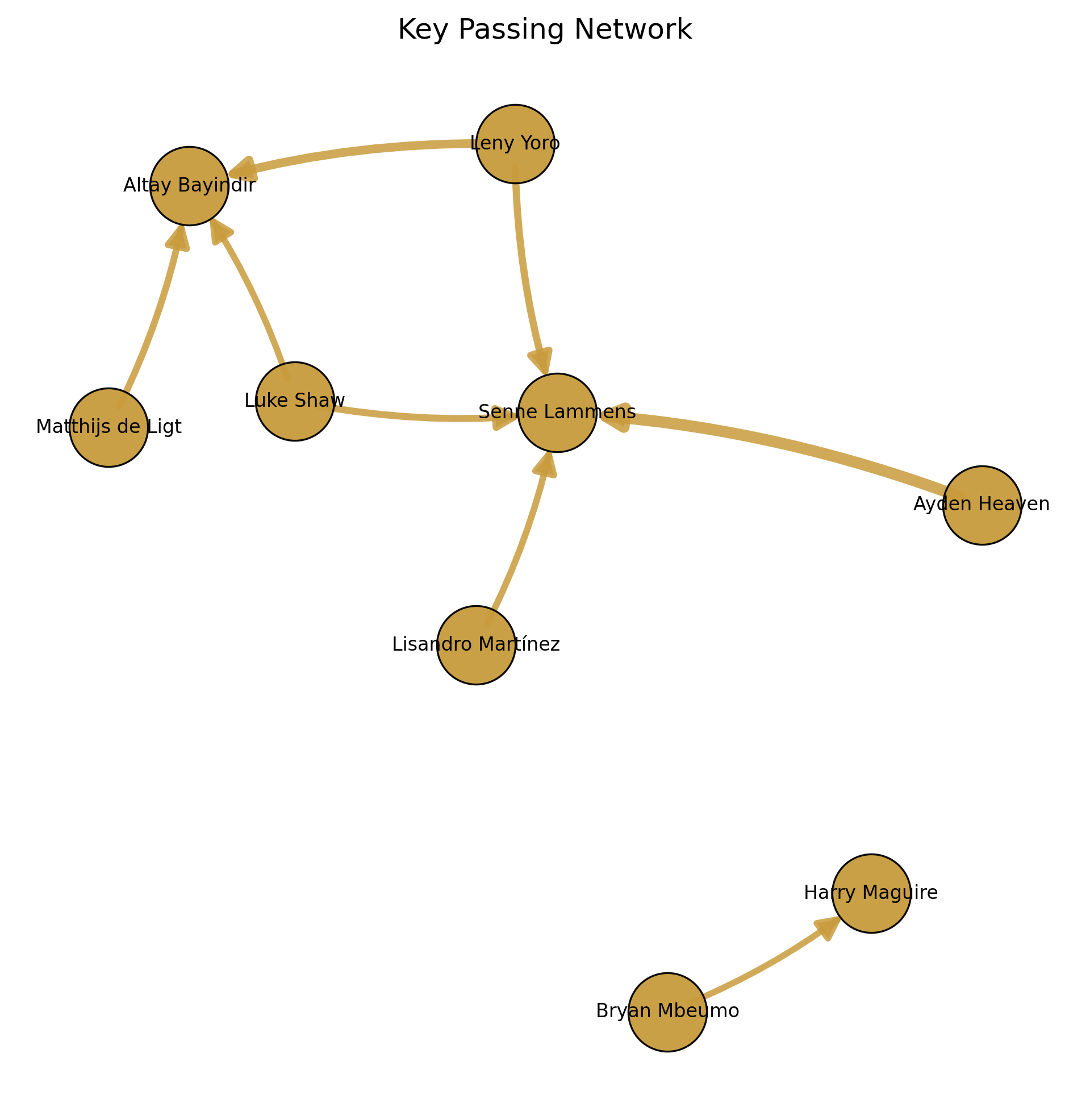
Some of the strongest edges in the network are:
Defender → Goalkeeper
Deep reset → Relaunch
Example:
Shaw → Lammens
Lisandro → Lammens
This tells us:
United often recover structure by going backwards.
That’s not inherently bad.
But it becomes a problem when combined with…
Dead Circulation Loops
Negative-value connections include:
De Ligt → Shaw
Yoro → Dalot
Mazraoui → De Ligt
These are:
horizontal
outward
low-threat
They:
keep possession
kill momentum
This is where attacks quietly die.
Defensive Reality: Control Without Destruction
United’s defensive profile is fascinating.
Territorial pressure: 0.999 (elite)
Suppression: 0.672
Destabilization: 0.425
Translation:
They control where the game happens… but not always how it ends.
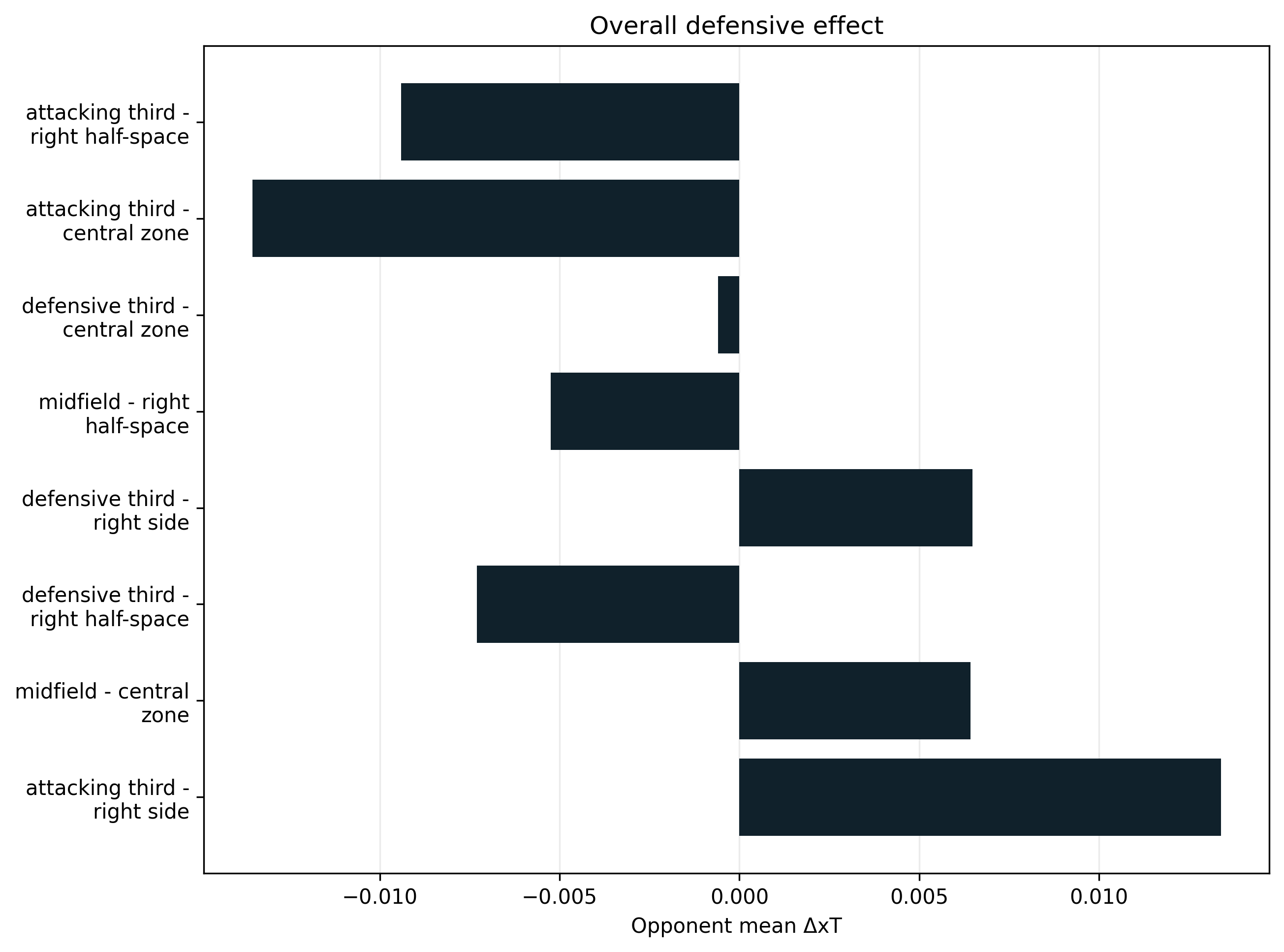
Where they actually hurt opponents
Attacking third (central)
negative opponent ΔxT
Right half-space (high)
Midfield right half-space
This is where pressing works.
Where they don’t
Defensive third (central): high volume, low impact
Defensive right side: even positive opponent ΔxT
Meaning:
When the press is broken, the structure behind it is vulnerable.
Resistance Response: Where Attacks Collapse
This is the key weakness of the season.
After pressure:
Instead of:
staying near the action
They:
reset wide or deep
lose ΔxT
Examples:
Final third → midfield reset → negative value
Half-space → defensive third → loss of threat
This confirms the core diagnosis:
United lose continuity after resistance.
Home vs Away: Two Versions of the Same Team
At Home
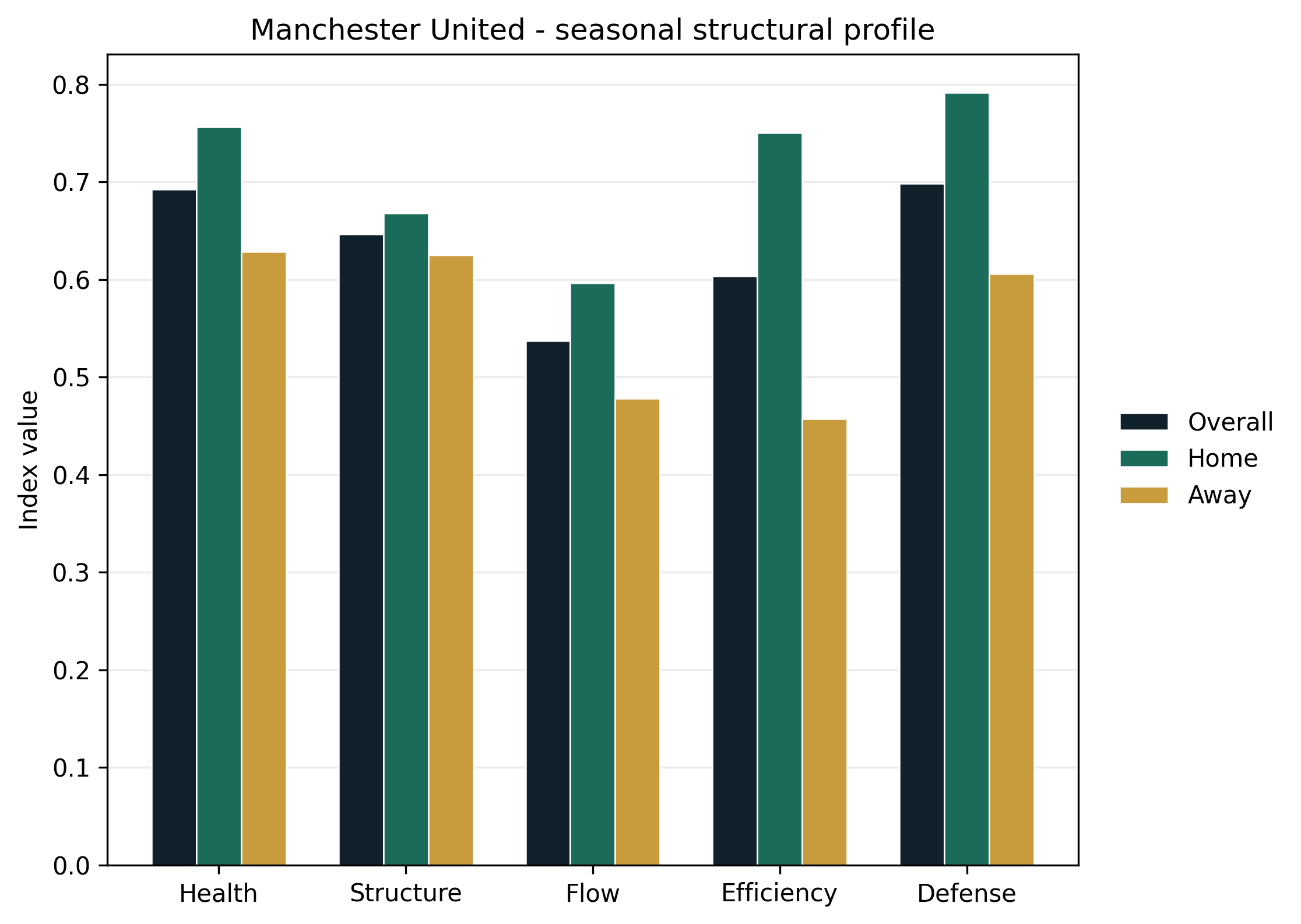
xT per 100 passes: 0.794
Final-third net: positive
Defensive influence: 0.791
This is the functional version of United.
broader progression
stable final-third play
bottleneck stays in midfield
Away
xT per 100 passes: 0.368
Final-third net: negative
Efficiency drops sharply
Here:
progression still exists
but breaks later
continuity collapses in attack
Most important stat:
Bottleneck reaches the final phase in 31% of away matches (vs 0% at home).
⚡ If you’re betting or trading this team…
You don’t need more opinions.
You need structure + probability.
That’s exactly what the app gives you:
👉 https://app.footballhacking.com/
Use it to:
compare your read vs model probabilities
detect over/undervalued markets
measure risk (Monte Carlo robustness) before entering
Because spotting patterns is step one.
Knowing when to trust them is step two.
Structural Risk Summary
There are three core vulnerabilities:
1. Final-third breakdown
Access is not the issue.
Retention is.
2. Wide/deep recycling
Kills attacking momentum.
3. Defensive gaps (right side, deeper zones)
Expose the team after press bypass.
Final Tactical Insight
Manchester United are:
A Bruno-led, center-finishing system with strong access — but fragile continuity.
They can:
reach danger zones
impose structure
control territory
But they struggle to:
sustain pressure
maintain attacking value after disruption
🎯 Final Call-to-Action
If you want to anticipate this BEFORE kickoff — not react to it mid-game:
👉 https://app.footballhacking.com/
Inside you’ll find:
probability models built for betting (not storytelling)
robustness layers (so you don’t get trapped in fake edges)
league-adjusted dynamics most models ignore
Live Match Checklist (Use This)
When watching Manchester United:
Is Bruno central to circulation?
Are entries finishing centrally or stuck wide?
After pressure, do they stay or reset deep?
Is left half-space feeding inside or outside?
Is the press creating negative xT or just forcing passes?
When the opponent breaks the press, especially right side — control or chaos?
If you can answer those in real time…
You’re not watching the game anymore.
You’re reading it.