


This analysis is entirely based on pass network structure and Expected Threat (xT) data, removing subjective bias and focusing purely on how each team generates, preserves, and loses value on the pitch.
Manchester United vs Liverpool - 3rd May - Matchweek 35 - Premier League
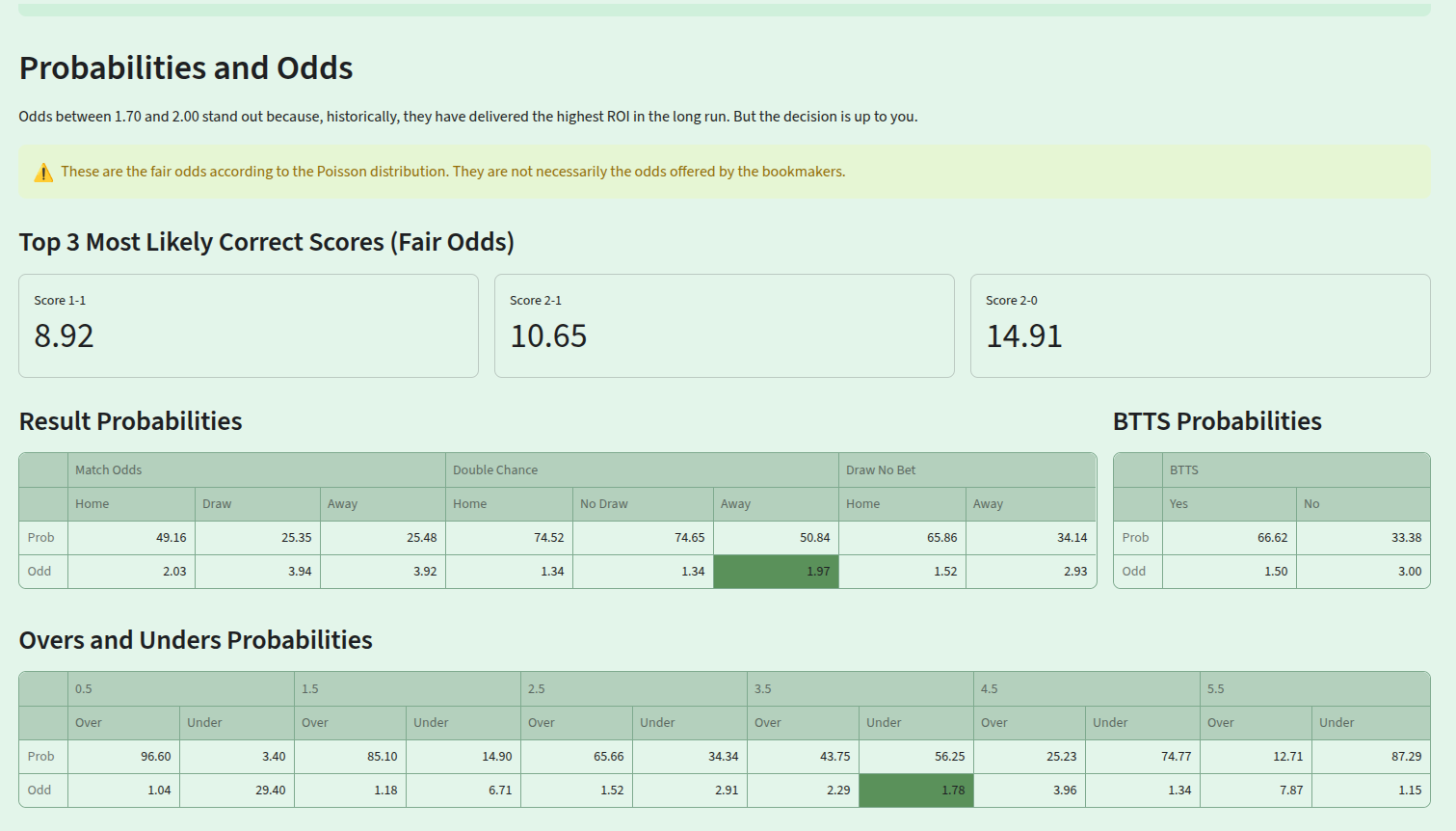
Match Probabilities (Model-Based):
Manchester United: 49.16%
Draw: 25.35%
Liverpool: 25.48%
Before diving into the tactical layers, here’s the key takeaway: this is not just a “big game” driven by narrative or historical rivalry. The numbers and structural analysis point to a clear, data-backed edge for Manchester United—and it comes from something deeper than form or individual quality.
👉 Want to see how these probabilities are generated (and access them for hundreds of matches)?
Check the Football Hacking web app:
It combines Poisson models, Dixon-Coles adjustments, and Monte Carlo simulations to produce fair odds and probability distributions. And with the European season approaching its end, leagues like the Brasileirão are already in full swing, offering continuous opportunities for analysis and betting edges.
The Core Thesis: This Match Is Decided by What Happens After Pressure
At first glance, this looks like a stylistic clash. But that’s not what the data shows.
This matchup is defined by one key principle:
Which team can preserve or increase value after encountering resistance?
And right now, that team is Manchester United.
They don’t just progress the ball.
They survive pressure and improve position within the next sequence.
Liverpool? They often don’t.
Phase Space Behavior: Same Bottleneck, Different Outcomes
Both teams build through a midfield bottleneck. That part is similar.
But what happens next is where everything changes.
Manchester United’s Midfield Structure
United’s central network revolves around:
Bruno Fernandes → Continuity Support + Third-Man Support
Casemiro → Security Support + Progression Support
Kobbie Mainoo → Continuity preservation under pressure
This creates something crucial:
A functional distribution of roles, not just positional occupation.
They don’t just circulate. They prepare the next action structurally.
Liverpool’s Midfield Structure
Liverpool relies heavily on:
Van Dijk (initiation hub)
Mac Allister, Szoboszlai, Gravenberch (connectivity)
But here’s the problem:
Their structure organizes possession… but does not sustain it after disruption.
That’s the difference between structure and functional structure.
The 5-Pass Rule: Where United Separate Themselves
The most important concept in this analysis is the post-resistance sequence.
What happens in the next 5 passes after pressure?
Manchester United
When facing resistance:
Left midfield resistance → progression into left half-space
Same scenario → direct switch into right attacking third
Central resistance → access to left half-space in final third
This shows:
Multiple escape routes
Strong xT gains
Real territorial progression
United don’t rely on one solution. They adapt structurally.
Liverpool
When facing resistance:
Central pressure → backward pass into defensive third
Right-side pressure → same backward pattern
Final third pressure → lateral or regressive movement
Liverpool’s structure collapses into territorial concession.
And that’s the difference.
Progression Patterns: Volume vs Value
Let’s break it down clearly.
Manchester United
Main routes:
Left half-space → left corridor
Left corridor → left corridor
Central corridor → left half-space
Key insight:
Their left-sided dominance is not empty circulation.
It’s supported by:
Central access
Role distribution
High mean xT gain
Liverpool
Main routes:
Left half-space → central corridor
Right half-space → central corridor
On paper? Looks clean.
In reality?
The progression is fragile under pressure.
They arrive in good zones—but:
Lose value immediately after
Fail to stabilize the attack
Efficiency vs Illusion
This is where many analysts get it wrong.
Manchester United
Slightly positive net progression
Strong xT per 100 passes
Positive final-third efficiency
Interpretation:
They are efficient, not passive.
They don’t need long possessions because:
Their sequences retain value
Their attacks don’t decay quickly
Liverpool
Negative net progression
Low xT per 100 passes
Negative final-third value
Despite:
High final-third pass volume
Interpretation:
They arrive often… but arrive poorly structured.
👉 If you want to quantify these edges before the market does, the app helps you do exactly that:
https://app.footballhacking.com/
Especially in leagues like the Brasileirão, where inefficiencies persist longer than in top European competitions.
Graphical Analysis: How Structure Translates on the Pitch


Final Third: The Illusion of Control
Liverpool’s biggest issue sits here.
They:
Reach the final third frequently
Maintain possession there
But:
They lose value instead of building advantage
This is a classic Finalization Space failure.
The attack:
Lacks stable Rupture Support
Fails to consolidate Superation Support
Becomes dependent on individual action
Meanwhile, United:
Turn fewer entries into higher-quality outcomes
Defensive Layer: Where United Control Rhythm
Manchester United’s defensive data adds another critical edge.
Key Zones
Defensive third (central) → opponent loses rhythm
Midfield right half-space → progression disruption
This creates:
A tempo-control defense, not just a reactive one
Liverpool’s strength?
High Central Pressure
In the attacking third:
They force instability
Cause major value destruction
This is their best weapon.
Tactical Interaction: Where the Match Can Flip
Here’s the key dynamic:
United attack mainly through the left
Liverpool disrupt mainly through high central pressure
So the question becomes:
Can Liverpool block the central connector (Bruno Fernandes)?
If yes:
United may fall into left-side circulation loops
If no:
United’s structure stabilizes
Their edge becomes decisive
Structural Fragilities
Manchester United
Risk:
Over-reliance on left-side circulation
Negative-value defensive recycling (Shaw ↔ Martínez)
If pressed:
Can enter reset loops
Lose progression tempo
Liverpool
Much more critical:
No reliable post-resistance progression
Frequent territorial loss
Weak Superation Support
Their structure breaks after pressure, not before
Match Prediction: Controlled Advantage vs Chaotic Opportunity
This game will likely follow one of two paths:
Scenario 1: Controlled Match (Favors United)
Structured buildup
Managed tempo
Sustained sequences
Outcome:
→ United’s progression advantage becomes decisive
Scenario 2: Chaotic Match (Favors Liverpool)
High turnovers
Short-field attacks
Central pressure dominance
Outcome:
→ Liverpool can disrupt and create volatility
Final Verdict: Why United Hold the Edge
This is not about possession.
Not about style.
Not about historical rivalry.
It’s about structural survival under pressure.
And the data is clear:
Manchester United are better at turning resistance into progression.
Liverpool:
Organize well
Progress initially
Collapse under pressure
United:
Adapt
Progress
Sustain value
That’s why the probabilities tilt the way they do.
👉 If you want to consistently identify these edges before kickoff (and live),
the Football Hacking app gives you exactly that layer:
With the European season wrapping up, now is the perfect time to explore leagues like the Brasileirão—where structural inefficiencies are still widely exploitable.
Live Edge Checklist: Identifying the Team That Deserves Your Bet
🔴 Manchester United — What YOU EXPECT to see (to BACK them)
🔁 Post-resistance superiority (THE EDGE)
After pressure, United progress OR switch side with gain
👉 Consequence: structure is working → attack will sustain and grow
❌ If they start going backward → edge is gone
📍 Left-side progression working
Repeated pattern: central → left half-space / left corridor
👉 Consequence: main route is alive → entries are structured and valuable
❌ If left side disappears → attack loses identity
⚙️ Bruno as connector (critical)
Bruno receiving between lines / acting as 3rd man
👉 Consequence: continuity → fixation → progression chain is intact
❌ If he’s blocked → United falls into circulation loops
🧠 Multiple escape routes under pressure
United escapes pressure to different zones (not just one)
👉 Consequence: opponent cannot trap → structural control
❌ If forced into one predictable exit → vulnerability ↑
🎯 Final third value (NOT volume)
Fewer entries but each one keeps or increases value
👉 Consequence: high efficiency → goal probability real
❌ If they reach but lose value → losing their main strength
🧱 Defensive disruption on Liverpool
United pressure causes loss of rhythm (especially central/right half-space)
👉 Consequence: Liverpool cannot sustain attacks → game tilts United
❌ If Liverpool plays comfortably → warning sign
❌ DO NOT BACK UNITED IF:
Constant left-side defensive recycling (Shaw ↔ CBs)
👉 Consequence: stuck in reset loop → no progressionBruno disconnected
👉 Consequence: no structure → attack dies
🔵 Liverpool — What YOU EXPECT to see (to BACK them)
🧱 High central pressure working (THE ONLY REAL EDGE)
Liverpool pressing high and forcing unstable United buildup
👉 Consequence: short-field attacks → chaos → Liverpool gains edge
❌ If United builds comfortably → Liverpool loses main weapon
🔁 Central progression surviving pressure (RARE BUT KEY)
Central corridor → pressure → STILL moves forward
👉 Consequence: structure is finally holding → dangerous scenario
❌ If: central → pressure → backward
→ same old problem → DO NOT BACK
📍 Clean central access to final third
Reaching final third through central corridor consistently
👉 Consequence: their intended structure is functioning
❌ If forced wide or backward → broken plan
⚙️ Midfield chain holding (Mac Allister / Szobo / Gravenberch)
They connect and sustain play after pressure
👉 Consequence: continuity → possible progression stability
❌ If broken → attack collapses quickly
🎯 Final third MUST keep value (THIS IS THE TEST)
After arriving → they don’t lose value immediately
👉 Consequence: rare case → Liverpool actually dangerous
❌ If: arrive → lose → reset
→ classic failure → DO NOT BACK
❌ DO NOT BACK LIVERPOOL IF (default scenario):
Pressure → backward escape to defensive third
👉 Consequence: conceding territory → no controlFinal third entries with negative or neutral outcome
👉 Consequence: empty possession → no threat
🎯 FINAL LIVE DECISION
👉 BACK UNITED IF:
They survive pressure AND
Left route is working AND
Bruno is connecting
👉 Consequence:
→ They impose structure → higher probability of scoring
👉 BACK LIVERPOOL IF:
They dominate high central pressure AND
United cannot build cleanly
👉 Consequence:
→ Game becomes chaotic → Liverpool gains edge
👉 STAY OUT IF:
United cannot progress
ANDLiverpool still cannot sustain attacks
👉 Consequence:
→ Broken game → no structural edge
💡 The real simplified read:
United wins if the game stabilizes.
Liverpool only wins if they break the game.
Closing Thought
Football is not just about reaching good positions.
It’s about:
What you can do once the opponent tries to stop you.
And in this matchup, one team survives that moment better than the other.
That team is Manchester United.