


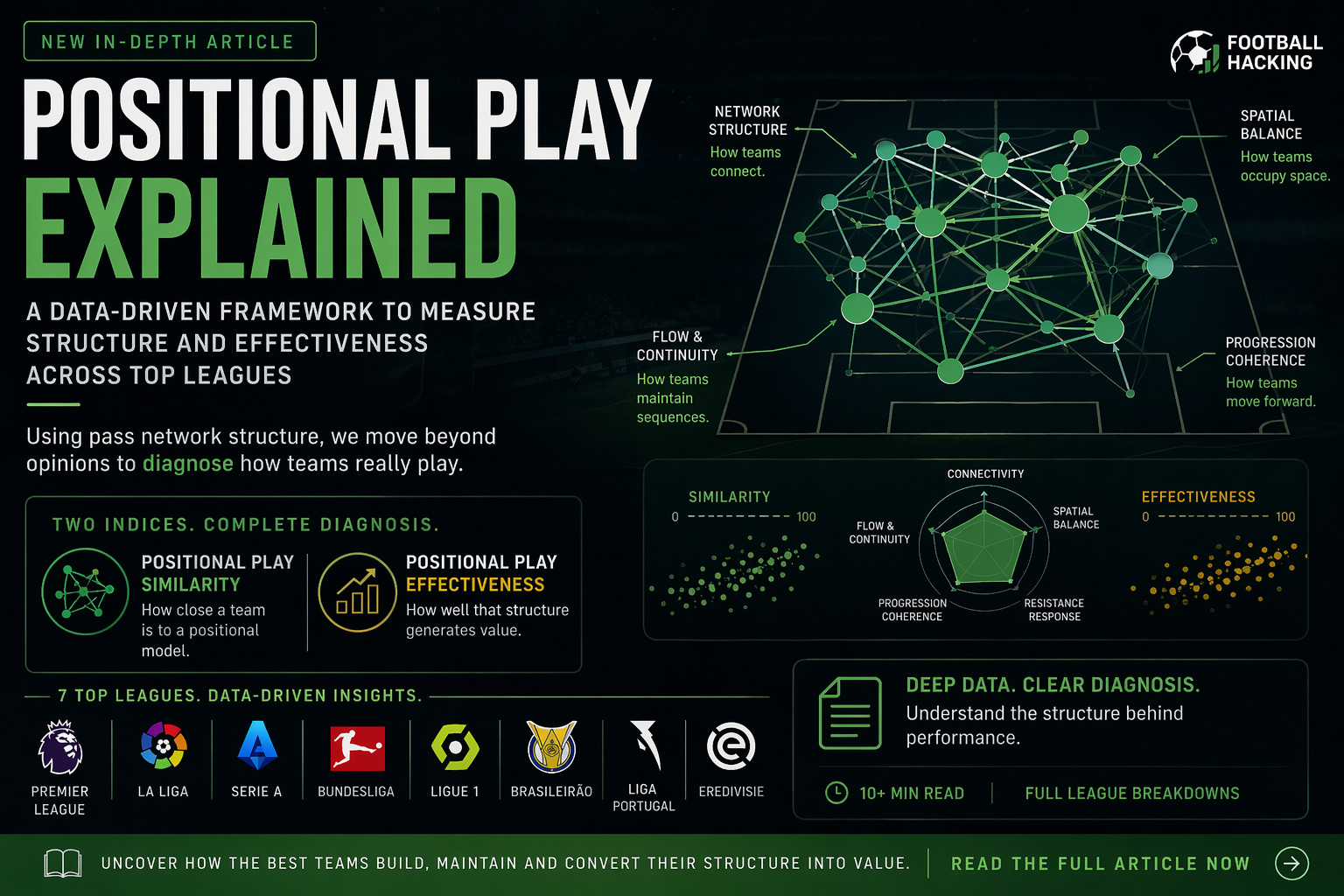
Debates around positional play are constant in modern football.
Coaches, analysts, and fans often disagree on which teams actually follow positional principles and which only appear structured on the surface. These discussions are usually driven by visual interpretation, stylistic bias, or isolated metrics.
This article takes a different approach.
It was produced using pass network structure data, with the explicit goal of diagnosing whether teams behave like positional systems. Instead of relying on labels, we rely on structure.
To do this, I built two complementary indices:
Positional Play Similarity Index → how closely a team’s structure aligns with positional principles
Positional Play Effectiveness Index → how well that structure translates into value during attacking sequences
Together, these indices allow us to move from subjective debate to objective structural diagnosis.
Understanding the Indices (Briefly)
Positional Play Similarity Index
This index measures structural alignment with positional play, based on:
connectivity and stability of the pass network
flow and progression patterns
spatial balance across corridors
continuity when facing defensive resistance
coherence in how teams reach the final third
It does not measure possession or aesthetics.
It measures whether the team behaves as a functional, repeatable structure.
Positional Play Effectiveness Index
This index measures whether that structure produces value:
progression quality (xT-based)
ability to retain value in the final third
response to defensive pressure
preservation of attacking sequences
A team can be structurally sound but ineffective—or highly effective without a positional structure.
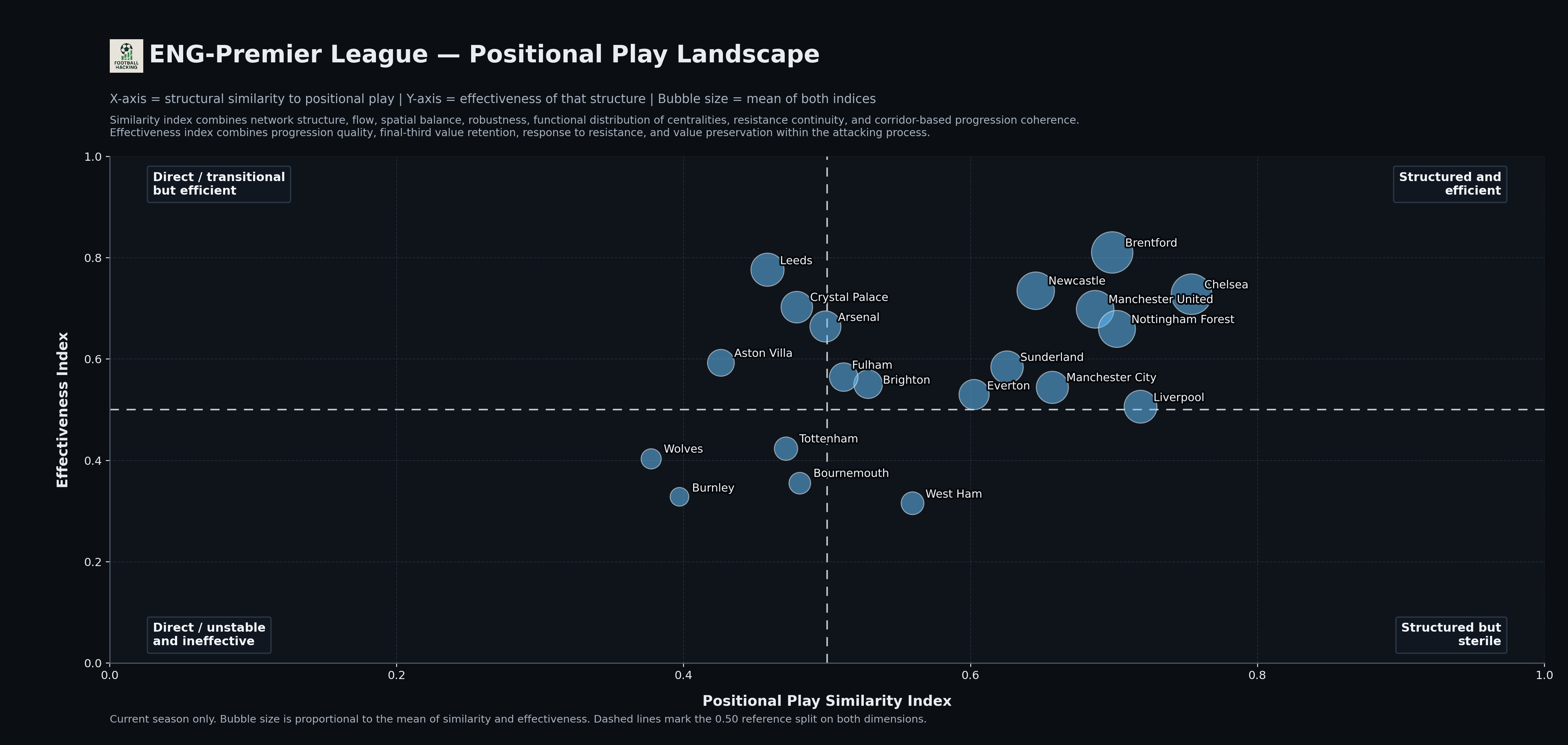
Premier League: Structural Clarity, Outcome Separation
The Premier League presents one of the clearest separations between structure and effectiveness.
At the top end of the distribution, teams combine:
high similarity to positional play
high effectiveness in converting structure into value
These teams are not only well-organized; they sustain progression quality even when facing resistance. Their networks show strong connectivity across lines, and more importantly, they maintain coherence after pressure events.
However, the middle of the league reveals a different pattern.
Many teams display:
reasonable structural organization
stable circulation in early phases
But they fail in a crucial moment:
value retention after resistance
Their networks break not in buildup, but in transition from control to penetration. The structure exists, but it does not survive contact with pressure.
At the lower end, teams tend to show:
lower structural stability
fragmented progression
inconsistent corridor usage
Key Diagnosis
The Premier League is not lacking structure.
It is lacking consistency in preserving value under pressure outside the top tier.
La Liga: Structural Identity Without Guaranteed Threat
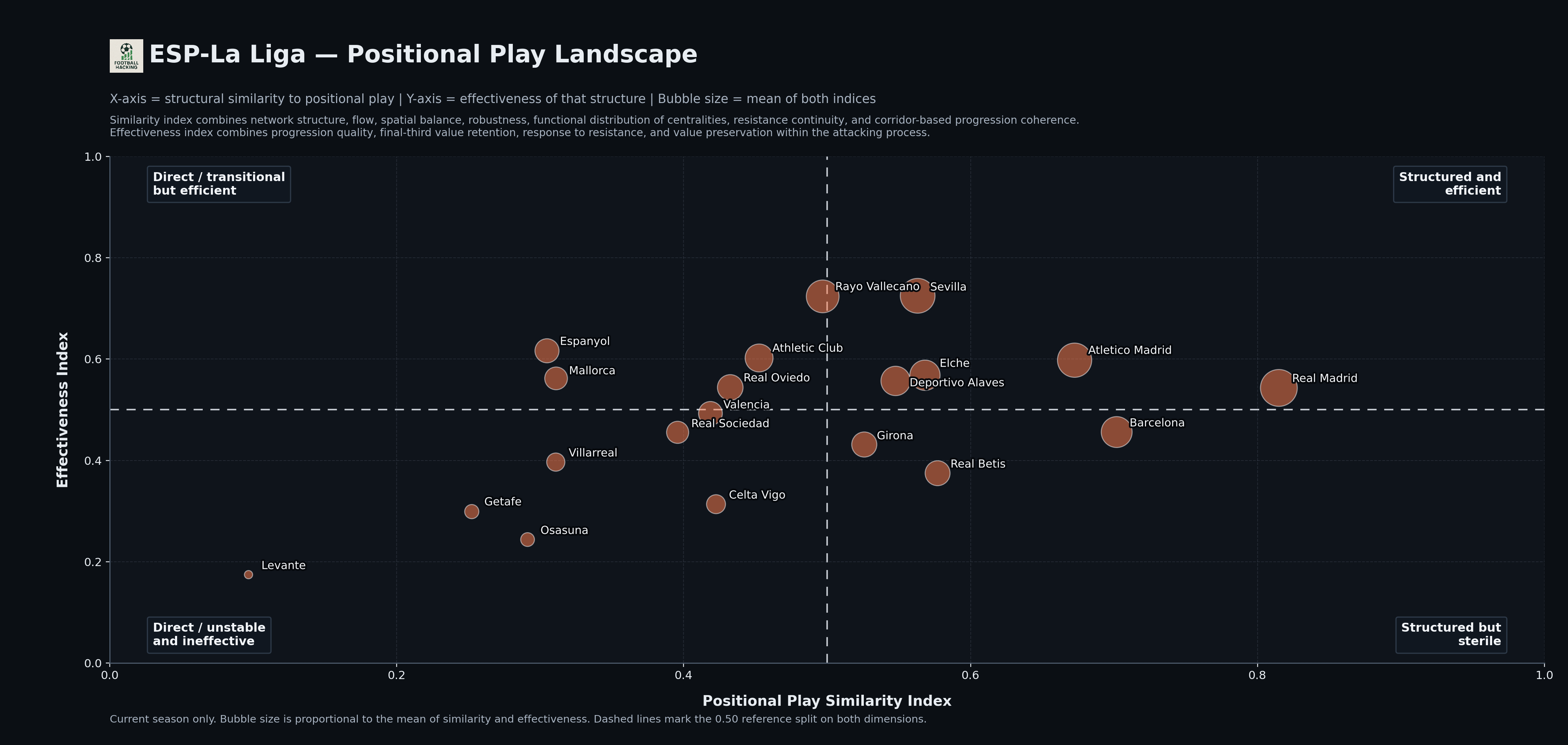
La Liga stands out for its structural consistency.
Across a wide range of teams, you observe:
well-distributed pass networks
clear occupation of corridors and half-spaces
controlled circulation patterns
This suggests a strong baseline of positional principles embedded across the league.
However, effectiveness does not scale with structure.
Many teams fall into a specific profile:
high similarity
moderate or low effectiveness
These teams:
maintain structure well
circulate effectively in early phases
but struggle to generate sustained attacking value
Their networks show continuity, but their sequences often lose value as they approach decisive zones.
Key Diagnosis
La Liga demonstrates that positional structure alone is insufficient.
The gap lies in turning structural control into final-third impact.
Serie A: Organized Systems, Limited Penetration
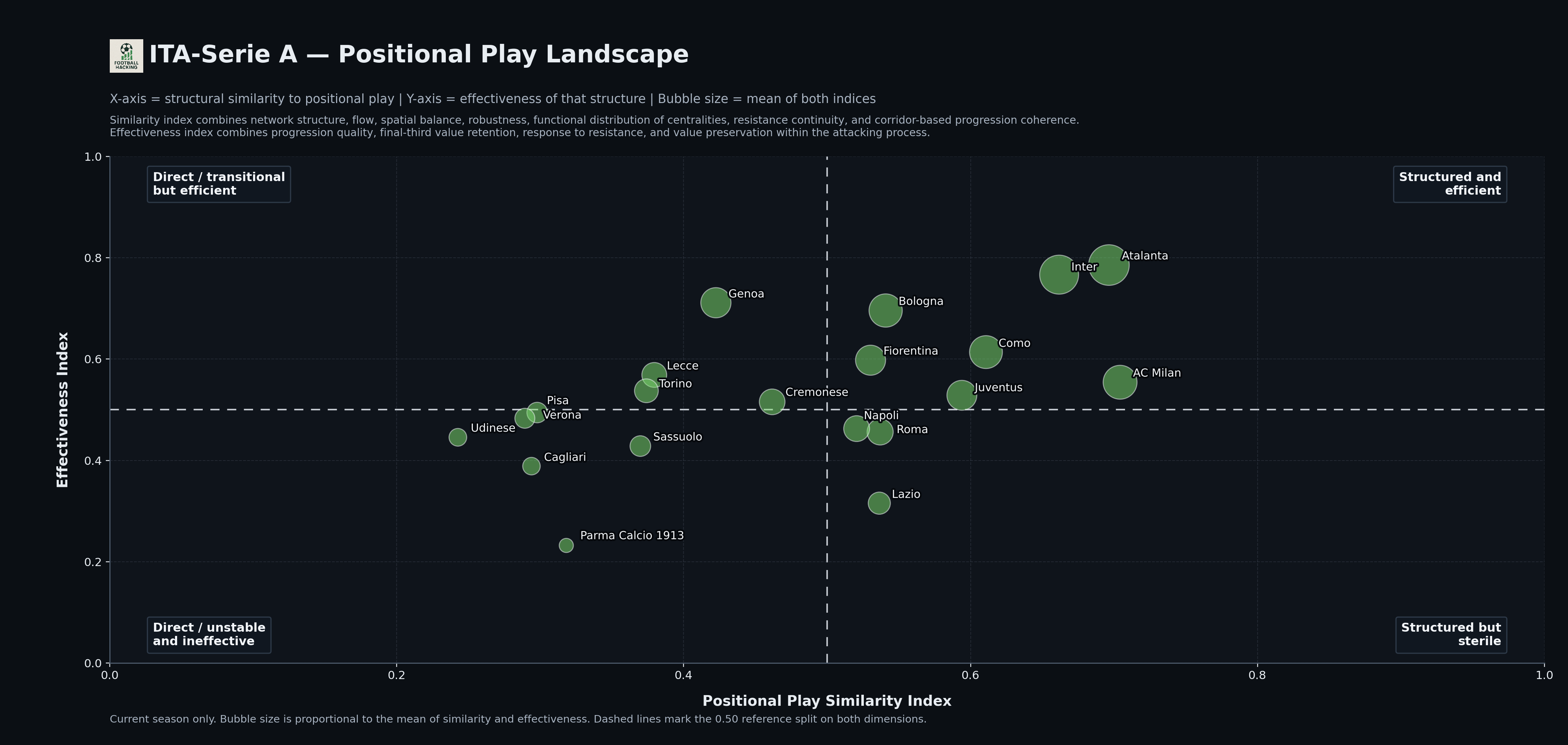
Serie A is characterized by disciplined structure and controlled progression.
Teams frequently show:
compact and organized pass networks
deliberate buildup phases
strong defensive balance embedded within their structure
However, this structural discipline comes with a trade-off.
Many teams:
prioritize control over risk
reduce exposure to defensive transitions
but also limit their own attacking ceiling
This leads to a recurring pattern:
stable structure
but limited progression efficiency
and difficulty sustaining value deep in the attacking phase
In network terms:
connections are present
but progression chains are shorter or less impactful
Key Diagnosis
Serie A teams are structurally coherent, but often under-leverage that structure to generate threat.
Bundesliga: High Output, Lower Structural Stability
The Bundesliga offers a contrasting model.
Here, you frequently observe:
high-intensity progression
aggressive verticality
more transitional behavior
Teams often sacrifice structural stability in favor of speed and directness.
This produces a unique profile:
lower positional similarity
but high effectiveness
In many cases:
networks are less balanced
connections are more volatile
but attacking sequences generate value quickly
The trade-off becomes clear:
higher risk
higher variance
but potentially higher short-term output
Key Diagnosis
The Bundesliga shows that effectiveness can exist without positional structure, but often with less control and higher volatility.
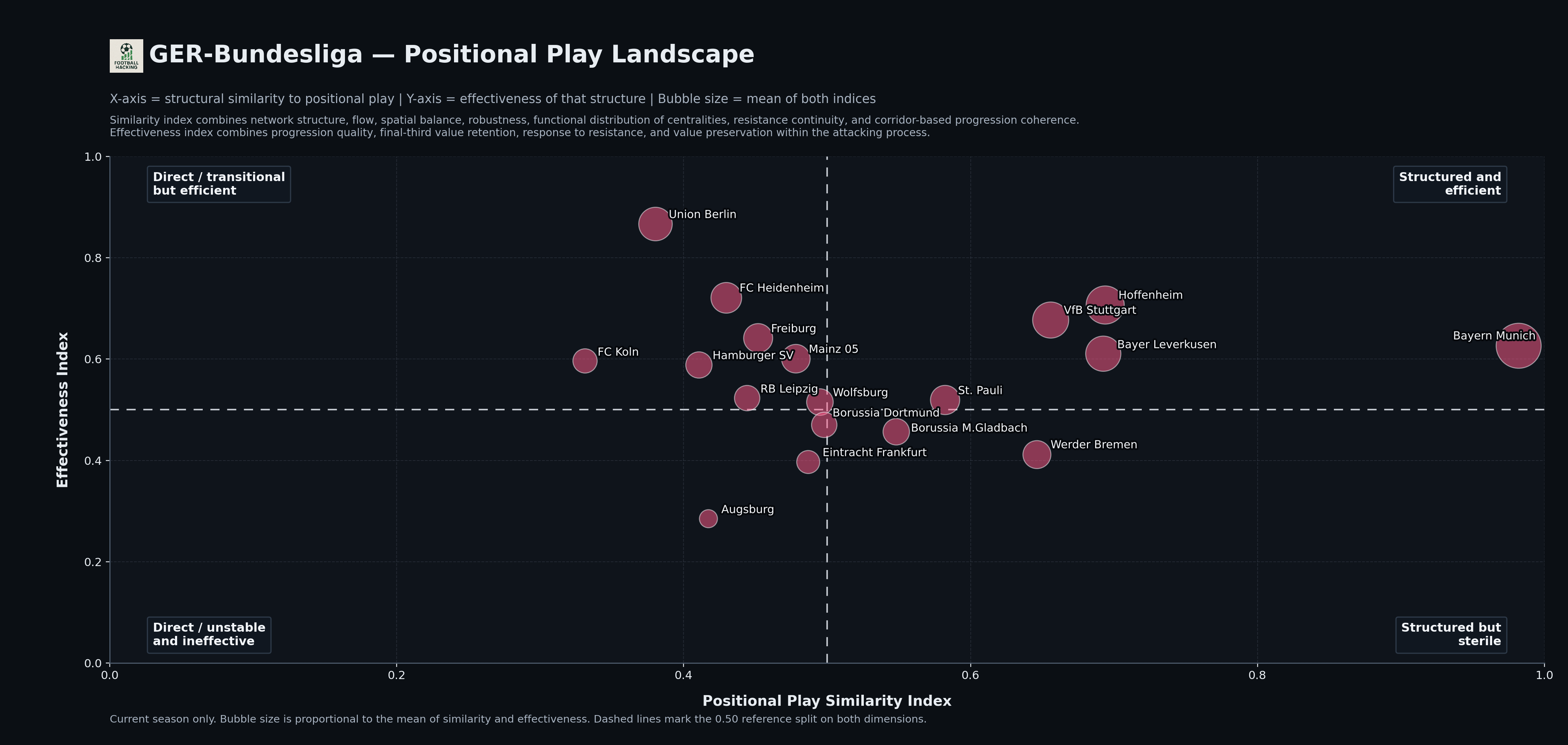
Ligue 1: Structural Polarization and Instability Under Pressure
Ligue 1 displays one of the widest structural gaps between teams.
At the top:
teams combine structure and effectiveness
strong networks with consistent progression patterns
Below that tier:
structural instability increases significantly
networks become fragmented
progression lacks continuity
A recurring issue across many teams is:
breakdown under resistance
Even when initial buildup is stable:
sequences fail to sustain value after defensive pressure
networks lose coherence in key moments
Key Diagnosis
Ligue 1 is defined by polarization:
a small group of structurally dominant teams and a large group struggling to maintain coherence under pressure.
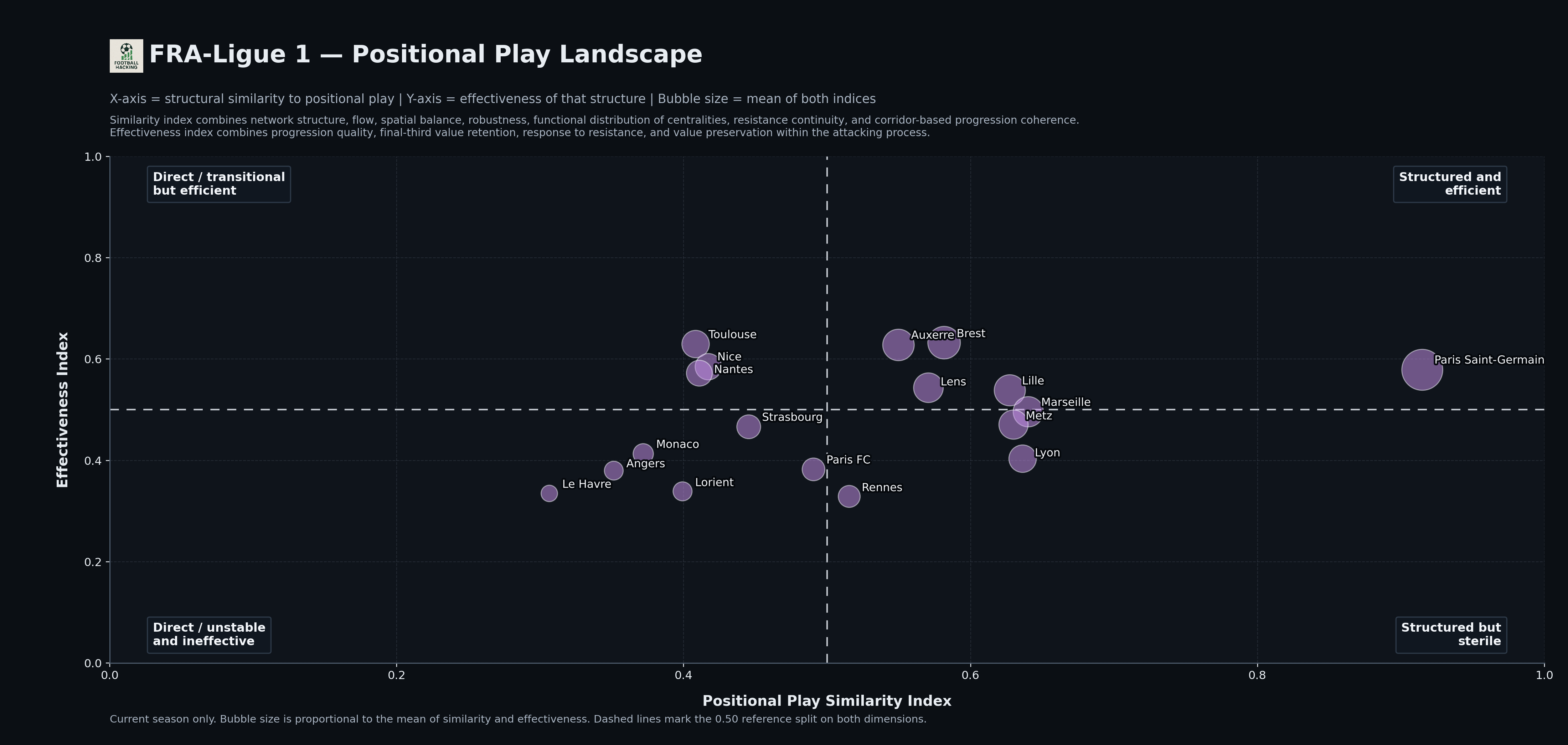
Brasileirão: Structural Diversity and Intentional Incisiveness
The Brazilian league is structurally diverse.
Unlike more homogeneous leagues, you see:
multiple tactical identities coexisting
significant variation in structural behavior
One of the most important observations is:
Some teams show:
low positional similarity
but high effectiveness
This is not a flaw.
It reflects a different design.
These teams:
do not aim for sustained positional control
prioritize incisiveness
generate value through direct progression
In network terms:
fewer recirculation patterns
faster transitions
more aggressive value creation
Key Diagnosis
In Brasileirão, low similarity does not mean inefficiency.
It often indicates a deliberate choice toward direct, high-impact attacking models.
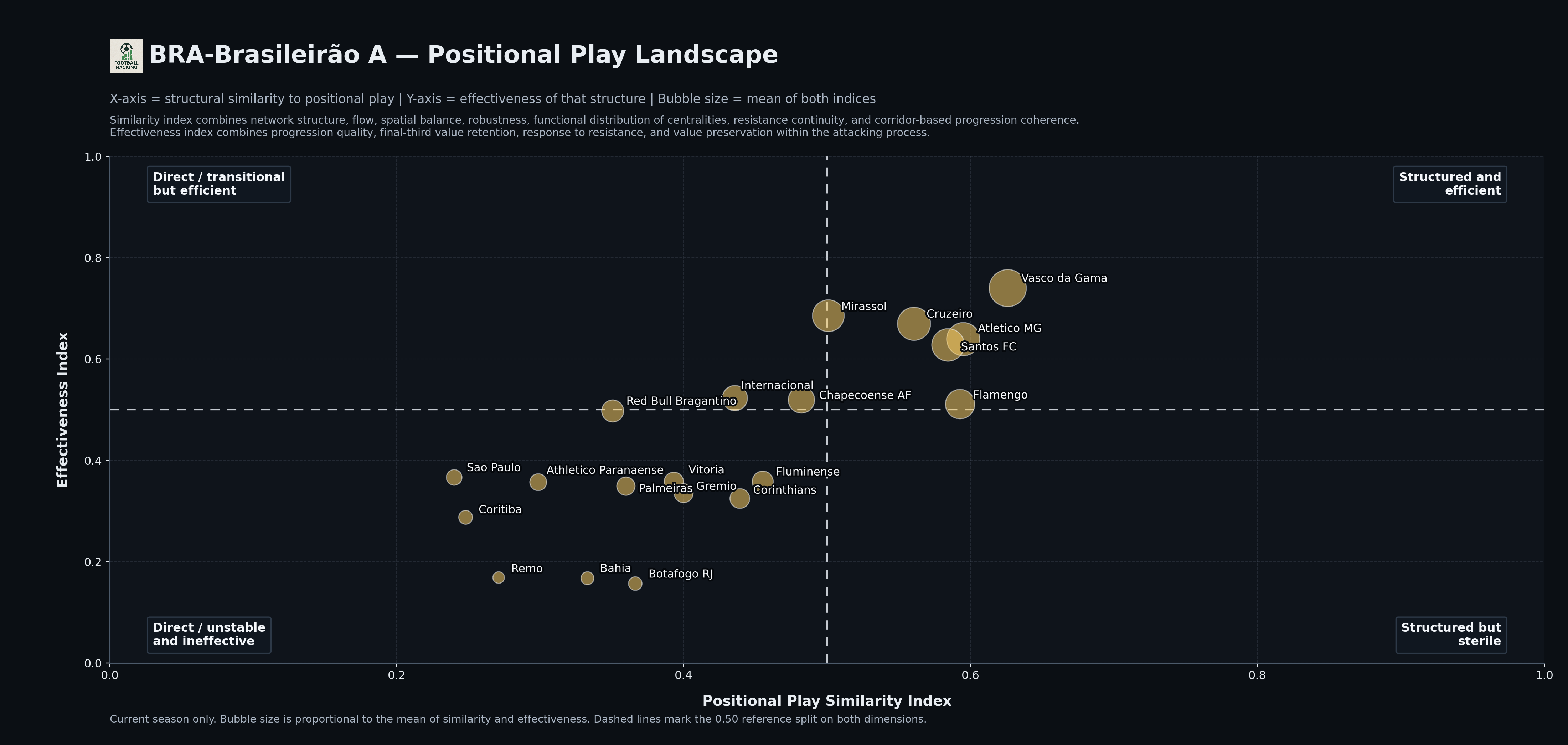
Liga Portugal: Hybrid Structures and Transitional Balance
Liga Portugal sits between structured positional systems and more direct models.
Teams often display:
partial positional structure in buildup
but increased verticality in progression phases
This creates hybrid behaviors:
structure in early phases
transition-oriented decisions in later phases
As a result:
similarity scores vary
effectiveness depends heavily on how well teams manage the transition between control and direct play
Some teams:
maintain structure consistently
Others:break structure intentionally to accelerate progression
Key Diagnosis
Liga Portugal reflects structural hybridity, where teams balance positional organization with transitional intent.
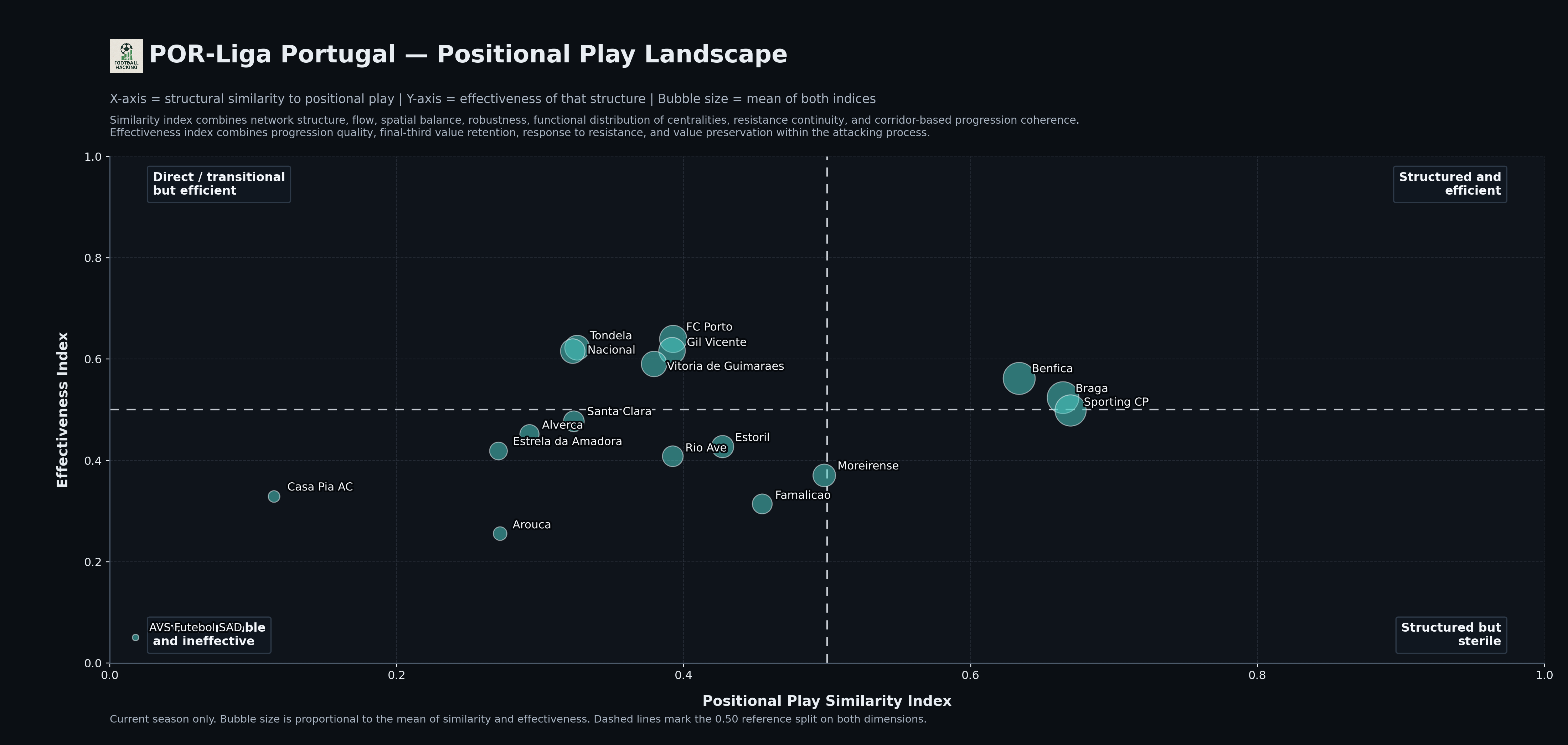
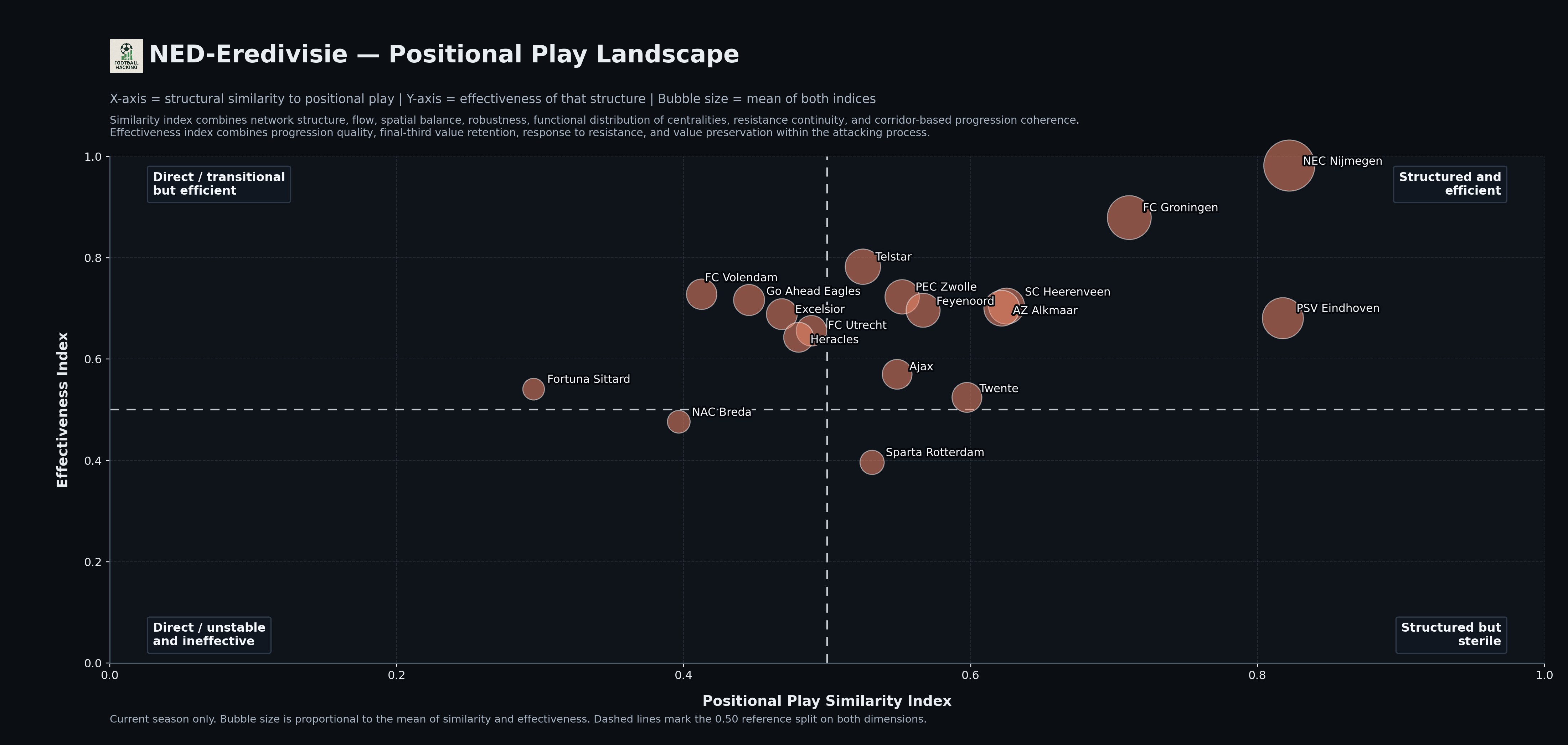
Eredivisie: Positional Intent, Inconsistent Execution
The Eredivisie tends to favor structured buildup.
Many teams exhibit:
clear positional intent
organized pass networks
structured occupation of space
However, execution is uneven.
While structure is present:
effectiveness varies significantly
many teams struggle to sustain value after entering advanced zones
Common patterns include:
good buildup structure
but inefficient final-third sequences
or loss of value under pressure
Key Diagnosis
The Eredivisie reflects strong positional intent, but inconsistent execution under competitive pressure.
Final Insight: Structure vs Outcome
Across all leagues, one principle stands out:
Structure and effectiveness are distinct dimensions.
A team can be:
structurally organized but ineffective
effective but structurally unstable
or aligned in both dimensions
Understanding this distinction is essential.
Because positional play is not about appearance—it is about how structure behaves:
under pressure
across space
and through progression
Conclusion
By analyzing pass network structure, we move beyond subjective labels.
We can:
identify structural patterns
evaluate how they function under resistance
and determine whether they produce value
This transforms positional play from a debated concept into a measurable diagnostic framework.
If you want to follow future analyses like this, subscribe to the newsletter.