


Estimated reading time: 15–17 minutes
How Spain’s Pass Network and xT Edge Decided Spain vs Argentina
Spain won 1-0, but the scoreline only captures the surface. The deeper story is that this match was decided by how each structure behaved after resistance, not by who simply reached advanced zones more often. This reading is based on pass network data and xT, so the key question is not possession volume or territorial appearance. It is what each team could still do within the five-pass sequence after pressure arrived.
That distinction mattered throughout. Spain were not overwhelmingly dominant in raw structural shape alone; Argentina’s structure index was close. But the collision tilted because Spain preserved attacking continuity more often in Progression Space and converted that continuity into cleaner finalization conditions, while Argentina repeatedly reached apparent control without sustaining value. One team used circulation to prepare progression. The other often used circulation to survive.
The result was a match in which Spain imposed the more functional structure. Argentina were not structurally absent, but they were structurally diluted.
Spain vs Argentina Tactical Analysis: The Structural Collision
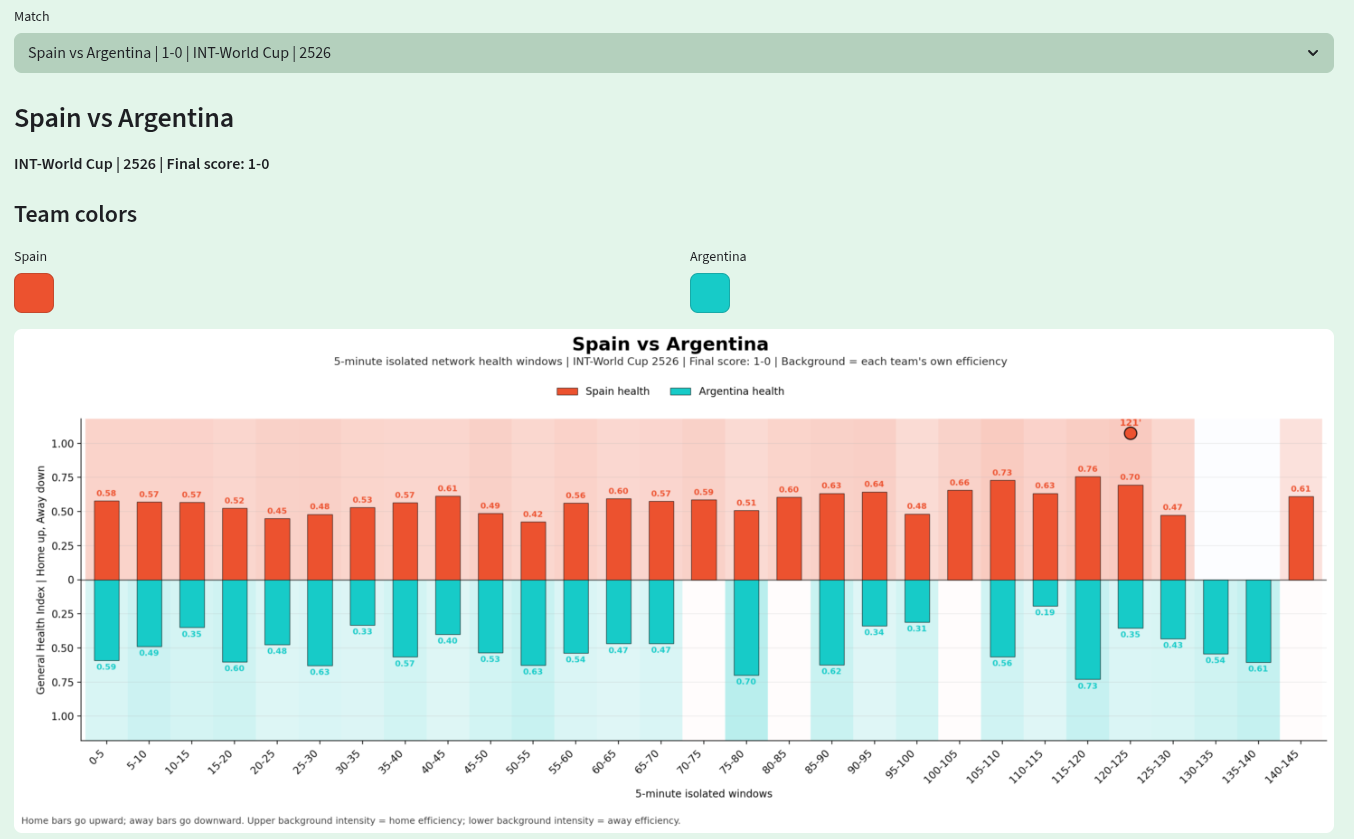
The match was defined by a contrast between Spain’s more coherent support structure and Argentina’s unstable response to pressure. Spain’s general health, flow, efficiency, and defensive influence all finished higher, but the most important gap was not aesthetic control. It was the efficiency gap. Spain’s xT per 100 passes sat at 0.733, Argentina’s at 0.316. That is not a minor difference in execution. It is a difference in the value extracted from structure.
In Initiation Space, Spain built through Pau Cubarsí, Pedro Porro, Rodri, Laporte, and Cucurella as the main central nodes. Cubarsí and Porro carried the highest network centrality, which already says something important: Spain’s base was not only stable, it was active in directing progression routes. Rodri functioned as Continuity Support and Security Support, but the structure did not stop with him. Cubarsí also gave Progression Support from the base, while Porro and Cucurella alternated between Progression Support and Third-Man Support depending on the route.
Argentina, by contrast, had Emiliano Martínez as the most central figure in their network. That is not automatically negative, but here it reflected a structural condition: too much of their continuity depended on backward security rather than forward stabilization. In a match where the goalkeeper becomes the strongest network hub and many of the most frequent return connections are attached to him, the team is often preserving possession without preserving positional value. That is exactly what happened.
So the structural collision was uneven in a specific way. Spain had circulation that could still reorient and attack the next line. Argentina had circulation that often reset the same problem.
Spain Pass Network Analysis: Route Diversity After Fixation
Spain’s most valuable progression did not come from one repetitive lane. It came from multiple origin corridors feeding different final-third corridors, especially from left half-space and right half-space origins. That matters because it shows route diversity rather than dependence on a single access point.
The clearest high-value Spanish route came from right half-space → progression → left half-space in the final third, producing the highest mean entry xT among their recurring routes. Pau Cubarsí to Dani Olmo appeared as the main connection in that route. Functionally, Cubarsí acted as Security Support and Progression Support in Initiation Space, while Dani Olmo offered Third-Man Support and Superation Support between lines.
This route matters less because of the pass itself and more because of the five-pass outcome after resistance: Spain could absorb pressure on one side, shift the reference point, and still arrive in a valuable interior receiving zone.
Another strong pattern came from left corridor → progression → right corridor or right half-space in the final third. Fabián Ruiz and Cucurella were central here. Fabián provided Continuity Support and Fixation Support by holding defenders toward the left reference, while Cucurella’s movement and release into Nico Williams gave Progression Support that often became Superation Support once Argentina’s line had been pinned.
Spain’s best edge by value was Pedri to Nico Williams, followed by Pedro Porro to Nico Williams. That tells the story clearly: Spain’s most dangerous actions were not random switches, but structurally prepared releases into a receiver who could attack destabilized space.
Nico Williams functioned as Rupture Support and Superation Support. Pedri was the key enabler, combining Continuity Support, Third-Man Support, and Fixation Support. When Spain found Nico after prior central or left-sided fixation, the action carried real value. When they found him too early or without enough structural backing, the move still advanced the ball but less reliably advanced the attack.
That is the key distinction in Progression Space. Spain had progression that moved the structure, not just the ball.
Spain xT Analysis: Why the Five-Pass Window Shows Sustainable Progression
The strongest evidence of Spain’s superiority comes after resistance.
When Spain met resistance in the defensive third central zone, their main reaction was a progressive escape into midfield central zone with strong vertical gain and positive xT. That means pressure on the first line did not force structural attacking breakdown. Rodri and the central defenders could preserve continuity and still move the next phase forward.
When resistance appeared in midfield left side, Spain’s reaction was even more valuable: midfield left side → progression → attacking third right half-space, with a very strong mean delta xT.
This is a classic functional sequence. Continuity Support stabilizes the first reception, Fixation Support draws the pressure reference, Rupture Support opens the far lane, and Superation Support attacks the released channel. Spain repeatedly completed this logic.
They also escaped from midfield right half-space into attacking third left half-space with positive value. So Spain were not only crossing the pitch laterally. They were using lateral movement to preserve or improve positional value within five passes. That is the difference between recirculation as a reset and recirculation as a weapon.
The weakness in Spain’s possession appeared when resistance hit midfield central zone. There, the common reaction became midfield central zone → lateral escape → midfield right half-space, with negative xT.
This is one of the few places where Spain’s support structure lost value after pressure. It points to a structural diagnosis: excess of Continuity Support without enough immediate Fixation Support before the next progression attempt. In those moments, the ball stayed alive, but the attack lost direction.
Still, the overall pattern remained favorable. Spain’s net progression index was slightly positive, and their final-third net per pass was positive as well. That is crucial. Their final-third occupation was not superficial.
Argentina Pass Network Analysis: Access Without Sustained Progression
Argentina’s progression map is deceptive if read superficially. They did create some high-value entry routes, especially left corridor → progression → central corridor, and central corridor → progression → left half-space. On paper, those routes can look dangerous. In practice, they were too sparse and too fragile after contact.
Their most valuable entry route by mean xT came from left corridor → progression → central corridor. But the problem was repetition and sustainment. Argentina did not build enough recurring support around that route to turn it into stable attacking continuity. They could enter. They struggled to remain.
This is where the distinction between frequency and value becomes decisive. Argentina had isolated routes with decent value, but their overall xT output remained low, their net progression index was negative, and their final-third net per pass was clearly negative. So even when they accessed useful zones, the next five-pass sequence often degraded the position.
In functional terms, Argentina often had Progression Support without enough structural backing from Fixation Support and Third-Man Support. Enzo Fernández and Paredes could connect phases, but too many attacks lacked a stable intermediate structure after the first line was bypassed.
Messi, Mac Allister, and De Paul could provide moments of Superation Support, but the team did not consistently create the preceding conditions.
That is why Argentina’s final-third presence felt lighter than its territorial map might suggest. They reached zones. They did not own them.
Emiliano Martínez and the Goalkeeper Paradox in Argentina’s Structure
Argentina’s best edges by raw value all point back toward Emiliano Martínez as recipient: Otamendi to Martínez, Romero to Martínez, Lisandro to Martínez, Paredes to Martínez, Medina to Martínez.
This should not be read as those passes being “good” or “bad” in isolation. Under the five-pass rule, they reflect a tactical reality: when Argentina met resistance, their most stable outlet was often regression into Security Support through the goalkeeper.
Sometimes that can be functional incisiveness management. Here it was not. Why? Because the post-resistance outcome rarely improved positional value. The structure kept resetting deeper and then re-entering without enough gain.
The same network also shows the reverse actions from Martínez outward as some of Argentina’s worst edges by value: Martínez to Lisandro, Martínez to Romero, Martínez to Nico González, Martínez to Julián Álvarez.
The issue is not the pass from the goalkeeper itself. The issue is what followed. Too often the reset led either to territorial loss, forced long release, or re-entry into pressure with weaker support timing.
So Martínez became both the team’s main Security Support and the symbol of its structural limit. Argentina had security, but not enough transformation of security into progression.
Pass Frequency vs Pass Value: Where Spain vs Argentina Was Separated
This was not a match where activity and impact aligned evenly.
Spain had high-frequency circulation through Porro, Cubarsí, Rodri, and Cucurella, but not all of it was equally valuable. Porro to Cubarsí was one of the most frequent Spanish connections and produced negative value overall.
Again, that does not make it a harmful connection by itself. It indicates that this route was often part of a reset loop rather than a progression gain. The same applies to Rodri to Cubarsí and Cucurella back to Laporte. These were continuity-preserving actions, not value-creating ones.
But Spain also had lower-frequency, higher-value links: Pedri to Nico Williams, Porro to Nico Williams, Nico Williams to Mikel Merino, Lamine Yamal to Ferran Torres.
Those actions were decisive because they emerged after prior fixation. Spain’s structure separated support functions effectively. The base preserved. The interior players connected. The wide receivers destabilized.
Argentina’s mismatch was harsher. Their high-frequency circulation often centered around the goalkeeper and center-backs, but the overall value remained low. They also had some high-value route entries, yet these were not repeated enough to shape the match.
So Argentina’s frequency lived in safe zones, while their value appeared in isolated bursts. Spain’s frequency, by contrast, was more capable of feeding value zones.
That is why the match never truly tilted toward Argentina despite some nominal structural stability. Their activity did not accumulate threat.


Defensive Pressure Analysis: Spain Disrupted Continuity, Argentina Redirected Play
Spain’s defensive influence was one of the match’s decisive features. In the attacking third central zone, Spain’s defensive action repeatedly forced Argentina into recirculation and caused loss of rhythm.
This is a vital distinction. Spain were not merely recovering the ball high; they were interrupting Argentina’s transition from Progression Space into Finalization Space. The pressure did not always win possession immediately, but it broke the sequence logic.
Zone → defensive action → reaction → consequence was clear:
Attacking third central zone → Spanish pressure → Argentine recirculation → loss of rhythm.
Spain also defended effectively in their own defensive third central zone and left-side sectors, where Argentina’s reactions were neutral and low impact. Even when Argentina arrived, the consequence was not sustained pressure but reduced attacking density.
The one area where Spain’s defensive action was less suppressive came in midfield left half-space. There, Argentina could still produce some volume after pressure. But even that did not become decisive because the next actions lacked enough value.
Argentina’s defensive work was more ambiguous. In the attacking third central zone, they generated many defensive actions and did cause local disruption. But in Spain’s attacking third left half-space and left corridor, their pressure had limited impact despite decent action volume.
Spain still produced strong opponent xT sums in those zones after the pressure event. So Argentina’s pressure often redirected Spain rather than structurally suppressing them.
That is a major diagnostic point. Argentina could trigger. They could not always cover the second action. Their pressure lacked enough surrounding Security Support and Third-Man denial to close Spain’s next route.
Attacking Continuity: Spain Sustained Progression, Argentina Reset
Spain’s attacking continuity was not perfect, but it was real. Their recurring loop looked like this:
Left half-space progression → pressure → central support release → switch or diagonal re-entry → final-third entry in the opposite corridor.
This loop matters because it preserved value after resistance. It also shows proper role sequencing: Continuity Support from the base, Fixation Support through interior occupation, Rupture Support through wide positioning, then Superation Support into the released lane.
Spain did not always finish the move, but they repeatedly sustained progression into meaningful zones.
Another Spanish loop was less productive:
Right corridor progression → pressure → backward pass to Porro or Cubarsí → reset → re-entry attempt.
This produced some of their lower-value circulation. It indicates occasional excess of Continuity Support without enough immediate Rupture Support.
Lamine Yamal, for all his danger, was also involved in several negative-value return actions toward Porro or Cubarsí. That does not mean he hurt Spain. It means Argentina sometimes contained his first action and forced the sequence back into Initiation Space.
Spain’s advantage was that they could often rebuild from there without full structural attacking breakdown.
Argentina’s recurring loop was more damaging:
Central or right half-space progression → pressure near attacking third → lateral escape or backward release → reset through Martínez or center-back line → re-entry attempt into the same corridor.
This is the textbook shape of apparent control hiding fragility. The team keeps the ball, but the attack loses positional value within the five-pass window. That is not functional incisiveness. It is structural inefficiency.
Argentina’s final-third net per pass being negative confirms that their occupation of advanced zones was often superficial rather than sustainable.
Key Players in the Spain vs Argentina Pass Networks
For Spain, Pedri was the most important relational piece. He operated as Continuity Support, Third-Man Support, and Fixation Support, especially in Progression Space. His connection into Nico Williams carried the highest value because it arrived after the structure had already manipulated the defensive reference.
Nico Williams was Spain’s main Rupture Support and Superation Support. He was not simply a receiver in the corridor. He was the player who transformed structural preparation into territorial and threat gain.
Pau Cubarsí deserves emphasis as a high-centrality Security Support and Progression Support in Initiation Space. Spain’s build stability began with him, but his role was not passive recycling. He enabled the angle changes that opened interior access.
Pedro Porro had a dual function. He was Continuity Support in the reset phase and Progression Support when Spain attacked forward quickly. His high-value passes into Nico Williams show that his best moments came when he released into prepared space rather than when he simply circulated with Cubarsí.
Rodri was the main Security Support, but also a stabilizing Continuity Support under pressure. The only limitation was that some of his recycling actions into the back line preserved possession more than they advanced it.
For Argentina, Emiliano Martínez was overwhelmingly Security Support. The problem is that he became too central because the structure needed rescue too often.
Enzo Fernández and Paredes provided Continuity Support and some Progression Support, but Argentina lacked enough reliable Third-Man Support around them. That weakened their ability to escape pressure without regression.
Cristian Romero and Otamendi had to carry too much of the first-phase progression burden. When center-backs become repeated forward problem-solvers without enough midfield stabilization ahead, the structure becomes stretched.
Messi’s role in these data appears less as a central network controller and more as a selective Superation Support option. The issue was not his presence. It was the lack of a stable route feeding him in advantageous conditions often enough.
Why Spain Beat Argentina 1-0: Four Connected Structural Reasons
The match tilted toward Spain for four connected reasons.
First, Spain handled resistance better in the five-pass sequence. Their progression after pressure more often maintained or improved positional value, especially from left-sided and interior starting points.
Second, Spain’s support roles were better distributed. They had Continuity Support in the base, Fixation Support in interior zones, and Rupture Support wide, with Pedri and Dani Olmo frequently serving as Third-Man Support. Argentina had parts of this chain, but not enough full sequences.
Third, Spain’s defensive pressure disrupted Argentina where it mattered most: around central attacking-third access. Argentina were repeatedly pushed into recirculation that reduced rhythm and delayed progression.
Fourth, Argentina’s apparent structural stability hid a value problem. Their structure index was competitive, but their efficiency index and final-third value were not. They could hold shape without turning shape into threat.
The scoreline reflects the structural reality more than it distorts it. A 1-0 can sometimes flatter the winner or hide a balanced match. Here it mostly compresses a wider functional edge into a narrow numerical result.
Spain vs Argentina 1-0: Final Tactical Insight
This match was defined by one dominant structural pattern: Spain repeatedly converted resistance into renewed progression, while Argentina repeatedly converted resistance into reset.
That is the decisive difference. Spain’s main fragility was occasional overuse of continuity on the right-side reset, but their structure could recover from it.
Argentina’s main fragility was the absence of enough Fixation Support and Third-Man Support after initial access, which turned promising entries into low-value final-third occupation.
Under similar conditions, that pattern would repeat: Spain’s structure would keep generating sustained progression, and Argentina’s would keep asking the goalkeeper and center-backs to solve attacks that had already stalled.