

Football prediction is no longer just about intuition, recent form, or scrolling through bookmaker odds hoping to spot value.
The people who consistently approach football with an edge are usually doing one thing differently: they are building structured probability systems.
That can mean Poisson models.
That can mean Dixon-Coles adjustments.
That can mean Monte Carlo simulation.
That can mean massive historical datasets.
Or all of them combined.
The problem?
Most people never reach the implementation stage because they get stuck somewhere in the middle:
They don’t have enough historical data.
Their data is messy.
They don’t know how to structure a predictive model.
They don’t know how to scale predictions into a product.
They don’t know how to automate probabilities.
They don’t know how to expose their model via API.
Or they simply don’t have time.
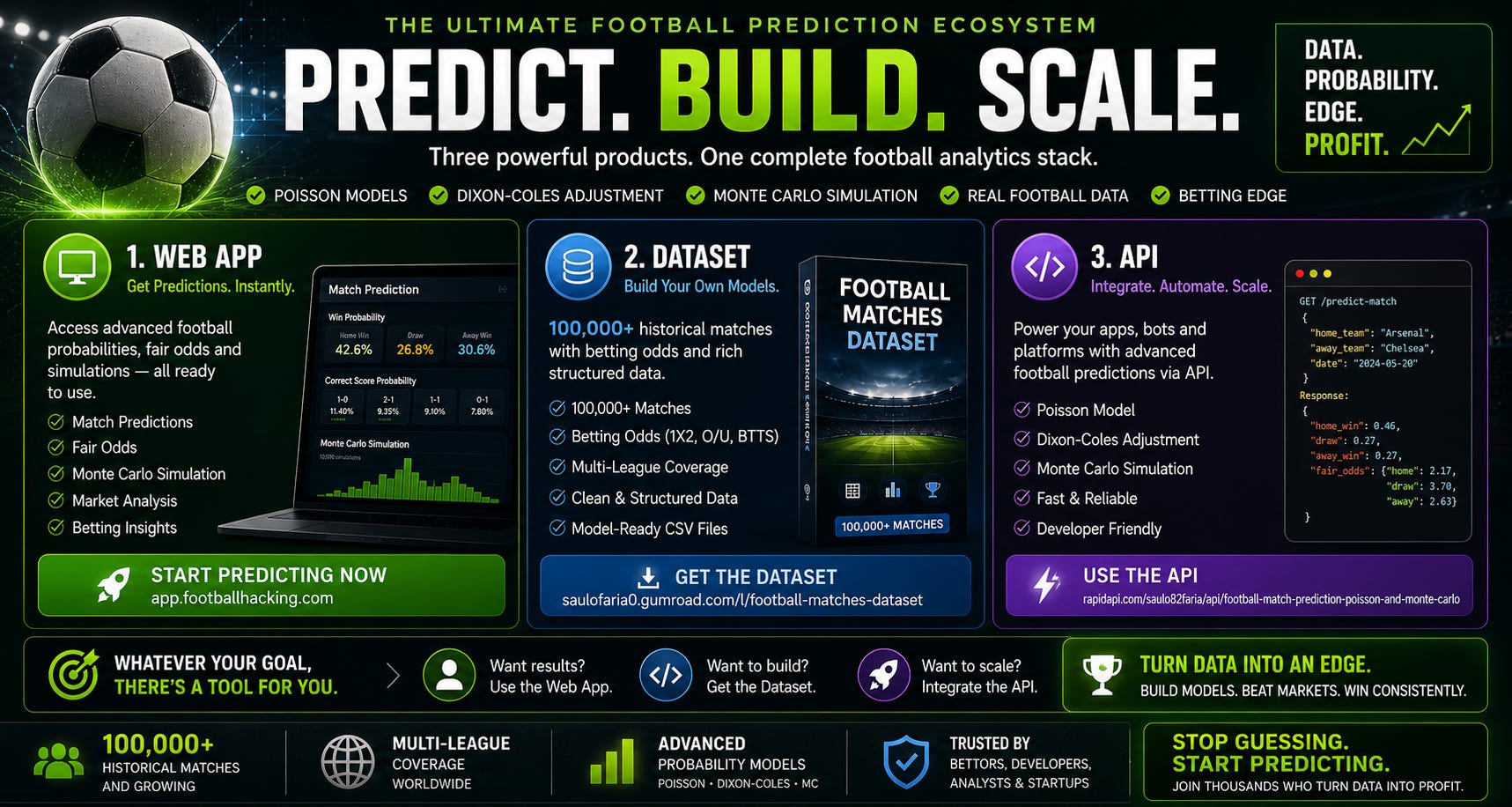
That is exactly why I built the Football Hacking ecosystem.
And depending on what you want to do, there are now three different paths available:
If you want ready-made predictions and betting intelligence → use the web app.
If you want to build your own models → use the dataset.
If you want to provide prediction services or integrate football probabilities into your own product → use the API.
This article will break down all three.
And more importantly:
I’ll explain how they connect.
Why Football Prediction Is Mostly a Data Problem
One thing becomes obvious very quickly when you work with football analytics:
Most prediction projects fail before the model even starts.
People spend weeks discussing machine learning algorithms while using terrible data.
Or they attempt to create predictive systems with:
incomplete historical records,
inconsistent odds formatting,
broken CSV structures,
duplicated matches,
missing fields,
poor league coverage,
or tiny samples.
Football prediction is fundamentally a data infrastructure problem.
The model matters.
But the infrastructure matters first.
That’s why professional-level football analytics projects always rely on three pillars:
Reliable historical match data
Probability modeling
Simulation layers
Without those three together, you are mostly guessing with prettier visuals.
The Three Different Types of Football Analytics Users
Over the last few years, I noticed football analytics users usually fall into one of these categories.
1. The User Who Wants Everything Ready
This person does not want to code.
They don’t want to clean data.
They don’t want to calculate Poisson distributions.
They don’t want to spend six months debugging models.
They simply want:
probabilities,
fair odds,
simulations,
market analysis,
and decision support.
That is exactly why I created the Football Hacking web app.
2. The Builder
This user wants control.
They want to:
create models,
train systems,
backtest strategies,
study leagues,
build betting tools,
or perform football research.
For this person, the raw material matters more than the interface.
That is where the dataset enters.
3. The Developer or Business Owner
This user already has a platform.
Maybe it’s:
a betting website,
a Telegram service,
a Discord bot,
a SaaS,
a mobile app,
or a football analytics startup.
They don’t need raw CSV files.
They need predictions delivered programmatically.
That is why the API exists.
The Football Hacking Web App
The Fastest Way to Access Football Probabilities and Simulations
If your objective is to access football probabilities immediately without building anything yourself, the web app is the most direct solution.
👉 https://app.footballhacking.com/
The idea behind the platform is simple:
You should not need to become a data scientist to access advanced football probability modeling.
The app delivers predictions powered by:
Poisson modeling,
Dixon-Coles correction,
Monte Carlo simulation,
probability distributions,
fair odds calculations,
and match reliability layers.
Instead of just showing “Team A is favorite,” the app attempts to quantify:
how strong that probability actually is,
whether the market is pricing it efficiently,
and how stable the prediction looks under simulation.
Why Poisson Alone Is Not Enough
Many football prediction systems stop at basic Poisson models.
That is usually where problems begin.
Football scores are not perfectly independent.
Low-scoring matches behave differently.
Context matters.
Variance matters.
That is why Dixon-Coles adjustments became so important historically in football modeling.
The Football Hacking app incorporates those concepts while also using Monte Carlo simulation as an additional reliability layer.
And this changes the conversation completely.
Because prediction is not only about expected goals.
It is about uncertainty.
Monte Carlo Simulation Changes Everything
One of the biggest mistakes football bettors make is thinking probability is certainty.
It is not.
A team with 62% probability still fails very often.
Monte Carlo simulation helps visualize this reality better because it repeatedly simulates possible match outcomes thousands of times.
This creates:
distribution stability,
variance analysis,
probability reliability,
and scenario understanding.
Monte Carlo methods are widely used in statistical football prediction systems because football itself is an inherently stochastic environment.
The goal is not to eliminate uncertainty.
The goal is to understand it better than the market.
Why Most People Misunderstand Betting Value
Most bettors still think in terms of “who will win.”
That is not the real question.
The real question is:
Is the market pricing this probability correctly?
That changes everything.
You can lose a bet and still make a correct probabilistic decision.
And you can win a bet while making a terrible probabilistic decision.
The Football Hacking app was designed around that distinction.
That is why fair odds matter.
That is why implied probability matters.
That is why simulation matters.
Because long-term performance is driven more by pricing efficiency than emotional prediction.
Who the Web App Is For
The web app is ideal if you:
want ready-made football probabilities,
use betting markets,
want fast decision support,
do not want to code,
want Monte Carlo simulations already configured,
want fair odds instantly,
or simply want a structured football analytics workflow without building infrastructure.
Instead of spending months building models, you can focus on interpretation.
The Football Matches Dataset
For People Who Want to Build Their Own Models
Now let’s talk about the second layer.
The dataset.
👉 https://saulofaria0.gumroad.com/l/football-matches-dataset
This is for a completely different type of user.
This is for people who want ownership of the modeling process.
Maybe you are:
a data scientist,
a football analyst,
a machine learning student,
a bettor building custom systems,
a researcher,
or someone creating predictive products.
The dataset exists because sourcing and structuring football data is far harder than most people expect.
Why Historical Football Data Is So Difficult
People think football datasets are easy to find.
Good football datasets are not.
Especially when you need:
historical bookmaker odds,
standardized formatting,
consistent league structure,
clean records,
scalable CSV handling,
multi-season continuity,
and enough sample size for serious statistical work.
The Football Matches Dataset contains more than 82,000 professional football matches with betting odds and structured match information.
And scale matters.
A lot.
Small Samples Destroy Football Models
One of the biggest problems in football analytics is overfitting.
A model performs beautifully on small samples…
then collapses in real markets.
Why?
Because football contains enormous variance.
Large datasets help reduce that problem.
The more historical structure you have:
the more robust your distributions become,
the more reliable your calibration becomes,
and the more realistic your simulations become.
This is especially important when building:
Poisson systems,
expected goals estimators,
market inefficiency models,
or machine learning pipelines.
What You Can Build With the Dataset
The interesting part is not the dataset itself.
The interesting part is what it enables.
With the dataset, you can build:
Betting Models
Poisson systems
Dixon-Coles models
Bayesian models
Elo-based systems
Market inefficiency models
Machine Learning Pipelines
Match outcome prediction
Goal prediction
Over/Under classification
Team strength estimation
League clustering
Research Projects
Home advantage studies
Market efficiency studies
Variance analysis
League behavior comparison
Probability calibration research
Commercial Products
Betting tools
Prediction dashboards
Telegram bots
Automated content systems
Statistical APIs
Why Developers Need Structured Data
Developers consistently underestimate the time required to clean football data.
And this becomes catastrophic at scale.
Imagine:
duplicate records,
missing odds,
inconsistent team names,
broken encodings,
mixed date formats,
league naming inconsistencies,
and corrupted CSV structures.
That can destroy entire pipelines.
Structured historical data is not exciting.
But it is the foundation everything else depends on.
👉 https://saulofaria0.gumroad.com/l/football-matches-dataset
The Football Prediction API
For Developers, Startups, and Automation
The third layer of the ecosystem is the API.
👉 https://rapidapi.com/saulo82faria/api/football-match-prediction-poisson-and-monte-carlo
This is for people who want prediction infrastructure without building prediction engines internally.
And honestly?
This is where many football products are heading.
Because modern football businesses increasingly need:
automation,
scalability,
and prediction delivery.
Why APIs Matter More Than Ever
Most modern football products are not standalone websites anymore.
They are ecosystems.
Examples:
Telegram prediction channels
Betting dashboards
SaaS products
Mobile apps
Discord bots
AI football assistants
Automated content systems
All of them need data pipelines.
And APIs solve that problem.
Instead of manually calculating predictions internally, you consume probabilities programmatically.
That reduces:
infrastructure complexity,
maintenance costs,
and development time.
What the API Provides
The Football Prediction API delivers football forecasting powered by:
Poisson modeling,
Dixon-Coles adjustments,
Monte Carlo simulation,
and probabilistic outputs.
This allows developers to integrate football prediction layers directly into their systems.
Possible use cases include:
Betting Platforms
Display:
probabilities,
fair odds,
market analysis,
or simulation outputs.
Telegram or Discord Bots
Automate:
match predictions,
alerts,
probability summaries,
or betting insights.
Football Apps
Integrate:
live prediction widgets,
pre-match intelligence,
or simulation layers.
Content Automation
Generate:
prediction posts,
newsletters,
match previews,
or probability reports.
Building Football Products Is Harder Than It Looks
A lot of people underestimate the engineering side of football analytics.
The math is only one part.
You also need:
hosting,
infrastructure,
scaling,
endpoints,
latency handling,
data continuity,
and maintenance.
The API removes a large portion of that complexity.
Instead of spending months building prediction architecture, developers can focus on:
user experience,
automation,
and product differentiation.
👉 https://rapidapi.com/saulo82faria/api/football-match-prediction-poisson-and-monte-carlo
Which Product Is Right for You?
This is the simplest way to think about it.
If You Want Predictions Ready Immediately
Use the web app.
You want:
fast access,
probabilities,
fair odds,
simulations,
and decision support.
👉 https://app.footballhacking.com/
If You Want to Build Models
Use the dataset.
You want:
raw historical data,
betting odds,
research capability,
and model-building freedom.
👉 https://saulofaria0.gumroad.com/l/football-matches-dataset
If You Want to Build Services
Use the API.
You want:
scalable prediction delivery,
integration capability,
automation,
and football forecasting infrastructure.
👉 https://rapidapi.com/saulo82faria/api/football-match-prediction-poisson-and-monte-carlo
The Future of Football Analytics
Football analytics is moving toward a world where:
probabilities matter more than narratives,
structure matters more than emotion,
and automation matters more than manual workflows.
The people who adapt early gain enormous leverage.
Because football increasingly rewards:
scalable analysis,
fast interpretation,
statistical discipline,
and data infrastructure.
Not hot takes.
Not emotional reactions.
Infrastructure.
And that is ultimately what the Football Hacking ecosystem tries to provide:
ready-made prediction tools,
raw historical football data,
and scalable prediction infrastructure.
Whether you are:
a bettor,
a developer,
a data scientist,
a startup founder,
or a football analyst,
there is now a path that fits the way you work.
Final Thoughts
Most people never build football models because they get trapped between complexity and execution.
That gap is exactly what these products try to solve.
If you want simplicity:
use the app.
If you want control:
use the dataset.
If you want scalability:
use the API.
The important thing is this:
Stop rebuilding the infrastructure layer every time you want to analyze football.
Start focusing on the actual edge.
Explore the Football Hacking Ecosystem
Web App
Dataset
100,000+ historical football matches with betting odds for modeling, machine learning, and research.
API
Football prediction infrastructure for developers, apps, bots, and services.
If you enjoyed this article, subscribe to Football Hacking for more football analytics, probability modeling, betting market analysis, and football data engineering content.