


If you build football prediction models long enough, you eventually encounter a frustrating reality.
Sometimes the model works beautifully.
Other times it fails completely.
And the strange part is that the model itself hasn’t changed.
What changed was the league.
Some competitions follow statistical patterns that align remarkably well with probabilistic models. Others produce erratic outcomes, unstable goal distributions, and unpredictable tactical dynamics.
In other words:
Football leagues themselves have different levels of predictability.
This insight is rarely discussed in mainstream football analytics, but it has enormous implications for anyone working with:
• sports data science
• predictive modeling
• betting market analysis
• probability forecasting.
Over the past weeks I ran a large modeling experiment across dozens of professional football leagues to answer a simple but powerful question:
Which football leagues are actually predictable?
To answer that, I evaluated three different prediction tasks:
• Match Odds (Home / Draw / Away)
• BTTS — Both Teams to Score
• Over 2.5 Goals
Each league was ranked using three probabilistic evaluation metrics:
• Log Loss
• Brier Score
• Global Goal Dispersion Index
Together these metrics reveal something deeper than simply “which team wins”.
They reveal how stable the statistical structure of a league actually is.
👉 Explore the Football Hacking web app
Free Preview
If two leagues have the same average number of goals per match, it does not mean they behave the same statistically.
In reality, football competitions vary enormously in terms of:
• tactical consistency
• attacking patterns
• defensive structures
• goal variance.
Some leagues follow distributions that fit extremely well with Poisson-based probability models.
Others exhibit significant overdispersion, where goal variance exceeds theoretical expectations.
This difference has a direct impact on prediction accuracy.
Even a well-designed model will struggle in a chaotic league, while a relatively simple model can perform surprisingly well in competitions where statistical patterns are stable.
In this study, I evaluated dozens of leagues by running rolling predictions and measuring how accurately the model estimated probabilities for:
• match outcomes
• both teams to score
• total goals.
The results produced a ranking of leagues based on their predictability under probabilistic models.
And some of the results are genuinely surprising.
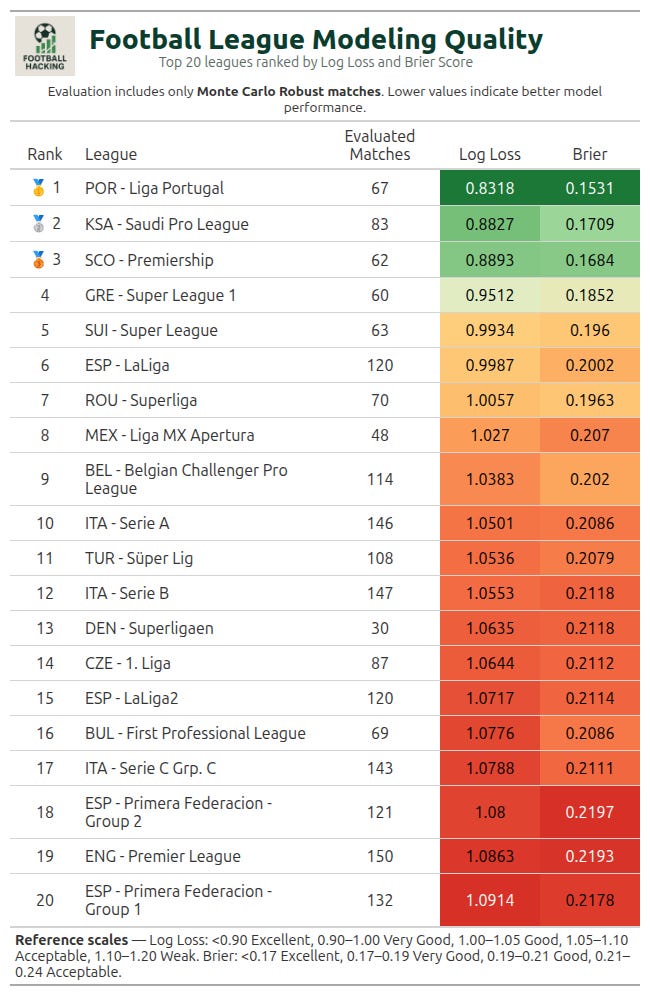
👉 Explore the Football Hacking web app
Methodology: How the League Rankings Were Built
The predictions used in this analysis are based on a structured probabilistic framework built around expected goals.
For each match, the model estimates:
• expected goals for the home team
• expected goals for the away team.
These values are derived from historical attacking and defensive strengths relative to league scoring averages.
Once expected goals are calculated, a Poisson goal distribution is used to estimate the probability of every possible scoreline.
For example:
0–0
1–0
1–1
2–1
2–2
3–1
and so on.
From this distribution we can derive probabilities for various betting markets.
However, real football results deviate slightly from pure Poisson assumptions — particularly for low-scoring matches.
To address this, the model applies Dixon–Coles adjustments, which correct the probabilities of outcomes like:
• 0–0
• 1–0
• 0–1
• 1–1.
These corrections significantly improve the realism of football probability models.
Once probabilities are generated, predictions are evaluated using proper scoring rules.
