

Let’s get one thing absolutely clear before we start:
This entire analysis is built exclusively on pass network structure and expected threat (xT).
There is:
No video observation
No subjective interpretation of chances
No highlight-based narrative
No “eye test” conclusions
Everything you’re about to read comes from structural data.
And that matters, because matches like PSG 5–4 Bayern Munich are exactly where traditional analysis fails.
A nine-goal thriller usually gets reduced to:
“chaos”
“defensive mistakes”
“momentum swings”
But this match was not random.
It was structurally asymmetric.
And once you understand that asymmetry, the result stops being surprising.
Why This PSG vs Bayern Analysis Is Different (and More Useful)
Most match reports answer:
“What happened?”
This one answers:
“Why did the structure produce that outcome?”
Because football at elite level is not decided by:
possession totals
number of attacks
visual dominance
It is decided by:
how much value each action generates — and how that value survives pressure
And that’s exactly what pass networks + xT reveal.
The Core Truth of the Match (Everything Starts Here)
From the structural data:
This match can be reduced to a single, decisive contrast:
Bayern Munich
More final-third presence
More circulation
Higher attacking frequency
Paris Saint-Germain
Higher xT per action
Higher value per progression
Better post-resistance sequences
So the real story is:
Bayern produced more attacks. PSG produced better attacks.
And in elite football, better always beats more.
The Illusion of Bayern’s Control
If you watched the game casually, Bayern may have looked like the dominant team.
They:
Controlled large phases of possession
Built through central corridors
Reached the final third repeatedly
Structurally, their network supported that:
Strong central triangle (Tah → Pavlovic → Kimmich)
High involvement in Initiation and Progression Space
Stable circulation patterns
On the surface, this is control.
But this is where the analysis becomes uncomfortable:
Control without value is not real control.
The Metric That Changes Everything
Let’s put numbers into context:
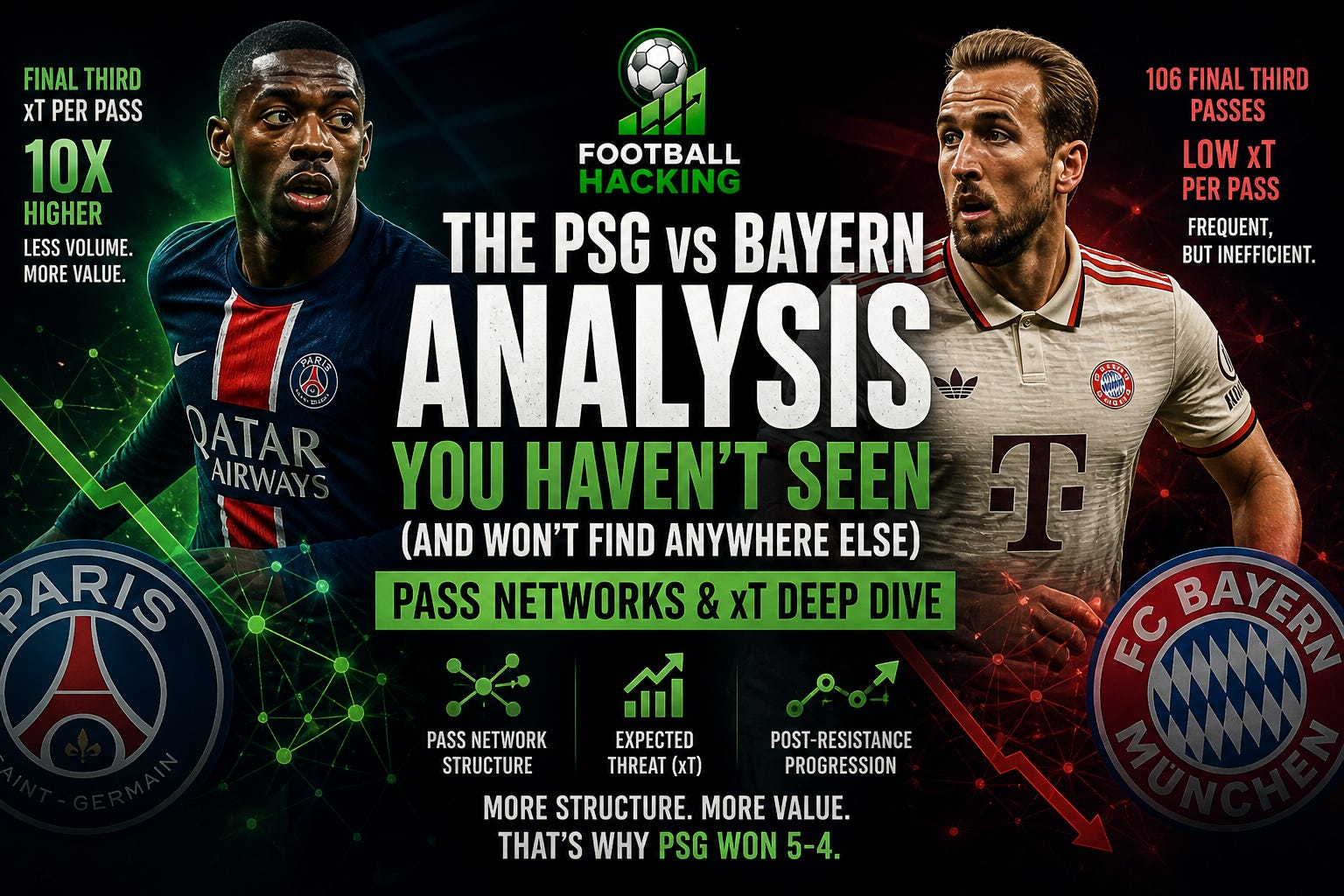
Bayern final-third passes: 106
PSG final-third passes: 46
Now the decisive layer:
Bayern final-third value per pass → extremely low
PSG final-third value per pass → more than 10x higher
This is not variance.
This is structure.
Frequency vs Value: The Match-Deciding Axis
This match is one of the clearest examples you will ever see of this principle:
Bayern
High frequency
Low efficiency
Repetitive circulation
Weak structural conversion
PSG
Lower frequency
High efficiency
Sharp progression
Strong structural conversion
This explains everything:
the goals
the rhythm
the instability
the final outcome


PSG’s Attacking Structure: Precision Over Volume
PSG did not need territorial dominance.
They needed structural clarity.
Their Main Progression Pattern
Start in central corridor or right corridor
Progress under controlled support
Shift into central corridor or left half-space in final third
Execute quickly before defensive stabilization
This is not random attacking.
This is controlled destabilization.
Why PSG Generated More Threat (With Less Ball)
PSG consistently completed the full attacking chain:
Continuity Support → stabilize possession
Fixation Support → hold defenders
Rupture Support → create imbalance
Superation Support → break pressure
Progression Support → attack valuable space
Bayern often skipped the middle steps.
And that’s where their structure collapsed.
Bayern’s Structural Problem: Access Without Conversion
Let’s be precise:
Bayern did NOT struggle to reach dangerous areas.
They struggled with what happened after reaching them.
Their most common attacking pattern:
Central progression
Entry into final third
Immediate pressure
Lateral circulation
Re-entry attempt
This creates:
Volume
Territory
Visual pressure
But not:
Threat
Structural instability
Goal probability
The Final Third: Bayern’s False Territory
Bayern’s final-third presence was structurally superficial.
They:
Stayed high
Circulated often
Maintained pressure
But:
They rarely increased value after resistance
That’s the key failure.
PSG’s Efficiency: Why They Needed Less
PSG didn’t stay in attacking zones.
They converted them.
Their sequences:
Arrived faster
Carried higher xT
Maintained value across multiple passes
Which means:
PSG didn’t need more attacks — they needed better ones.
Player Roles That Defined the Structure
Ousmane Dembélé
Primary Superation Support
Also Third-Man Support
Key link to João Neves (highest value connection)
He didn’t just progress play.
He transformed sequences into threat.
Vitinha
Core Continuity + Security Support
Controlled when progression should happen
He made PSG stable enough to be dangerous.
Achraf Hakimi
Progression + Rupture Support
Drove asymmetry in Bayern’s defensive shape
Désiré Doué
Fixation + Third-Man Support
Provided control before acceleration
Bayern Structure
Kimmich & Pavlovic
Strong Continuity + Progression Support
Enabled circulation, not conversion
Tah
Initiation + Security Support
Anchored the network
Kane
Intended fixation point
But lacked structural support around him
Bayern’s Critical Weakness: The Right Corridor
One of the clearest failures:
Stanisic → Olise connection
Repeated sequences
Negative xT outcomes
What does that mean structurally?
Weak Third-Man Support
Poor support timing
Lack of rupture capacity
So the ball arrives…
…but the attack dies.
PSG’s Weakness (And Why Bayern Stayed Alive)
PSG were not flawless.
Their biggest issue:
Midfield Resistance Collapse
When pressed early:
They retreated into defensive third
Lost vertical progress
Reset structure
Especially on the left side:
Large negative progression distances
Negative xT sequences
This is why Bayern:
Stayed competitive
Found moments
Scored 4 goals
Defensive Layer: PSG’s Hidden Advantage
PSG didn’t just defend.
They devalued Bayern’s attacks.
In key zones:
Defensive-third central corridor → forced rhythm loss
Half-spaces → delayed progression
Recirculation → negative value sequences
Bayern could arrive…
…but couldn’t stabilize.
The 5-Pass Rule: Where PSG Won the Match
Every sequence is evaluated by:
What happens in the next 5 passes
PSG:
Maintained or increased value
Bayern:
Lost or stagnated value
This is the real difference between:
progression
and effective progression
Two Different Types of Instability
PSG Instability
Occurs in midfield
Leads to resets
Recoverable
Bayern Instability
Occurs in final third
Leads to stagnation
Structurally damaging
That difference decides matches.
Why the Match Tilted Toward PSG
Four structural reasons:
Higher xT per sequence
Better conversion after entry
Stronger defensive disruption
More effective second-phase progression
This Was Not Chaos — It Was Structural Inefficiency
A 5–4 scoreline invites lazy explanations.
But the data shows:
PSG were not lucky.
Bayern were not dominant.
The match followed structural logic.
What This Means for Analysis, Coaching, and Betting
This match proves:
Possession is overrated
Final-third presence can be misleading
Structure determines sustainability
Value beats volume
Live Betting Insight (Actionable Edge)
Watch for:
High Bayern-style circulation → low real threat
PSG-style fast corridor shifts → high threat
Midfield resistance outcomes → match direction
Right corridor stagnation → Bayern inefficiency
Why This Type of Analysis Matters
Because it scales.
This is not:
opinion
narrative
highlight bias
This is:
repeatable
measurable
predictive
Want More Analysis Like This?
If this changed how you see the game…
You’re exactly who this project is for.
👉 Subscribe to the newsletter
You’ll get:
Structural match breakdowns
Pre-match diagnostics
Live betting frameworks
Pass network + xT insights
⚠️ Important: All Articles Are FREE Until May 20
This is your chance to:
Explore the full methodology
Understand the edge
See how it applies weekly
Final Insight
You didn’t just watch a 5–4 thriller.
You watched:
A team with lower volume but higher structural value
defeat a team with higher volume but lower structural efficiency
And once you start seeing football through that lens…
You won’t go back.
If you want that edge every week:
You know where to find it.