


This analysis was built entirely through pass network structure, centrality metrics, and Expected Threat (xT) models. Every tactical conclusion presented here emerges from quantitative structural behavior — including progression routes, resistance responses, corridor occupation, and post-pressure sequence evolution — without relying on subjective video-based interpretation.
Arsenal enter Sunday’s Premier League clash against West Ham on May 10 knowing the title is now within touching distance. The margins are becoming thinner, the pressure heavier, and every sequence matters more than ever. But structurally, this match is far more complicated than a simple “title contender vs mid-table opponent” narrative.
Because beneath the surface, the data reveals something uncomfortable for Arsenal:
West Ham may actually be the more efficient team in the most decisive moments of the game.
And that is exactly what makes this matchup so dangerous.
(The win probabilities and fair odds for this match are shown in the image below.)
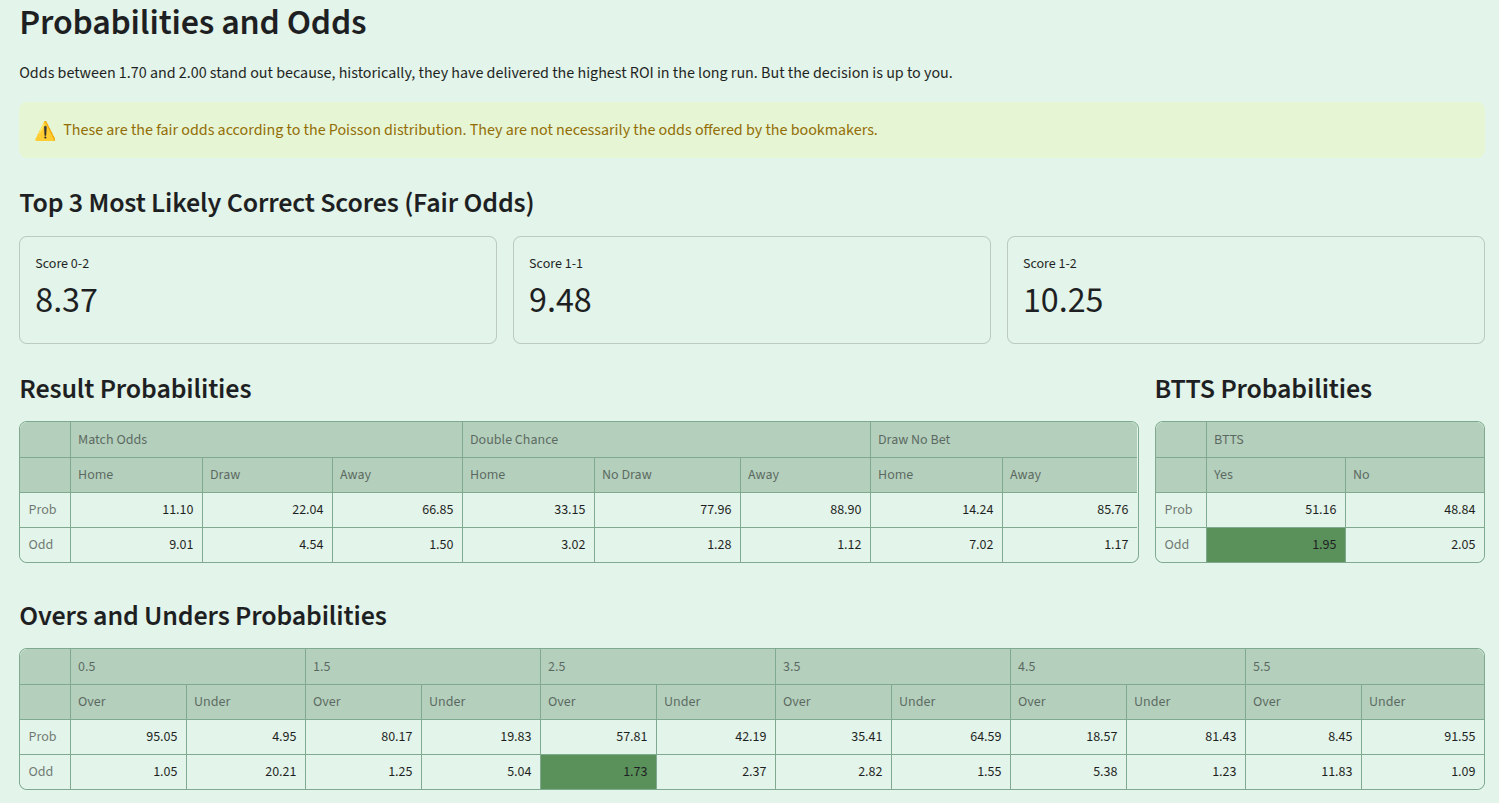
At this point, if you want access to the same structural analysis framework used in this article — including Poisson projections, Dixon-Coles adjustments, Monte Carlo simulations, fair odds, dispersion diagnostics, value identification, league reliability analysis, and live-betting suitability indicators — the Football Hacking web app was built precisely for that purpose.
Inside the platform, you get:
Fair odds for multiple betting markets
Poisson matrices for exact score probabilities
Monte Carlo simulation layers
League reliability diagnostics
Detection of overpriced and underpriced market lines
Structural pass-network analysis
xT-based progression evaluation
Home vs away degradation diagnostics
Live-betting suitability signals
Support for both major leagues and smaller leagues often ignored by the market
Indicators showing when sample sizes are statistically reliable for modeling
Most betting content online focuses only on outcomes.
Football Hacking focuses on why outcomes emerge structurally.
And that difference matters.
Arsenal’s Contradiction: More Control, Less Final Third Value
The most important structural contradiction in Arsenal’s profile is surprisingly simple:
They generate more final-third passes than West Ham… yet their final-third net value per pass is negative.
That changes the entire interpretation of their possession dominance.
This is not a team struggling to arrive in advanced areas. Arsenal absolutely can progress into dangerous zones. The issue is what happens after they arrive.
The data shows a recurring pattern:
Stable circulation
Strong central occupation
Sustained continuity
Weak rupture
Reduced destabilization of the opponent’s defensive structure
In other words, Arsenal often control territory without consistently converting that control into sustained attacking payoff.
That is the core tactical warning embedded inside this matchup.
Structurally, Arsenal remain a “continuity-first” team. Their network revolves around maintaining sequence stability through centrality-heavy circulation.
Declan Rice and Martín Zubimendi dominate the possession network through load and closeness metrics, while William Saliba operates as the foundational stabilizer in initiation phases.
The result is a team extremely comfortable in:
Initiation Space
Early Progression Space
Central continuity maintenance
Positional occupation
Defensive control after loss
But there is a catch.
Too often, Arsenal’s progression routes collapse inward into the central corridor without enough effective rupture support.
The team can secure continuity.
The team can secure circulation.
The team can secure central occupation.
But the transition from continuity into decisive destabilization is not always happening.
And against a team like West Ham, that matters enormously.
Why West Ham Are More Dangerous Than Their Table Position Suggests
West Ham’s structural profile is almost the opposite.
They are not possession-heavy.
They are not circulation-heavy.
They are not trying to dominate territory for long periods.
But they are highly dangerous once resistance is broken.
That distinction is critical.
West Ham’s superiority comes from functional incisiveness rather than territorial dominance.
Their sequences survive pressure and rapidly transform into high-value territory inside the five-pass window after resistance.
And that makes them structurally explosive.
The article file highlights multiple examples where defensive-third resistance becomes attacking-third value within only five passes.
Those are not ordinary transitions.
Those are long-distance territorial escapes carrying meaningful xT acceleration.
That explains why West Ham’s lower circulation volume should not automatically be interpreted as inefficiency.
In reality, their structure is optimized for payoff rather than control.
And that creates a dangerous asymmetry in this game.
Arsenal may control the shape of the match.
West Ham may control the value of the decisive moments.
Arsenal’s Central Corridor Obsession
Arsenal’s attacking map is heavily centralized.
Their most frequent progression routes involve:
Central corridor → progression → central corridor
Right half-space → central corridor
Left corridor → central corridor
This means Arsenal consistently seek interior reception zones after progression.
The problem is not access.
The problem is sustainability after contact.
Under strong resistance inside the attacking-third central zone, Arsenal’s sequences can regress dramatically — sometimes collapsing all the way back into the defensive-third central corridor within five passes.
That is not a harmless reset.
That is structural attacking degradation.
It means the route survives possession-wise but loses positional value completely.
This is one of the biggest hidden tactical vulnerabilities in Arsenal’s current profile.
And West Ham’s pressure profile is capable of exploiting exactly that type of instability.
The One Arsenal Zone That Truly Looks Dangerous
There is, however, one extremely important exception.
The data shows Arsenal’s attacking-third left side remains highly stable under resistance.
Even under pressure, sequences there frequently preserve continuity while generating strong positive value swings.
This matters tactically because it suggests Arsenal’s left-sided Finalization Space is structurally healthier than the central-right attacking zones.
In practical football terms:
The left side retains attacking continuity better
Pressure there produces less regression
Fixation support appears stronger
Local continuity survives contact more efficiently
That may become one of the most important live indicators during the match.
If Arsenal’s dangerous attacks increasingly emerge through left-sided continuity rather than repeated central circulation, their attacking profile likely becomes healthier.
If everything keeps collapsing back into central occupation without rupture, West Ham’s defensive resistance may gradually neutralize Arsenal’s territorial control.
Arsenal’s Defensive Edge Is Still Real
Despite the attacking contradictions, Arsenal’s defensive structure remains elite in several areas.
Their strongest defensive control zone is the attacking-third central corridor.
That high pressure frequently disrupts opponent rhythm before routes can properly form.
This is a major control mechanism.
Arsenal compress Initiation Space aggressively and force slower re-entry sequences.
That matters enormously against West Ham because West Ham’s greatest fragility appears when midfield resistance arrives.
And this is where the match becomes fascinating.
Because Arsenal’s best defensive mechanism directly attacks West Ham’s biggest structural weakness.
West Ham’s Midfield Fragility
West Ham’s bottleneck is entirely midfield-based.
When resistance emerges inside:
Midfield central zones
Midfield right-side zones
Progression Space transitions
…the structure can collapse backward rapidly.
The file repeatedly highlights sequences where midfield resistance forces:
Territorial loss
Backward escape
Negative xT
Defensive-third regression
That is the biggest tactical risk for West Ham on Sunday.
If Arsenal successfully transform the match into repeated:
central progression → pressure → backward escape → reset → re-entry attempts
…then West Ham’s direct efficiency profile becomes much harder to activate.
In simple terms:
Arsenal want the game to remain organized.
West Ham want the game to become unstable.
The Key Players Structurally
Arsenal
Declan Rice
The main continuity support reference between circulation layers.
Martín Zubimendi
Progression stabilizer and continuity controller.
William Saliba
The primary Security Support in Initiation Space.
Martin Ødegaard
Likely the main Third-Man Support bridge between central and right half-space circulation.
West Ham
Mateus Fernandes
The structural hinge of the entire team.
He dictates whether routes stabilize or collapse backward.
Jarrod Bowen
The main destabilizer.
When West Ham’s attacks become dangerous, Bowen is usually involved in the transition from progression into rupture and superation.
Tomás Soucek
Advanced-zone fixation support and secondary rupture reference.
Why This Match Could Become Uncomfortable for Arsenal
The biggest risk for Arsenal is psychological as much as tactical.
They are extremely close to the title.
That naturally increases pressure.
And structurally, they are facing a team optimized to punish unstable moments rather than dominate long phases.
If Arsenal over-commit centrally without enough rupture support, West Ham can absorb pressure and attack the spaces left during rest-defense expansion.
That is precisely the type of match where possession percentages can become misleading.
Arsenal may dominate the ball.
West Ham may dominate the highest-value transitions.
And if that happens, the game could become much tighter than the league table suggests.
The Tactical Collision That Will Define the Match
The central tactical battle is clear.
Arsenal want:
Stability
Central compression
Sustained circulation
Repeated recoveries high up the pitch
Territorial continuity
West Ham want:
Broken structure
Open progression space
Fast superation moments
Corridor switches
Rapid value extraction after resistance
This is not simply a possession battle.
It is a battle between:
Control
vsPayoff
And that distinction changes how the entire game should be interpreted.


Final Structural Expectation
The file’s conclusion is extremely important:
“Continuity favors Arsenal. Disruption favors West Ham.”
That is probably the cleanest summary of this matchup.
Arsenal should:
Control more territory
Generate more final-third occupation
Dominate possession
Spend more time in the attacking half
West Ham should:
Create fewer attacks
Produce faster attacks
Generate more explosive value spikes
Punish unstable defensive moments
The decisive factor may ultimately become very simple:
Which team survives resistance without surrendering positional value inside the next five passes?
And in structural football, that is often where matches are truly decided.
Brief Live Betting Checklist
Arsenal Positive Signals
Left-sided attacking continuity remains stable under pressure
High recoveries in attacking-third central zones
West Ham repeatedly forced into backward midfield escapes
Ødegaard receiving between lines with forward continuity preserved
West Ham Positive Signals
Bowen receiving after first pressure line is broken
Fast defensive-third → attacking-third transitions
Arsenal central attacks repeatedly collapsing backward
Warning Signs Against Arsenal Backers
High possession with low final-third destabilization
Excessive defender-to-defender circulation
Central occupation without rupture
Repeated resets after attacking-third pressure
If you want access to these types of structural diagnostics before kickoff — including fair odds, Monte Carlo projections, league-specific reliability signals, pass-network analysis, and xT-based progression frameworks — the Football Hacking web app was designed exactly for that.
Because football matches are not decided only by possession.
They are decided by what survives pressure.