

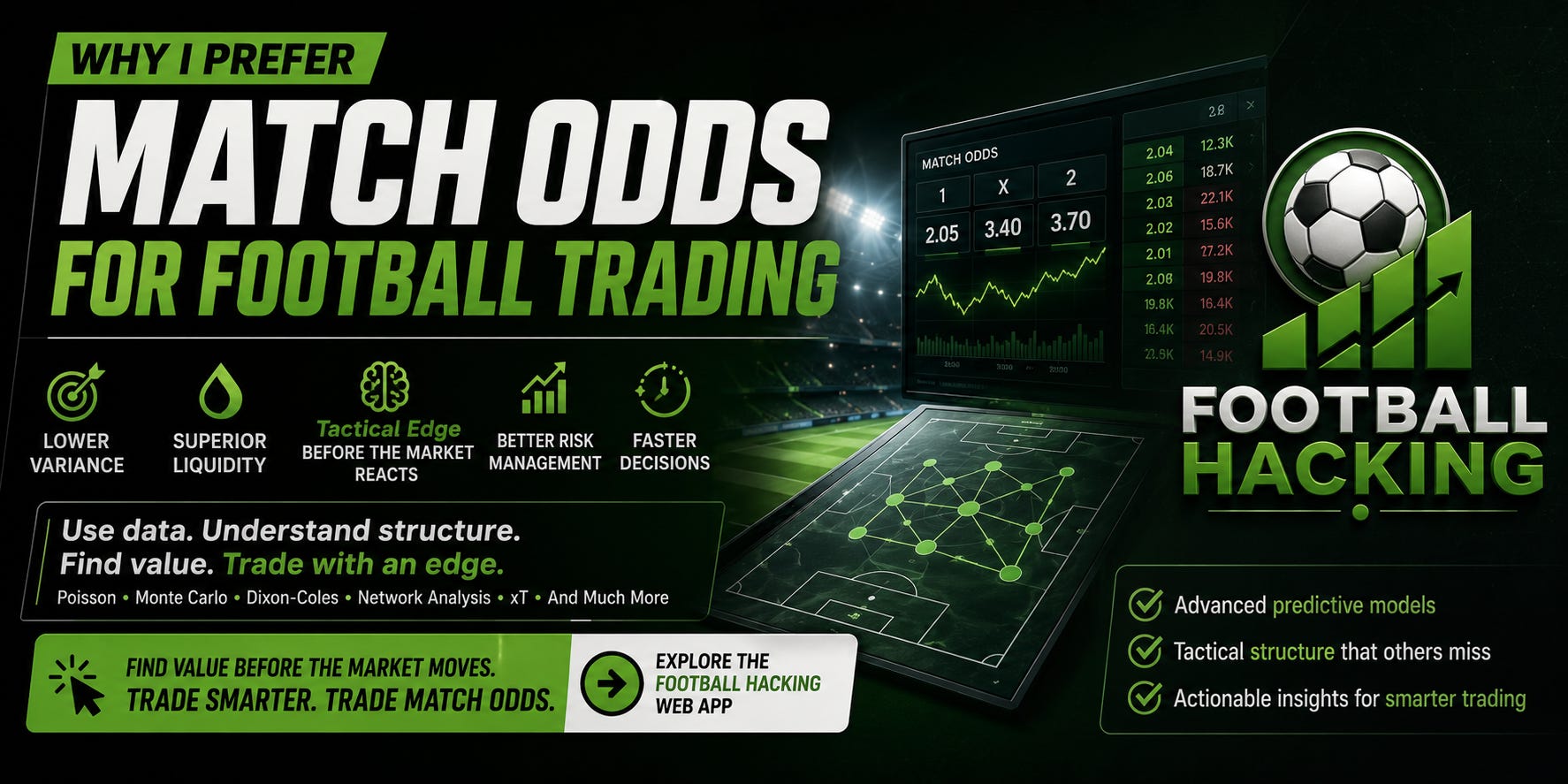
It is important to reinforce that this article is specifically about trading, not punting. The objective here is not simply predicting winners and holding positions until the final whistle, but actively exploiting price movements and market inefficiencies during the match. In trading, timing, liquidity, tactical interpretation, and risk management matter just as much — if not more — than the final result itself. That distinction is crucial, because many of the advantages discussed throughout this article, especially the ability to anticipate structural shifts before the market reacts, become significantly more powerful in a trading environment than in traditional pre-match betting.
If you want to survive in football trading long term, you need one thing above everything else: value before kickoff.
That is the real foundation.
Not emotions.
Not “feeling the game.”
Not chasing goals.
Not jumping from market to market trying to force opportunities.
The entire game starts with identifying where the market is wrong before the ball even starts rolling.
That is exactly why I built the Football Hacking web app.
The platform combines:
Poisson models
Dixon-Coles adjustments
Monte Carlo simulations
Fair odds generation
Dispersion metrics
League reliability diagnostics
Match-specific structural indicators
Pass Network Health Index
All designed to help identify when market prices are inefficient before kickoff.
And after years working with football data, tactical structures, live trading, and quantitative modeling, I reached a conclusion that changed the way I operate:
Match odds is the market that best combines tactical edge, lower variance, liquidity, scalability, and informational advantage.
While most traders jump obsessively between over/under, corners, cards, correct score, and dozens of micro-markets, I increasingly prefer focusing my trading around match odds.
Not because it is easier.
Because it is cleaner.
More stable.
More readable.
And, most importantly:
Because tactical structure impacts match odds more directly and more predictably than almost any other football market.
Why Most Football Traders Struggle Long Term
Most football traders are not actually trading.
They are reacting emotionally to randomness.
That sounds harsh, but it is true.
A goal happens and they panic.
A red card appears and they chase.
One dangerous attack occurs and they overestimate momentum.
Another team has possession for two minutes and suddenly they think the entire match changed.
Football is an extremely noisy sport.
And if your strategy depends heavily on isolated events, you become hostage to variance.
That is one of the biggest reasons I moved more and more toward match odds trading.
Because match odds allows you to trade structural superiority instead of isolated randomness.
That distinction changes everything.
Match Odds Rewards Structural Understanding
Goals are noisy.
Structure is persistent.
This is the key idea.
A team can miss chances.
A goalkeeper can overperform.
A deflection can happen.
But over time, structural dominance tends to manifest itself.
And match odds is constantly repricing structural control during the game.
That is where tactical analysis becomes incredibly powerful.
If you understand:
progression quality,
corridor occupation,
pressure resistance,
pass network stability,
centrality concentration,
final-third access patterns,
defensive disruption zones,
attacking continuity,
you can often detect shifts before the market fully reacts.
That edge is enormous.
Especially live.
Why I Prefer Match Odds Over Goals Markets
This is where many traders disagree with me initially.
People love over/under because goals are exciting.
But from a trading perspective, goals markets often introduce unnecessary chaos.
Here is why.
1. Goals Markets Are Hyper-Sensitive to Variance
A random deflection changes everything.
One isolated counterattack changes everything.
One individual mistake changes everything.
Even statistically dominant teams can completely fail to produce goals.
The problem is that goals are low-frequency events.
And low-frequency events create brutal short-term variance.
Match odds, on the other hand, reacts to broader structural information.
A dominant team sustaining territorial control, progression continuity, and stable attacking pressure can still see its match odds price compress even before goals happen.
That creates opportunities.
2. Match Odds Has Superior Liquidity
Liquidity matters far more than most beginners understand.
If you want to scale seriously, liquidity becomes essential.
Match odds markets generally have:
tighter spreads,
deeper liquidity,
faster matching,
more efficient entry and exit possibilities.
This matters enormously during live trading.
You can enter and exit positions more efficiently.
You can hedge more cleanly.
You can reduce slippage.
You can manage risk better.
Many secondary markets simply do not provide the same flexibility.
3. Match Odds Reflects Tactical Reality Better
This is probably my favorite reason.
Football is fundamentally about territorial and structural superiority.
Not just goals.
And match odds reflects that reality more naturally.
A team can be:
progressing consistently,
creating superior positional occupation,
forcing defensive collapses,
generating stable final-third entries,
disrupting opponent circulation,
without necessarily generating immediate shots.
But the market eventually notices.
Especially sharp traders.
The earlier you identify these patterns, the greater your edge becomes.
That is why tactical analysis is not optional anymore.
It is essential.
Why Pass Network Analysis Is a Massive Edge for Live Trading
Most traders still watch football through highlights logic.
They look for:
shots,
dangerous attacks,
possession percentages,
xG spikes.
But football structure starts much earlier than that.
This is exactly why I focus heavily on pass network analysis and structural diagnostics.
Because the game reveals its tendencies before the shots appear.
Pass networks allow you to identify:
progression bottlenecks,
overloaded corridors,
centrality concentration,
unstable circulation,
isolation of key connectors,
weak pressure resistance,
asymmetric buildup patterns,
fragile rest-defense structures.
And the beautiful part is this:
You do not need to manually watch every previous match anymore.
The structural patterns repeat.
Teams repeat behaviors.
Certain buildup mechanisms recur constantly.
Certain progression routes become predictable.
Certain pressure vulnerabilities become chronic.
That is where data-driven tactical analysis becomes incredibly powerful.
And honestly?
This type of analysis is still massively underutilized in football trading.
Inside the Football Hacking web app, you can analyze how healthy a team’s pass-network structure has been throughout the season and over its most recent 5 matches.
The platform provides structural diagnostics based on pass networks, centralities, progression patterns, corridor usage, pressure resistance, and xT flow — helping traders understand whether a team’s underlying football supports the market expectation before the match even starts.
Because the best live decisions usually begin with better pre-match structural understanding.
Why Speed Matters in Trading
Football trading is not just about being right.
It is about being right before the market.
That changes everything.
And this is precisely why automated structural analysis matters so much.
Because manually analyzing every match is impossible at scale.
If you need to rewatch six matches from every team before every trading session, you lose scalability completely.
Instead, I prefer extracting structural tendencies quantitatively:
pass networks,
xT patterns,
progression corridors,
resistance zones,
centrality metrics,
defensive disruption maps.
That allows faster decision-making.
Faster recognition.
Faster reaction.
And in trading, speed combined with accuracy is where the real edge lives.
Why Lower Variance Matters More Than Most Traders Realize
Most traders massively underestimate psychological variance.
Not just statistical variance.
Psychological variance.
Huge swings destroy discipline.
Huge swings create emotional instability.
Huge swings make people abandon profitable systems.
One of the reasons I increasingly prefer match odds is because it generally produces smoother volatility profiles compared to highly event-dependent markets.
Of course, football is still volatile.
But structurally driven match odds trading tends to create more manageable fluctuations.
That matters.
Especially long term.
Because consistency beats adrenaline.
Every single time.
The Problem With Chasing Every Market
A lot of traders try to operate:
over/under,
corners,
cards,
correct score,
halftime,
player props,
next goal,
Asian handicaps,
all simultaneously.
Usually this creates noise, not edge.
Specialization matters.
Deep understanding matters.
The deeper your understanding of one market becomes, the stronger your informational advantage grows.
For me, match odds offers the cleanest intersection between:
tactical structure,
quantitative modeling,
liquidity,
scalability,
and psychological sustainability.
That combination is incredibly hard to beat.
Why Pre-Match Value Is Essential Before Going Live
One of the biggest mistakes traders make is entering live markets without pre-match context.
That is dangerous.
You need a baseline.
You need fair value references.
You need probabilistic expectations before kickoff.
This is exactly where predictive models become essential.
Inside the Football Hacking app, I use:
Poisson distributions,
Dixon-Coles corrections,
Monte Carlo simulations,
fair odds generation,
league dispersion analysis,
confidence diagnostics,
to estimate whether the market is overpricing or underpricing teams before kickoff.
That pre-match framework becomes the anchor for live trading.
Without it, you are trading blind.
Why Monte Carlo Simulation Matters for Traders
Monte Carlo simulation is incredibly important because football is probabilistic.
Not deterministic.
Most people think in terms of certainty.
Professional trading requires thinking in distributions.
A team may win 52% of the time.
That does not mean they will win today.
It means the price matters.
Over large samples, pricing inefficiencies become exploitable.
Monte Carlo simulation helps estimate:
outcome distributions,
volatility ranges,
score probabilities,
pricing asymmetries,
market inefficiencies.
That allows traders to think like portfolio managers instead of gamblers.
Huge difference.
Why Tactical Structure Creates Predictive Power
This is probably the most misunderstood aspect of football trading.
Structure creates future probability.
Not isolated moments.
For example:
A team consistently progressing through the left half-space with stable third-man connections is more likely to sustain attacking pressure later.
A team with fragile buildup centrality under pressure is more likely to collapse territorially later.
A team whose defensive actions occur too deep repeatedly may eventually lose territorial control.
These patterns matter enormously.
And they often appear before the market fully adjusts.
That delay is where edge exists.
Why Most Public Football Analysis Is Too Slow
Most football content online is reactive.
People explain what already happened.
I care much more about identifying what is likely to happen next.
That is a massive difference.
And this is exactly why structural data matters.
Because it allows anticipation.
Not just description.
That is also why my newsletter focuses heavily on pass network structure, xT progression, tactical recurrence patterns, and quantitative diagnostics.
You are not just reading opinions.
You are reading structural interpretation backed by data.
👉
Match Odds Allows Cleaner Risk Management
Risk management is massively underrated in football trading discussions.
Many markets become difficult to manage dynamically.
Match odds is cleaner.
You can:
scale in more efficiently,
hedge more naturally,
reduce exposure faster,
react to tactical shifts cleaner,
exploit momentum compression better.
This flexibility matters enormously during live conditions.
Especially when tactical dynamics change rapidly.
The Psychological Advantage of Match Odds Trading
This is another huge point.
Match odds trading generally encourages better decision-making discipline.
Because you are trading broader match dynamics rather than obsessing over every isolated attack.
That creates calmer execution.
Cleaner thinking.
Better emotional control.
And emotional control is one of the biggest hidden edges in trading.
Most people lose not because their ideas are terrible.
They lose because emotionally they cannot survive variance.
Why I Believe Tactical Traders Will Dominate the Future
Football markets are becoming sharper.
Pure statistical edges are shrinking.
Everyone has access to xG now.
Everyone has access to shots.
Everyone has access to possession.
But very few people truly understand structure.
Very few people deeply understand:
network dynamics,
progression geometry,
corridor manipulation,
pressure resistance,
centrality disruption,
territorial stability.
That is where future edge lives.
Especially live.
The traders who combine:
quantitative modeling,
structural tactical analysis,
probability theory,
and disciplined execution
will dominate long term.
I genuinely believe that.
My Current Trading Philosophy
Today, my philosophy is much simpler than years ago.
I care about:
pre-match value,
structural superiority,
tactical sustainability,
liquidity,
manageable variance,
and fast information processing.
Match odds fits all of those criteria better than any other football market for me personally.
That does not mean other markets cannot work.
Of course they can.
But match odds aligns best with the way I analyze football structurally.
And the more my tactical models evolved, the more this became obvious.
Final Thoughts
Football trading is not about predicting every goal.
It is about understanding probability better than the market.
And in my experience, match odds offers the cleanest environment to express that edge.
Especially when combined with:
pre-match fair odds,
Monte Carlo simulation,
Dixon-Coles adjustments,
pass network analysis,
xT diagnostics,
and structural tactical interpretation.
That combination creates something extremely powerful:
The ability to anticipate before the market fully reacts.
And in trading, anticipation is everything.
If you want to build a more structured, data-driven, and tactically informed football trading process, you can explore the Football Hacking ecosystem below:
Web App
Newsletter
The future of football trading belongs to traders who understand structure before everyone else does.