

👉 If you want full access to my models, data, and interactive tools, become a premium subscriber to Football Hacking. Premium members get complete access to the web app, more leagues, and deeper analytics. This is where I publish and maintain everything I actually use in practice.
Football fans love certainty. Bettors love probabilities. Data scientists love models. And somewhere in the middle of all that sits one of the most popular tools in football analytics: the Poisson model.
If you’ve ever tried to predict football scores, you already know the drill: estimate expected goals (λ) for each team, run a Poisson distribution, build a score matrix, and out come the probabilities. Simple. Elegant. Powerful.
But there’s a catch.
If you’ve tested this seriously across multiple leagues, you’ve probably noticed something strange:
the same Poisson model can look great in one league and pretty mediocre in another.
That’s not a bug. That’s a feature of reality.
In this article, I’ll explain why the accuracy of Poisson-based models is strongly related to the technical and structural level of a league, what’s really going on under the hood from a statistical point of view, and how you can use this insight to become more selective, more realistic, and more profitable with your models.
And if you want to explore these ideas in practice, with real data and interactive tools, you can check the Football Hacking web app here:
👉
https://footballhacking.streamlit.app/
The Hidden Assumptions Behind Poisson
Let’s start with something most people skip: what Poisson is actually assuming about football.
When you model goals with a Poisson distribution, you are implicitly assuming that:
Goals are rare, discrete events
They occur with a stable average rate (λ) over the match
Each goal is approximately independent of the previous one
The process is stationary enough to be summarized by a single parameter
In plain English, Poisson works best when:
The game behaves like a reasonably stable random process with a consistent scoring rate.
Of course, football is not perfectly like that. Tactics change, red cards happen, teams adapt, psychology matters, and randomness is everywhere. But in some environments, reality is much closer to these assumptions than in others.
And that’s where league quality and structure come in.
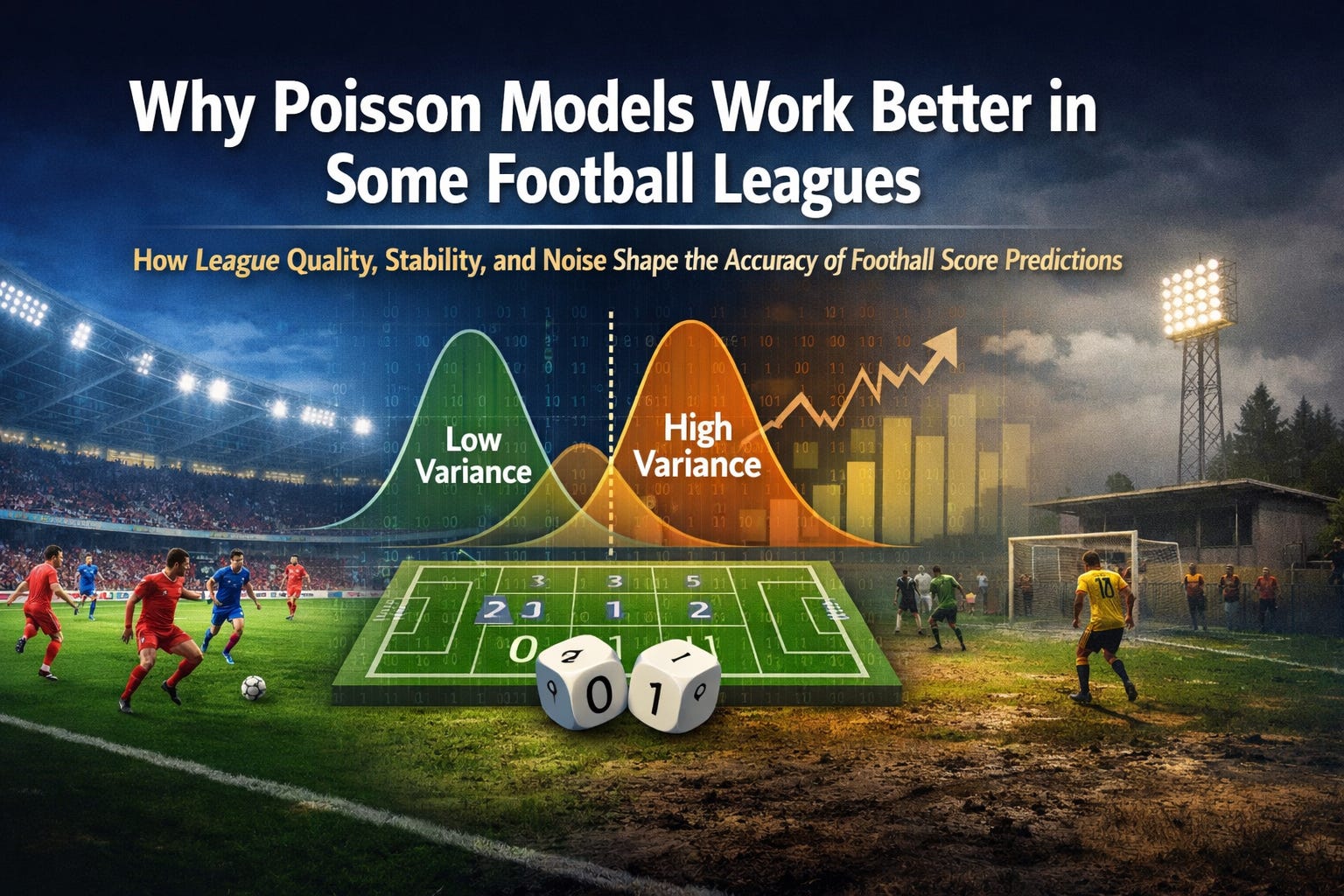
High-Level Leagues: More Signal, Less Noise
In top leagues and major competitions, you usually see:
Better tactical organization
More consistent game models
Fewer extreme, chaotic matches
Higher technical quality in finishing and defending
More predictable team behavior over time
Better data quality and more stable lineups
All of this has a statistical consequence:
The goal-scoring process becomes more stable and more regular.
From a modeling perspective, that means:
The estimated λ values are more reliable
The variance is closer to what Poisson expects
Extreme outliers are less frequent
The distribution of scores looks more “Poisson-like”
In other words, in strong, well-structured leagues, there is more signal and less noise. And simple probabilistic models love that.
This is one of the reasons why Poisson (especially with small corrections like Dixon–Coles) often performs surprisingly well in top European leagues and major competitions.
If you want to see how this looks in practice across different leagues, you can explore the interactive models in the Football Hacking web app:
👉
https://footballhacking.streamlit.app/
Lower or More Chaotic Leagues: When Noise Takes Over
Now let’s look at the other side.
In many lower-tier or structurally unstable leagues, you often find:
Big tactical inconsistencies
Large quality gaps between teams
Frequent individual mistakes leading to goals
More red cards and game-breaking events
Poor pitches, travel issues, or unstable squads
Less predictable match dynamics
Statistically, this creates several problems:
The true scoring rate is not stable
Variance tends to be higher than the mean (overdispersion)
You see more extreme scorelines than Poisson would expect
The independence assumption between goals is violated more often
A single event can completely change the nature of the match
The result?
The real data generating process moves away from what Poisson assumes.
So even if your model is coded perfectly, calibrated carefully, and backtested properly, it will naturally perform worse in these environments. Not because Poisson is “bad”, but because the league itself is more chaotic and less statistically regular.
This Is Really About Stability, Not Just “Quality”
It’s tempting to summarize this as “Poisson works better in better leagues”. But that’s a bit too simplistic.
A more precise statement is:
Poisson works better in more stable, structured, and predictable environments.
Technical quality helps, yes. But what really matters is:
Tactical consistency
Behavioral regularity of teams
Lower variance in match dynamics
A more stationary scoring process
You can even find leagues that are not elite in global terms, but still very stable and structured, where Poisson performs reasonably well. And you can also find high-profile competitions with crazy schedules, heavy rotation, and wild match dynamics, where performance drops.
So the key variable is not fame. It’s statistical stability.
Overdispersion: The Silent Enemy of Simple Models
One of the clearest ways to see this effect is through overdispersion.
In a perfect Poisson world, we expect:
Variance ≈ Mean
But in many real leagues, especially chaotic ones, you often observe:
Variance > Mean
This means:
More blowouts than expected
More weird scorelines
Fatter tails in the distribution
More uncertainty than your λ can capture
When overdispersion is high, a simple Poisson model will:
Underestimate extreme results
Misprice longshots
Look poorly calibrated in the tails
Appear “inaccurate”, even if your average predictions are decent
This is not a small technical detail. It’s a structural mismatch between model and reality.
Where Dixon–Coles Helps (And Where It Doesn’t)
The Dixon–Coles adjustment is a smart, practical fix for one very specific problem:
the dependence between low-score outcomes like 0–0, 1–0, 0–1, and 1–1.
In many organized leagues, this correction:
Improves calibration
Fixes systematic bias in low scores
Makes the joint distribution more realistic
But notice something important:
Dixon–Coles does not fix chaos.
If your league suffers from:
Highly unstable team behavior
Frequent game-breaking events
Massive overdispersion
Rapid regime changes inside matches
Then the problem is much bigger than low-score correlation. You’re no longer dealing with a small correction to a mostly Poisson-like process. You’re dealing with a different process altogether.
What Betting Markets Already Know (And Show You)
Here’s the cool part: bookmakers already encode this uncertainty in the odds.
Remember the concept of overround / juice?
Big leagues, high liquidity → low margin, tight prices
Small or risky leagues → higher margin, worse prices
That higher margin is not just greed. It’s risk management.
It’s the market saying:
“This environment is harder to price. There is more uncertainty here.”
Which is exactly the same conclusion your Poisson model is quietly reaching when it starts to miss more often.
Practical Implications for Your Modeling
If you’re building Poisson-based models (like I do in Football Hacking), this leads to some very practical rules:
Segment performance by league instead of trusting global metrics
Measure overdispersion and calibration per competition
Demand a higher edge in noisier leagues
Consider shrinking, regularizing, or smoothing λ more aggressively where instability is high
Be selective: not all leagues deserve the same confidence or stake size
In other words:
Your model’s accuracy is not just about your code. It’s about the statistical nature of the league you’re modeling.
You can see how this plays out across different competitions in the Football Hacking web app, where I expose the same framework to multiple leagues and markets:
👉
https://footballhacking.streamlit.app/
A Useful Mental Model: Signal vs Noise
Here’s the simplest way to think about all this:
Strong, stable leagues → More signal, less noise
Chaotic, unstable leagues → Less signal, more noise
Poisson is a signal-hungry model. It needs a world where the average rate actually means something.
When noise dominates, no amount of elegance in your probability theory will save you.
So, Are You Right?
Yes. Absolutely.
Your intuition is correct: the effectiveness of a Poisson model is strongly related to the technical and structural level of the league—more precisely, to how stable and regular the goal-scoring process is in that competition.
This is not a philosophical opinion. It’s a direct consequence of:
The assumptions behind Poisson
The variance structure of different leagues
The presence (or absence) of chaos in match dynamics
Final Thoughts
Poisson is not magic. It’s a tool. A very good one—when reality cooperates.
The real edge is not just building a better model. It’s knowing where your model deserves to be trusted and where it should be treated with skepticism.
That’s how you move from “I have a model” to:
“I understand the environment my model lives in.”
And that’s where real, long-term edges are built.
👉 If you want full access to my Poisson models, multiple leagues, and the tools I actually use in practice, become a premium subscriber to Football Hacking and use the web app here:
👉 https://footballhacking.streamlit.app/